

Just last week, a home on Francis Court — where we were writing an offer for our buyers — received 27 offers. That’s not a slowdown. That’s serious demand.
Many homeowners are staying put because they have low mortgage rates or aren’t sure where they’d move next. The result? Fewer homes for sale. And when a well-prepared home in a good Belmont location hits the market, buyers don’t have many options — so competition can be intense.
Today’s Buyers Are Serious
Buyers right now are:
Well qualified
Well funded
Focused on the long term
When the right home comes along, they act quickly — and often aggressively.
But here’s the key: Not every home gets multiple offers.
The homes that win typically have:
Smart, realistic pricing
Strong preparation and presentation
Clear value compared to recent sales
A desirable micro-location (flat streets, walkability, commute access, etc.)
In today’s market, strategy matters more than ever.
The Hidden Opportunity for Sellers
Because inventory is so limited, prepared sellers currently have:
Less competition
Highly motivated buyers
Strong negotiating leverage
The potential for multiple offers
The Francis Court property is a perfect example of what happens when strong demand meets limited supply.
Should You Wait for Rates to Drop?
Many homeowners ask this question.
The reality is: when rates fall, more buyers will enter the market — but so will more sellers. That means more competition.
Right now, the environment is unusual: Strong demand with limited competition.
Belmont Is a Local Market
Home values here depend on the details — street location, lot usability, expansion potential, commute access, and neighborhood feel. Understanding how buyers see these factors often makes the difference between a good result and a great one.
Curious What Your Home Might Do Today?
The headlines may sound uncertain, but locally, well-positioned homes are still performing very well.
If you’re wondering what your home might sell for — or whether this market makes sense for you — we’re always happy to provide a local, no-pressure analysis.
Because in today’s Belmont market, success comes from preparation and strategy — not timing the headlines.
Enjoy the day!

Drew and Christine Morgan are experienced REALTORS and NOTARY PUBLIC located in Belmont, CA, where they own and operate MORGANHOMES, Inc. They have assisted buyers and sellers in their community for over 30 years. Drew and Christine have received the coveted Diamond award, ranking among the top 50 agents nationwide and the top 3 in Northern California by RE/MAX. To contact them, please call (650) 508.1441 or emailinfo@morganhomes.com.
For all you need to know about Belmont, subscribe to this blog right here. You can also follow us on Facebook and on X.
This article provides educational information and is intended for informational purposes only. It should not be considered real estate, tax, insurance, or legal advice; it cannot replace advice tailored to your situation. It’s always best to seek guidance from a professional familiar with your scenario.
In Belmont, the sales statistics for May 2022 show that the inventory of homes has grown to one month of inventory, while this past January it stood at .3 months. To help put that into perspective, during the downturn in 2009, the months of available inventory in Belmont sat at 10.
While some homes are still selling over the asking price, they are on average receiving 10% less over asking than in Q1.
Some of these anomalies are seasonal, and as such, with May being a month that is affected by seasonality in home sales, some of what the market is experiencing is seasonal and normal.
The most recent sales in Belmont are for far less than the sales in January-April. That is of course when the February interest rate hikes really kicked in, coinciding with the stock market taking a hit.
Since many Bay Area buyers are tech workers, whose compensation is augmented to a high degree with stock options, when the stocks are high, buyers are more bullish and can compete in the home bidding process by liquidating more stocks. Conversely, when the stock market takes a hit, buyers not only have less capital to work with, but they also tend to sit back and wait for the market to stabilize before liquidating their holdings.
Where We Stand Today
This graph illustrates the rapid rise in the 30-year mortgage rate this year. We suspect that much of the overzealous bidding that occurred in the first quarter of 2022 was due to buyers’ knowledge that rates were scheduled to rise, and their desire to take advantage of lower rates while they could—even if that meant overpaying in a bidding war for a home.
The S&P 500 and home values seem inextricably connected. One can see in this graph the rise and decline during that same Q1 period that buoyed purchasing power and is now waning.
As seen in this graph for all sales in San Mateo County, Condominium values take a hit first. We attribute this to two factors. The first being that condominiums tend to be akin to a commodity. Many are similar if not nearly identical. There are of course varying degrees of upgrades, whether one has an end or upper floor unit, the location within the complex, but overall, the differentiating factor in a market with growing inventory, comes down to price.
The secondary factor is that as prices and competition for single family homes fall, condominium owners have an opportunity to make a move into a stand-alone home, while buyers who were just shy of being able to purchase a home, and would have bought a condo, now turn to owning a home with a yard.
What is Different Now
What has changed is that with fewer buyers in the market, and less competition, they can be choosier. While it’s still too early to call it a buyer’s market across the board, certain sectors such as the condominium market and cities, and even neighborhood within cities that are less desirable, are most affected.
This means that not every home will sell—at least like they did in the past. Homes will have to be spruced up, staged, show well, and most likely be vacant to garner the level of excitement necessary to captivate the dwindling pool of buyers, so as not to take an inordinate hit on the sale price.
For the typical three-bedroom home, looking at the sales in Belmont, between March and April the seller’s enjoyed a list to sales price ratio of 119%. Since April that has dropped 11% to 108%. With the median home price still hovering around $2,400,000, that represents a $250,000 decrease in overbidding per home.
Buyers are in shock because for the past 20 years, 30-year mortgage rates averaged 3.035%. They never knew rates prior to that 20-year period when between 1980 and 2000 they averaged 10.3%. And the average 30 mortgage rate since 1971 when interest rates were tracked, is 7.7%. Buyers who have never even heard of an interest rate over 4% will acclimate and become accustomed to the new norm, and life will go on. Longer term homeowners who have lived through the interest rate roller coaster ride, will be less effected emotionally, and probably move forward with life’s plans accordingly.
Drew & Christine Morgan are REALTORS/NOTARY PUBLIC in Belmont, CA. with more than 25 years of experience in helping sellers and buyers in their community. As Diamond recipients, Drew and Christine ranked in the top 50 RE/MAX agents nationwide and the top 3 in Northern California. They may be reached at (650) 508.1441 or emailed at info@morganhomes.com.
The information contained in this article is educational and intended for informational purposes only. It does not constitute real estate, tax, insurance or legal advice, nor does it substitute for advice specific to your situation. Always consult an appropriate professional familiar with your scenario.
If you’re considering selling your home, you’ve probably also been thinking about how to go about finding the right real estate agent to help.
Choosing precisely the right real estate representation makes a bigger difference than you might ever imagine. So where does one begin?
DEFINING A TOP AGENT
REALTORS banter around the term “Top Agent” quite loosely—Top 1%, Top 10%, etc. They earn that title for dollar volume in sales—not any independent measurement of the quality of their work or survey from past clients. In the Bay Area, most agents surpass any threshold for earning the Top award distinction due to the median sales prices—not the they are any better than their colleagues in Kansas who need to sell 10 times the number of homes to garner that distinction.
Discard any idea of using on-line companies that recommend agents or say they will “find” you a perfect match. These are nothing more than companies extorting money from agents to be in their directory. They are not recommending the best agents, but rather the ones willing to pay to be recommended.
YELP tends to do the same thing. Although the reviews are organic in nature, agents must pay to be listed at the top of the search, even though they are often far from top agents.
Agents with the most listings or yard signs in a neighborhood are also not necessarily the agent doing the best job, they’re just getting the most attention.
Doing a native on-line search is more time consuming, but it will yield you the best results. Search for local agents that have been in the business long enough to have learned the ropes at someone else’s expense. Any real training of agents happens in the field, not the classroom. Look for examples of their work product on their own web sites—video tours, photos, and descriptive informational pieces.
THE MEET
Once you’ve found an agent you’d like to meet with, reach out and set up an initial meeting. Don’t call three of four agents all at once. It takes hours to prepare for a meeting and you’re wasting agents’ valuable time.
If you’re not happy with the first agent you meet, by all means contact another.
No two REALTORS are the same and each one acts essentially as their own independent contractor. They develop a business plan on their own and so you’re really hiring the agent, not the company they work for.
Are their differences in the companies’ agents work for? Sure, but far less important than the agents you’re hiring. Most agents will focus on how big (or small) their company is—how much “market share” and how much “technology” they have but how does that really benefit you?
The fact is most agents are capable of selling your home in this seller’s market, but the service they offer and the attention to detail and marketing varies greatly.
With that invariably comes differing degrees of success and results.
SELECTING AN AGENT—WHAT QUESTIONS TO ASK
These are the questions most sellers are prepared to ask:
How much do you charge?
What do you think my home is worth?
More detailed sellers might throw in a few more:
How long have you been in business?
In what cities do you specialize?
Do you work with mostly sellers, or buyers?
Do you have referrals with whom we may speak?
And that’s pretty much the extent of most sellers’ questions. The two which paradoxically seem to carry the most weight are two sellers always ask—how much is my home worth and what do you charge. These are two very important questions, but they should have little to do with choosing an agent. You can always find a discount agent to sell your home and you will most certainly get cut rate service and results as well.
The price the agent tells you your home is worth should also have little to do with whether you hire them. You get to pick the asking price for your home and if you’ve watched sales in your neighborhood, you probably have a pretty good idea at what price homes are selling.
Be careful not to decide on your agent based solely on the highest estimated sale price you hear, since that agent may not know your market or could be trying to “buy” your listing—meaning they are trying to get you to list with them under the pretense that they can magically get more for your home just by asking for it. Unfortunately, it just doesn’t work that way.
Buyers choose the price they are willing to pay for your home—not you as a seller or your agent!
We’ve heard sellers say, “We’re going to hire the REALTOR that sold our friends house—they said that they liked him and felt that he did a good job.”
And perhaps they did do a good job, but then again maybe the seller just thought because they received multiple offers well over the asking price that they must have done a good job. But could they have done better?
THE MOST IMPORTANT QUESTION
Results. Before you’d consider having any important surgery done, wouldn’t you like to know what your Doctor’s survival rate is for his patients? How many operations has she performed? How much they charge would probably be the least of your concerns, so long as you survive to pay the bill.
Wouldn’t it be nice before booking a flight to know how long the pilot has been flying and how many hours they’ve logged?
Any agent can proclaim to be the best, or sell their listings for more in a shorter period of time, but you need to ask for proof.
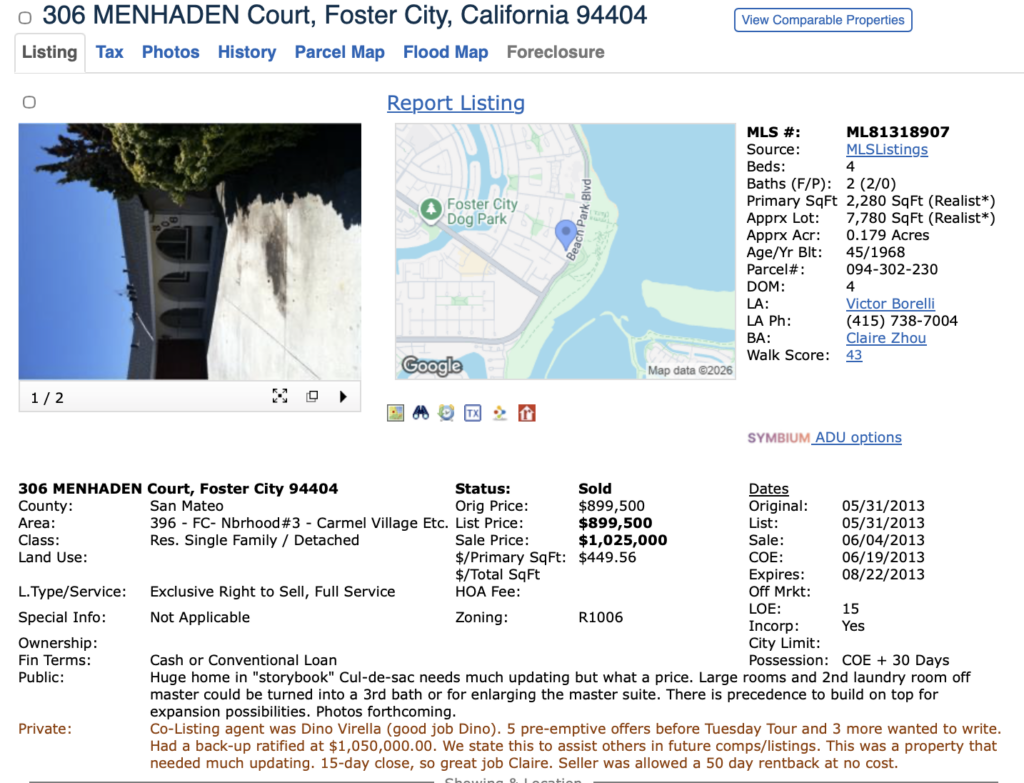
When the sellers hired these agents, they no doubt never expected this shoddy work product would be what they received—and we can all but guarantee that it’s not what was promised.
This is what is referred to as a Moral Hazard—wherein under the contractual protection of a listing agreement an agent takes advantage of their client—promising one thing and doing another.
But as bad as the photo of the home on its side may be, the agents went on to boast in the private comments (in red) to all agents, that had they waited to hear offers, they would have received three more—and one back-up offer was for $25,000 more than the early offer they may have steered their seller into accepting. To add insult to injury, when they went back into the listing to amend the comments with self-aggrandized accolades once it closed, they still never took the time to fix the photo. So great job Dino!
This may be a gross example of agents taking advantage of a seller, but many agents are guilty of taking the path of least resistance, (e.g. work), to get paid.
We can’t count how many times we’ve represented a buyer, delivered an offer only to receive a call late at night that the seller accepted a different offer. Many times, if the agent had reached out to us, our buyers would have stepped up in price and the seller would have received even more for their home.
We often download disclosures for our buyers which is an indication that we have a very interested party. An offer date is set and we rarely if ever receive a call from the listing agents asking if our buyers are interested in making an offer, and if not, why.
Agents will probably tell you that they will hold open your home for all agents to view on a special day referred to as “Broker Tour Day”. They may even tell you that they will serve food to attract the masses. And unless you ask if they will be present—they usually won’t. Agent Teams that have someone different for every aspect of the job are especially guilty of this. Many times, they don’t even go that far—they have a vendor such as a mortgage company hold open the home so they don’t have to bother being present. Other times we’ve seen the “Catered Broker Tour Lunch” promised to the seller relegated to a tray of stale sandwiches on a counter with the agent nowhere to be found. Being present at an open house is critical to answer other agents’ questions about the home.
Unfortunately, these breaches in moral behavior are more common than not.
YOU CAN DO BETTER
Do your homework. Research agents organically on-line to see what work product they are capable of and delivering. Then, be armed with the best questions most agents are ill prepared to answer.
If you’re interested in receiving a list of questions every seller should be asking, we’d be glad to deliver 35 of the best questions when we meet in-person for our initial visit.
Here’s a preview…
Drew & Christine Morgan are REALTORS/NOTARY PUBLIC in Belmont, CA. with more than 25 years of experience in helping sellers and buyers in their community. As Diamond recipients, Drew and Christine are ranked in the top 50 RE/MAX agents nationwide and the top 3 in Northern California. They may be reached at (650) 508.1441 or emailed at info@morganhomes.com.
The information contained in this article is educational and intended for informational purposes only. It does not constitute real estate, tax, insurance or legal advice, nor does it substitute for advice specific to your situation. Always consult an appropriate professional familiar with your scenario.
Unless you’ve been living under a rock the past two years, you’ve no doubt heard that home values climbed their assent into the stratosphere.
But as local agents for over 25 years, even we have a hard time wrapping our heads around the staggering numbers.
You may have also heard that there’s “no inventory”. Well, that’s not exactly true.
Then what’s causing the spike in prices? High demand, not lack of supply—unlike the overall economy that’s suffering from a lack of supply and high demand.
Comparing the annual number for 2020 to 2021, we’ll start with the inventory of homes for sale.
The number of new listings that came on the market in 2020 was 234 in 2020 and 249 in 2021 which is an increase of 6.4% more homes available for sale in 2021. Then why is everyone talking about low inventory? Because sales went from 183 units in 2020 to 254 in 2021—a whopping 38% increase—so there are no homes left to buy.
One might ponder, “How can that be?” If you only have an increase of 6.4% in new listings, how can you have 38% more sales. The answer is everything is selling in 2021 while in 2020 some of those new listings never made it into escrow.
That’s evident in the days on market, which dropped 45%, from 20 days to only 11, and the percent a seller received over the asking price climbed from 105% in 2020 to 114% in 2021.
Another indicator of the scant number of homes available at any given moment is the “Months of Inventory” statistic, that measures how long it would take to sell all of the available inventory at the current rate of sales. That dropped from a meager .4 months, to an almost immeasurable .1 month, (overall, the U.S. stands at around six months of inventory at any given time).
What effect did this have on home values? Nothing, but it had a lot to do with home prices. They hit their highest level in history recording a median home price of $2,245,000 up from $1,888,000—a 19% increase YOY and a 28% increase in the past two years—while the size of homes selling in the last two periods stayed statistically similar at 1,968 and 1,962 square feet respectively.
Rising interest rates may give buyers some relief from a super-heated market, may also serve to quell their purchasing power while softening prices. The irony is just when buyers may be able to compete in the market, even if they were to pay less for a home, they’ll end up paying more in interest in their loans.
Drew & Christine Morgan are REALTORS/NOTARY PUBLIC in Belmont, CA. with more than 25 years of experience in helping sellers and buyers in their community. As Diamond recipients, Drew and Christine are ranked in the top 50 RE/MAX agents nationwide and the top 3 in Northern California. They may be reached at (650) 508.1441 or emailed at info@morganhomes.com.
The information contained in this article is educational and intended for informational purposes only. It does not constitute real estate, tax, insurance or legal advice, nor does it substitute for advice specific to your situation. Always consult an appropriate professional familiar with your scenario.
Four walls and a roof over your head isn’t the only way we define the word ‘home.’ Home is more than just a shelter, it’s where we love, it’s where we feel, it’s where we can be ourselves and it’s where life happens—this home fulfills all of those dreams. We could describe it as chic, luxurious, inviting, and comfortable, but one really must see this home in-person to appreciate the complete experience.
Built by Blackwell, this home is the highly coveted single-level “Carlmont” model in prestigious Upper Hallmark. It has been lovingly enhanced, remodeled, and remade in a contemporary style best described as “living at the same time; belonging to the same time”. The result? Gracious, streamlined spaces that radiate harmony.
Step from the slate tiled front porch, inside to the formal entry and step upon rich hardwood flooring that emanates throughout the entire living area. We first come to the large open office and spacious remade great room which includes a custom modern gas fireplace with tiled mantle façade.
Soaring ceilings guide you through the open style formal dining room to a copious entertainment area encompassing a family room with a glass gas fireplace and granite hearth, nearby an expansive gourmet kitchen.
This remarkable kitchen was redesigned with soaring ceilings and a generous island offering a place for casual meals, conversations or food preparation station. Here we also find a butler’s bar with built-in wine storage, and a smart glass doored pantry. Crisp white cabinetry wakes up one’s senses and are keenly offset by the warm Caesarstone® counters. A welcoming array of high-end stainless appliances including a large LG® refrigeration unit, Viking® combination microwave and convection oven, Dacor® six burner gas stove top with Viking®stainless hood, and Bosch® dishwasher make this kitchen deeply functional while staying true to the sensible flow for guests and home chefs alike.
Down the hallway we uncover three more bedrooms and several more baths—all updated to today’s demanding standards. The owner’s ensuite enjoys its own private place to bathe in luxury with a grand walk-in shower and seamless glass doors. A secluded water closet with Toto commode, dual sinks, while the fine cabinetry even has powered drawers to keep the Caesarstone® counters uncluttered while the adjacent full walk-in closet can accommodate the most extensive wardrobe.
The level rear yard is perfect for entertainment options which features a wood deck with overhead LED illuminated lighting, patio dining area and grass play area. Dine alfresco and enjoy the wooded Hallmark Park backdrop in this delightful rear yard.
Prestigious Belmont Heights, also known as the Hallmark area of Belmont, is an admired and picturesque location. This area is adjacent to over 1,000 acres of open space and trails, with sweeping panoramic views of San Francisco and the Bay. Over the back fence is Hallmark Park which has tennis courts, children’s play area, with views of neighboring Crystal Springs Reservoir and the open space.
Belmont is ideally located on the Peninsula between San Francisco and the Silicon Valley with SFO International airport just a short drive away. It’s close proximity to major travel arteries—Highway 101, 280 and Caltrain are only a few miles away. For this very reason, many who choose to live here select this strategically ideal location. The Carlmont Village Shopping Center offers a variety of retailers and restaurants including Starbucks, Hassett Ace Hardware, Lunardi’s, Bank of America and Ladera Nursery. Nearby popular gathering spots include, Vivace Ristorante, Iberia Restaurant, Waterdog Tavern and the Farm House Restaurant.
Contact us to find out why more people are moving to the Mid-Peninsula. 650-508-1441
Four bedrooms—one currently employed as an office
Two and 1/2 updated baths—shower over tub
Owners ensuite—hardwood flooring, Toto® commode, walk-in closet with built-in organizers, recessed lighting and soaring ceilings.
Updated island kitchen with newer sleek appliances including L.G Refrigerator and Bosch® dishwasher, Dacor® six burner gas stove, Viking® stainless hood and oven including microwave and convection oven.
Large open communal kitchen and family room—granite façade glass rock gas fireplace
Large great room with soaring ceilings, recessed lighting—full wall tiled gas fireplace
Approximate sq. ft. ~2,210 sq. ft. home
Substantial ~7,800 sq. ft. lot
Built in 1974—updated by current owner
Rich engineered hardwood flooring
Multiple outdoor dining and entertainment deck areas—level rear grass yard area
Newer heating and air conditioning—NEST® controls
Solar panels (owned) with German Sonnen® battery storage system
New electrical panels and wiring
Rachio® smart watering system
Ring® security cameras
Three-car attached garage—completely finished space
RV or boat parking with power and dump station
Award winning Belmont schools
Conveniently close to San Francisco International Airport, Half Moon Bay and Coastal towns, major commute arteries, nearby parks and plenty of excellent shopping and dining options
Every so often, there’s a home so special that words cannot do it justice. We could describe it as chic, modern, high-tech, luxurious, inviting and comfortable, but one really must see this home in person to appreciate the complete experience.
This nine-year new classically crafted home has been designed in a contemporary style best described as offering clean lines, proportions, open layouts and abundant natural light. Additional characteristics include flat and shallow-pitched roofs, large expanses of glass, clean unencumbered walls, and an intrinsic connection between the indoor and outdoor space. The result? Gracious, streamlined spaces that radiate harmony.
The entire main floor is thoughtfully laid out with a ground level bedroom, full bath, great room, grand dining area, and kitchen combination. The great room on the main level, encompasses a professional styled kitchen, impressive communal dining area, and an eat-at bar and separate enclave for casual meals or conversations. Functionality includes a six burner Viking® stainless stove and oven combination, warming drawer, deep soft-close drawers while industrial-styled custom concrete countertops complete the chic feel. With a separate stainless prep sink and custom metro shelved pantry, this kitchen remains deeply functional while staying true to the minimalist aesthetic.
Rooms are naturally illuminated with a combination of celestial skylights and transom room transitions. Floor–to-ceiling windows feature expansive views of San Francisco City, the Bay, Mt. Diablo as well as 180º views from the pronounced view deck—harmoniously integrating the indoors with the world.
Bamboo hardwood flooring and stainless cabled railings flow gracefully throughout the home and the inverted layout with the bedrooms below, exemplifies the views from the upstairs main living area.
Down the naturally illuminated open stairwell, we find the lower level bedrooms—perfectly located for warm summer nights. The lower area consists of a main hall with nine foot ceilings leading to the laundry area, two bedrooms serviced by a central hall bath, and a bonus room or 5thbedroom. Also on this level is the owner’s ensuite, which enjoys its own private deck access with spa overlooking the bay. A dual floating sink vanity is in the owner’s suite bath along with a seamless separate shower enclosure and oversized soaking tub and a walk-in closet is nearby.
To visit 1926 Oak Knoll is to realize the passion that went into creating this unique home. We are excited to proudly present this enchanting retreat— welcome home!
FEATURES:
HOME
Nine-year new construction with ~68 posts and piers
Quiet cul-de-sac
Protected micro-climate location
Street level entry main living area-reverse floor plan
Hardwood Bamboo floors
Smooth stucco & sheetrock wall finish
Contemporary styling
Transom windows
Solid core doors
Led recessed lighting
Stainless cabled railings
Dual pane Anderson windows
Tankless water heater
MAIN LEVEL
Great room with ~11’ gradient ceilings
Large communal dining area
Celestial windows with automated opening system
Open style great room floor plan with pitched ceilings and stunning views
Corner low-heat glass fireplace
Office, Media room or additional bedroom
Two car garage—S.F. views, and plumbed for H&C convenient car washing
CHEF’S KITCHEN
Six burner Viking® stove & stainless hood
Built-in Viking® microwave
Side prep sink
Deep cabinetry drawer for professional cooking vessels
Walk-in pantry includes custom metro shelving
Appliance garage
Built-in warming drawer
Stainless basin sinks
Stainless floating hood
Custom concrete counters
FUNCTIONAL VIEW DECKS
Multiple private view decks with spa—plumbed for natural gas outdoor grill
180º bay views of San Francisco downtown & Bay, Mt. Diablo to the south bay
Eastern profile for dramatic sunrises year round
GROUNDS
Level lower area with large flat paved space suitable for basketball (hoop installed w/lighting), play area or entertaining
Gardening beds
Mature plantings on almost ¼ acre includes chicken coop and run
OWNER’S SUITE
Expansive walk-in closet, soaking tub and separate seamless shower enclosure,
Dual raised sinks on floating cabinetry
Access to private second level decks and spa
~9’ ceilings
LOWER LEVEL
Owner’s Suite and three additional bedrooms
Amazing lower level storage areas with ideal wine storage capacity
When is the best time to sell my home is perhaps one of the top five questions we are frequently asked. On my desk I have a crystal ball—literally. And often when I am asked to venture a guesstimate as to how the real estate market will perform, I simply stare down at the glass orb until my clients’ eyes follow mine to my point of fixation, and they realize their question was really impossible for me to answer with any certainty.
If you’re read our blog page, you know I love to look at the numbers—how much have homes have gone up, what percent sellers are receiving of asking, etc.
These numbers don’t really tell me what will happen—they’re historical numbers so they only tell me what did happen. But before we get started, no decent look at the market would be worth anything if we didn’t first explain our thought process and methodology.
In assigning probabilities, there are two common to employ. Frequency based probabilities, which rely and past data points to lend credibility to predicting a future event, and subjective probabilities based upon our belief that something will or will not occur.
Of course the belief or subjective probability approach at first glance appears just as the name infers—that it’s too subjective. However it’s actually quite important, and you probably use this approach more often than you do frequency based analysis when conducting your day-to-day assessment of say, whether or not you think the price of gas will be lower next week to decide if you want to wait to fill up then.
What about when we use both approaches, or aren’t sure which one is more appropriate for a given situation? Refinancing your home is a good example. Today’s question might be, “Will rates go lower than they are today, or will they soon rise to more historical levels?”. Here we might use frequency based analysis to look at the historical trend of mortgage rates and see where they are today in relation to average historical rates. Seeing how they are near the bottom of where rates have been over the last 30 years, one might conclude that they have nowhere to go but up, yet once again they dropped this October even after the Fed’s all but promised a rate hike—because things change.
One of the problems inherent in using only frequency based analysis is that there’s a trade-off between accuracy of the information (having enough data points) and relevancy (how old is the data). Going back further and plotting more data points is certainly going to give us more information to evaluate, but the relevancy begins to drop off as we got too far back in time, when say our economy was in a different state— pre-internet for example.
So it is with these probability approaches in mind that we deliver to you our trend for the percent a seller receives of their asking price–each month of the year, over the past 17 years. Glancing at the graph one can easily see that spring appears to be the best point at which sellers get the highest percentage of their asking price. Note: the months tagged in the graph above the line are the months in that year where the seller received the highest percentage of their asking, while the red numbers below the line illustrate the month in each year where the seller received the least percent of their asking price. **clicking on these graphs will bring up an enlarged image.
These are the percentages of frequency in occurrence where each one has an 8.3% (1/12) equal chance of homes selling either over or under the asking price in a given month.
May is a clear winner as to when reported sales of homes showed that sellers obtained the highest percent over their asking price—statistically. Since most of May’s homes probably sold in April, it’s more likely that the sale actually was consummated in April with a typical 30 day list to close time frame.
The problem with probabilities based solely upon past performance is that things can change quickly. Governments can topple or be overthrown sending the world into economic panic, external natural effects such as tornados, tidal waves, droughts, El Nino events, etc. can all contribute to altering selling and buying patterns. For example, October never shows up as a month where the least amount a seller received occurred, except for in 2001, after the September 11th terrorist’s attacks.
Also interesting to note is that if one breaks down this graph into pre-Deep Recession and Post Recovery periods there’s much less of a clear distinction as to which month is consistently a winner—or loser. An important and fair distinction should also be made in relying solely upon the percent a seller receives of asking as a definitive demarcation as to when selling your home is optimal. Sellers could be pricing their homes lower in the spring than they do later in the year, when new higher price levels have already been achieved. So measuring how much the seller received in real dollars is actually more important, but doing so involves tracking the median price trend which is easily influenced by relatively small market samples when larger or smaller homes sell in a given month. Tracking the price per square foot per month would help add more information into the mix, but that is susceptible to errors when homes with larger or smaller lots are involved.
And to throw the final wrench into the works, one must remember that during these 17 years there have been two recessions, and a lot of variance of interest rates and various government stimulus packages which have influenced people’s personal behaviors one month over another, not to mention El Nino’s and droughts which also have affected buying and selling patterns.
We hope this has helped further the cause of trying to turn the uncertainty of when to sell your home into a measurable risk. But remember, as Mark Twain is attributed to having once said, “History doesn’t repeat itself, but it does rhyme”.
Drew & Christine Morgan are REALTORS/NOTARY PUBLIC in Belmont, CA. with more than 20 years experience in helping sellers and buyers in their community. They may be reached at (650) 508.1441 or emailed at info@morganhomes.com.
The information contained in this article is educational and intended for informational purposes only. It does not constitute real estate, tax or legal advice, nor does it substitute for advice specific to your situation. Always consult an appropriate professional familiar with your scenario.
Tuesday is our tour day and this home was the best deal we found in Belmont. It's located in a GREAT area of Belmont with a nice micro climate. It's hard to beat the west side for $749,000. This home shouldn't last a week.
Choose a city and check on school boundaries OR send us your information and we’ll look into it for you.
NOTE: THE BELMONT/REDWOOD SHORES SCHOOL DISTRICT USES A COMPLEX ALGORITHM TO CALCULATE THE CLOSEST SCHOOL. AT THE BOTTOM OF THE PAGE IS AN APPROXIMATION TOOL TO ASSIST YOU IN LOCATING YOUR LOGICAL SCHOOL ASSIGNMENT.
NOTE: This is in intended as information only and should not be relied upon when choosing a home.
Many cities offer an interactive search where you can input your address, and others offer a less sophisticated map.
*Boundaries are subject to change. We take no responsibility for the accuracy of third party information.