
Belmont Housing Forecast—-Are We in For Another Bubble?

2015 Real Estate in Review and 2016 Forecast–Are we in for another housing bubble?

Our Peninsula housing market certainly has a life of its own.

While the nation’s housing sector has been slow to climb out of thHousing-bubblee doldrums, the SF Bay Area housing sector has been catapulted into the stratosphere fueled by historically low interest rates and demand for housing from the gainfully employed high-tech sector.

U.S. housing growth, as measured by the renowned Case-Shiller Home Price Index supplied by Standard & Poor’s, showed composite housing prices on the national level rose 4.8% year-over-year since September 2014, while the San Francisco MSA (Metropolitan Statistical Area) rose over 11% during the same period. Looking back to when the Bay Area housing market began its recovery in April of 2009, home values have risen 84%, while on a national level they have risen only 20%. (Data as of SEP 2015—S&P Indices lag the market by two months).

—Where do we go from here?

For the last three years, demand has outstripped supply resulting in multiple offers and over bidding, driving home values to record levels. But our housing sector is so heavily influenced by the tech sector’s success that any bump in the road could spell a reversal in fortunes for thousands of homeowners.

It’s seems against the very essence of REALTORS® to acknowledge our industry is susceptible to downturns—this despite recently experiencing the largest housing decline since the Great Depression. Changes in a couple of key market forces could dramatically slow or even reverse the current trend of rapid housing appreciation in the Bay Area.

Jobs—According to the Economic Institute, for each job created in the high-tech sector, approximately 4.3 local jobs are created in other goods and services sectors. That’s great when job creation in the high-tech sector is on the rise, but when the tables turn it could send the housing sector into an economic death spiral.

Interest Rates—The Federal Reserve has been droning on about an increase in the Federal Funds Rate for over a year now. If mortgage rates rise as well, a half percent (0.5%) increase would cause monthly housing payments to be 6% higher. That increase would not only affect the amount one is qualified to borrow for a mortgage, but would also limit monthly cash flow. When money becomes more expensive to borrow, the amount a potential home buyer can bid will decrease, effectively ebbing the tide of over exuberant bidding.

We’re not saying that we believe we’re there yet, and we could be years away, but one thing is certain—home values in our area are at an all-time high, and they won’t stay there forever.


Drew & Christine Morgan are REALTORS/NOTARY PUBLIC in Belmont, CA. with more than 20 years experience in helping sellers and buyers in their community. They may be reached at (650) 508.1441 or emailed at info@morganhomes.com.

You can find them on Facebook athttps://www.facebook.com/Morganhomes and also find them on Twitter @ https://twitter.com/morganhomes


The information contained in this article is educational and intended for informational purposes only. It does not constitute real estate, tax or legal advice, nor does it substitute for advice specific to your situation. Always consult an appropriate professional familiar with your scenario.

Pumpkin Pie Strudel for Thanksgiving

Thanksgiving is a great time to get together with friends and family and try out some new recipes. Sure they old standbys are a nice way to paPumpkin Pie Strudely homage to our parents’ holiday traditions, but we like to mix it up just a little bit at the risk of enraging any stalwart traditionalists.

If you’ve been on our mailing list for over a year, you already know about our famous Upside Down Pumpkin & Pecan Pie recipe we call “Piece of Cake Pumpkin Pie”, in reference to the pecan and cake crust which is used, as well as the simplicity of the recipe.

But last year, we added something new from, once again, Michael Symon. It’s a light Pumpkin Strudel, and also simple to make . If you’re not up for making a large batch of pies, or just want something new, this will do the trick.

Happy Thanksgiving!

Total Time:

45 min

Prep:

30 min

|

Inactive Prep:

|

Cook:

15 min

Level:

Easy

Yield:

12 servings

INGREDIENTS

  • FILLING:
  • One 15-ounce can pumpkin
  • One 8-ounce package cream cheese, room temperature
  • 1/2 cup packed brown sugar
  • 1/2 teaspoon ground cinnamon
  • 1/2 teaspoon salt
  • 1/4 teaspoon ground ginger
  • 1/4 teaspoon ground nutmeg
  • 12 sheets frozen phyllo dough (18- by 14-inch rectangles), thawed
  • 2/3 cup butter, melted
  • 1 cup chopped pecans
  • 3 tablespoons turbinado sugar, or other coarse sugar
  • 2 tablespoons honey, for serving
  • Whipped cream, for serving, optional [who said optional?]

DIRECTIONS

Preheat the oven to 400 degrees F. 

For the filling: Combine the pumpkin, cream cheese, brown sugar, cinnamon, salt, ginger and nutmeg in a small bowl. Mix until nearly uniform and set aside. 

Place 2 sheets of the phyllo on top of one another and brush the top sheet with some of the butter. (Keep the remaining phyllo dough covered with plastic wrap to prevent it from becoming dry and brittle.) 

Cut the 2 layered sheets of phyllo lengthwise to create 2 long strips. Place a well-rounded tablespoon of the filling about 2 inches from the end of the dough strip. 

To shape, fold the bottom edge of the phyllo up and over the filling. Fold in the sides and roll up to encase the filling, brushing the exposed dry phyllo with some of the butter as you roll. Place the rolled phyllo on a baking sheet, seam-side-down. Brush the top of the phyllo with some of the butter. Repeat with the remaining ingredients. Sprinkle the tops of the phyllo with pecans and turbinado sugar. Bake until the phyllo is golden brown, about 15 minutes. Serve the phyllos warm drizzled with the honey and topped with whipped cream if using.

Recipe courtesy of Michael Symon

Don’t Wait—Beat the Crowds and Buy This Winter

Don’t Wait—Beat the Crowds and Buy This Winter

snow-globe-house

We’ve been saying this for years, the best time to buy a home is when it’s not the best time to sell–and the statistics back us up. But we’re not telling you anything you shouldn’t already know. However, there’s even more compelling reasons this year, with the much ballyhooed talk about interest rate hikes.

Now that the U.S. has regained its job-creation mojo, as the October employment report showed, the demand for housing is only going to grow.

After all, when people have jobs they can break off and form new households—ditching the roommates behind or finally moving out of Mom and Dad’s basement—and that’s what fundamentally drives home purchases.

Most of the households created over the past two years have been renting households, but based on U.S. Census data for the third quarter of this year, it appears that homeownership has started to recover.

This especially makes sense now that it is cheaper to own than rent in more than three-quarters of the counties in the U.S. And it’s not getting better— rents are rising year over year at twice the pace of listing prices. Meanwhile, mortgage rates remain at near record lows but appear poised to increase over the next year. And home prices are rising, too.

So if you qualify for a mortgage and have the funds for a down payment and closing costs—and if you intend to live in a home long enough to cover the transaction costs of buying and selling—you will be better off financially if you buy as soon as you can. After all, if you are tired of your current home now, you won’t feel better about it in six months.

The top factors driving home shoppers this summer were pent-up demand and recognition of favorable mortgage rates and home prices. These drivers will likely remain well into next year.

Yet demand for housing is extremely seasonal. In most markets in the country, we are conditioned to believe that we should buy homes in the spring and summer. So come each October, plans to purchase shift to the spring. While the school calendar and weather do influence the ideal time to move, many buyers would benefit from buying this fall and winter rather than waiting until next spring.

In October, the percentage of would-be buyers on realtor.com® saying that they intend to buy in seven to 12 months was the highest it has been all year and represented the largest time frame for purchase. Likewise, October produced the lowest percentage of would-be buyers saying they intend to buy in the next three months.

In other words, people’s stated plans point to a very strong spring for home sales. Great, right? But here’s the problem: Inventory isn’t likely to be higher in March and April than it is now. And while inventory should grow in late spring and into summer, it won’t grow as fast as the seasonal demand.

So, if you are ready, consider getting in the market now instead of early spring. You will have more choices and less competition, and you can lock in today’s rates rather than risk rates being 25 to 50 basis points higher. (A basis point is 0.01 percentage point.)

A 50 basis-point increase in rates (for example, from 4.05% to 4.55%) would cause monthly payments to be 6% higher. And that increase would not only affect your monthly cash flow but could also affect your ability to qualify.

So if you are considering buying a home this spring, it’s worth exploring the inventory now and reaching out to a local Realtor®. A new home could be the best gift you give yourself and your family this holiday season.

And if you are considering a move, we’re ready to help you make a good decision.

Drew & Christine Morgan are REALTORS/NOTARY PUBLIC in Belmont, CA. with more than 20 years experience in helping sellers and buyers in their community. They may be reached at (650) 508.1441 or emailed at info@morganhomes.com.

You can find them on Facebook at https://www.facebook.com/Morganhomes and also find them on Twitter @ https://twitter.com/morganhomes


The information contained in this article is educational and intended for informational purposes only. It does not constitute real estate, tax or legal advice, nor does it substitute for advice specific to your situation. Always consult an appropriate professional familiar with your scenario.

Belmont Home Sales Drop, But Values Rise

Any way you slice this month’s statistics for Belmont home sales, seller’s really made out this October.

October is historically not a great month for home sales, but in recent years with warmer fall weather, it’s been possible to market homes well into the winter months.

Let’s look at the numbers for October 2015…

Belmont Home Sales October 2015
Belmont Home Sales October 2015-Click on the image to enlarge.


SALES

Belmont home sales (the number of homes sold), was down 24% year-over-year; down from 21 in 2014, to 16 in 2015. A 24% drop seems like a lot, until you realize only five less homes sold.

MEDIAN HOME PRICE

Belmont’s median home price rose 19% over last October, and was up considerably from the prior month of September.

The median home price in Belmont now stands at $1,546,500. To put that large number into perspective, it has only been surpassed twice before—both times earlier in this year—in May, and again last June. The all-time peak for Belmont’s home values occurred in June of 2015 when we reached a median home price of $1,629,000. Does this mean Belmont home values have peaked? Perhaps. The homes that closed escrow back in June sold for 5.3% more than now, and yet were 6.7% smaller. We’re going to temper that statement with the statistic that the summer price peak to October fall-off has occurred in six of the last eight years.

PRICE PER SQUARE FOOT

This is a check and balance against the median home price. If much larger homes sell during a given period, the median home price will typically yield a larger number as well, while the price per square feet which homes sell for will drop. It’s a quirky inverse relationship that manifests itself since larger homes tend to sell for less per square foot. This happens because land is not involved in the square foot equation,  and can frequently account for up to 50% of a home’s value.

For example, homes which sold in October of last year, were 2,000 sqft in size, compare to 1,905 sqft this year. They sold for $707 per sqft as compared to $877 this October, while the lot sizes remained fairly constant. This means that the median price for homes went up in real dollars—not just that larger homes sold this October.

DAYS ON THE MARKET (DOM)

In both years, it took on average only 18 days to sell a home.

PRICE REDUCTIONS

In 2014, 14% of Belmont home sellers had to lower their asking price. In 2015 that number dropped to .6%–just over one-half of one percent.

OVER-ASKING OFFERS

In 2014 66% of Belmont homes sold for more than the seller’s asking price—this October that number went up to 87%.

The number of homes which sold at the seller’s asking price represented 14% of all sales in 2014 and none in 2015, while the homes which sold under the asking price dropped from 20% in 2014, to only 13% in 2015.

PERCENT RECEIVED

Of the homes which sold in Belmont this October, the seller’s received 109.5% of their asking price, contrasted to last October when they received 107.5.

As you can see Belmont housing market fared extremely well this October.

We are now into the ninth year of economic recovery, and the fourth year of the median home price increasing steadily in Belmont. The question we are being asked by many buyers is “are we at the peak”? This uncertainty in the market can cause buyers to hesitate and sit on the sidelines to wait for the next downturn. If that happens it could be a self-fulfilling prophecy.

We’re not saying that we believe we’re there yet, but one thing is certain, home values are at an all-time high and we won’t stay there forever.

Disclaimer:

Drew & Christine Morgan are REALTORS/NOTARY PUBLIC in Belmont, CA. with more than 20 years’ experience in helping sellers and buyers in their community. They may be reached at (650) 508.1441 or emailed at info@morganhomes.com.

You can find them on Facebook at https://www.facebook.com/Morganhomes and also find them on Twitter @ https://twitter.com/morganhomes

The information contained in this article is educational and intended for informational purposes only. It does not constitute real estate, tax or legal advice, nor does it substitute for advice specific to your situation. Always consult an appropriate professional familiar with your scenario.


Save the Daylight- When Did Daylight Saving Time Start

How and When Did Daylight Saving Time Start?

It’s that time of the year to turn the clocks back to end Daylight Saving Time.

Of course you’ll remember to turn your clocks back when you go to bed Saturday night, but do you know why–beside for the obvious reasons that you want to be in sync with the rest of the country?

My brother sent me a great book a few years ago titled “Seieze The Daylight” by David Prerau that explained the whole reason we have a Daylight Saving period and how it originated. Below, you’ll find a brief synopsis of his book.

For example, did you know that one of the more staunch advocates for when to end Daylight Saving Time is the candy industry? They rely heavily on the sale of candy near Halloween. Over the years they have lobbied heavily to end Daylight Saving Time after Halloween so that their customers would enjoy an additional hour of trick-or-treating. Looks like they finally won.

Ben Franklin-of “early to bed and early to rise” fame-was apparently the first person to suggest the concept of daylight savings, according to computer scientist David Prerau, author of the book Seize the Daylight: The Curious and Contentious Story of Daylight Saving Time. Benjamin Franklin

While serving as U.S. ambassador to France in Paris, Franklin wrote of being awakened at 6 a.m. and realizing, to his surprise, that the sun would rise far earlier than he usually did. Imagine the resources that might be saved if he and others rose before noon and burned less midnight oil, Franklin, tongue half in cheek, wrote to a newspaper.

“Franklin seriously realized it would be beneficial to make better use of daylight but he didn’t really know how to implement it,” Prerau said.

It wasn’t until World War I that daylight savings were realized on a grand scale. Germany was the first state to adopt the time changes, to reduce artificial lighting and thereby save coal for the war effort. Friends and foes soon followed suit.

In the U.S. a federal law standardized the yearly start and end of daylight saving time in 1918-for the states that chose to observe it.

But there was also a real need for standardized time too. Prior to public train transportation, people traveled very slowly from point to point. Once they arrived in a town they would reset their watch to whatever time the local town square clock tower read. Once transportation by train became prevalent, people would find themselves in perhaps more than one time zone in a day and people waiting for a train needed to know that everyone was on the same relative time.

During World War II the U.S. made daylight saving time mandatory for the whole country, as a way to save wartime resources. Between February 9, 1942, and September 30, 1945, the government took it a step further. During this period daylight saving time was observed year-round, essentially making it the new standard time, if only for a few years.

Since the end of World War II, though, daylight saving time has always been optional for U.S. states. But its beginning and end have shifted-and occasionally disappeared.

During the 1973-74 Arab oil embargo, the U.S. once again extended daylight saving time through the winter, resulting in a one percent decrease in the country’s electrical load, according to federal studies cited by Prerau.

Thirty years later the Energy Policy Act of 2005 was enacted, mandating a controversial month long extension of daylight saving time, starting in 2007.

But does daylight saving time really save any energy?

Want more? Click here…


Disclaimer:

Drew & Christine Morgan are REALTORS/NOTARY PUBLIC in Belmont, CA. with more than 20 years experience in helping sellers and buyers in their community. They may be reached at (650) 508.1441 or emailed at info@morganhomes.com.

You can find them on Facebook at https://www.facebook.com/Morganhomes and also find them on Twitter @ https://twitter.com/morganhomes

The information contained in this article is educational and intended for informational purposes only. It does not constitute real estate, tax or legal advice, nor does it substitute for advice specific to your situation. Always consult an appropriate professional familiar with your scenario.

Uncertainty in the Housing Market

October brings to mind images of Jack-O’-Lanterns, will-o’-the-wisps, spider webs, creative costume expressions on All Hallows Eve, and the gentle stir of leaves falling from the trees. But there’s more rustling around in the wind than dry leaves right now—it’s the sound of uncertainty in the housing market. Are we headed for a crash? Or is the market still in a Bull Run phase?

We’re getting asked a lot about what we think is going on, as there’s a lot of uncertainty in the housing market. Whenever there’s a perceived slow down, it gives cause for questioning the market conditions. We think those concerns might be a little premature.

But people should be skeptical. The housing market did-in a lot of people during the great Recession and they’d be foolish not to be concerned about being in a better position for the next downturn.

So we hope that our small window of analysis will help you sleep better, at least if you live on the mid-Peninsula—the sweet spot of our market and where we focus our energy.

Belmont September 2015

Belmont–September 2015. Data from the MLS of SMC. Click on the picture for a larger image.

These are the statistics for several of the cities we watch carefully.

San Carlos—Median Price was up 11.6% year-over-year this September. Down from 14% YOY (Year-Over-Year) from 2013-2014 so a bit of a slow down there. Seller’s received 5% more over asking though.

Belmont—Median price rose 12.5 % since last September, up from just 2% YOY (a year earlier) (we discount this as an anomaly of small numbers). Sellers are still getting 107% of asking price—same as last September.

San Mateo—Median Price went up 12.8% YOY, down from a 27% increase in 2013-2014. Sellers are getting 1% more over asking this year than last.

Hillsborough—Median price fell 6% YOY in 2015, down from a 26% increase in 2013-2014. Sellers got slightly more over asking—97% last year as compared to 101% this year.

San Mateo County-This is a good indicator of the overall market conditions since it includes so many cities and a lot of data points. But it can also be somewhat misleading. For example, when prices are skyrocketing in Menlo Park, San Carlos and Belmont early in a recovery phase, Daly City, San Bruno and South San Francisco are typically still foundering. Yet when the top three start to peak in terms of price, buyers flood these less expensive areas and cause the overall increase in the median home price to appear to be climbing, when in your city it may be stalling.

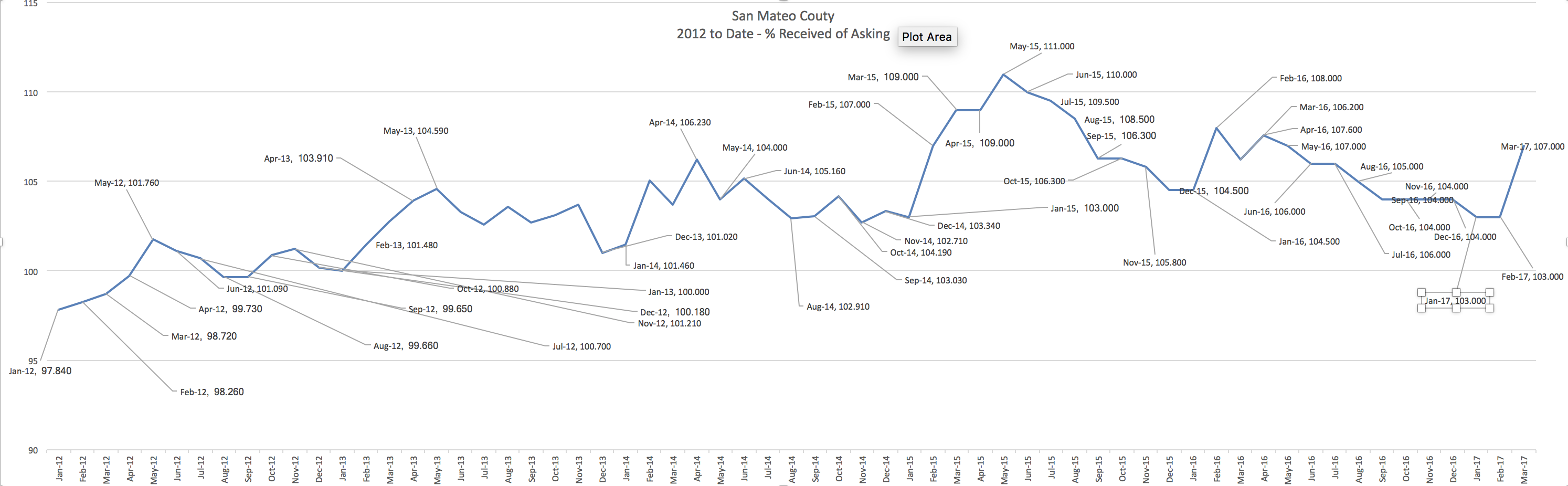
Think of the San Mateo Median home price like a “composite index” if you will. It rose 12.1% YOY since last September, and seller’s received 3% more of their asking price. Last year it gained 18% and in 2012-2103 it rose 16.3%–that’s coming off a 21% increase from 2011-2102.

Let’s hope it calms down even more in 2016. A more sustainable recovery always lasts longer.

NOTE:–As always you can view these graphs on our web page.

Disclaimer:

Drew & Christine Morgan are REALTORS/NOTARY PUBLIC in Belmont, CA. with more than 20 years experience in helping sellers and buyers in their community. They may be reached at (650) 508.1441 or emailed at info@morganhomes.com.

You can find them on Facebook at https://www.facebook.com/Morganhomes and also find them on Twitter @ https://twitter.com/morganhomes

The information contained in this article is educational and intended for informational purposes only. It does not constitute real estate, tax or legal advice, nor does it substitute for advice specific to your situation. Always consult an appropriate professional familiar with your scenario.

Hola Says Adios!

[fusion_text]Adios Hola!Hola Adios

I remember the first day Hola opened in Belmont. People were lined up outside to experience a new high-end Mexican Style restaurant rumored to be fashioned after one of our personal favorites, Guaymas in Tiburon. So it was with great anticipation that we joined the throngs of people excited to experience a new place after the Pine Brook Inn’s 26 year tenure at this location.

My first order was to try their Posole, a dish we make at home each New Year’s Day. Sadly, they did not have it—next week they said.

Next week turned out to be every week until they finally just removed it from the menu. The Cilantro Rice that Guaymas was famous for started to slowly be swapped out for regular Spanish style rice.

The food became notorious for being decent at best, but the heart of the business really was long gone before the doors actually closed.

Today there was an auction at the restaurant, and the last of Hola will be no more. Now that the Carlmont Nursery is also gone, one wonders what will fill the location. The rumor circulating the parking lot today was steak a house? Here’s to hoping for some culinary diversity. Cheers![/fusion_text]

When is the Best Time to Sell My Home?

When is the best time to sell my home is perhaps one of the top five questions we are frequently asked. On my desk I have a crystal ball—literally. And often when I am asked to venture a guesstimate as to how the real estate market will perform, I simply stare down at the glass orb until my clients’ eyes follow mine to my point of fixation, and they realize their question was really impossible for me to answer with any certainty.

If you’re read our blog page, you know I love to look at the numbers—how much have homes have gone up, what percent sellers are receiving of asking, etc.

These numbers don’t really tell me what will happen—they’re historical numbers so they only tell me what did happen. But before we get started, no decent look at the market would be worth anything if we didn’t first explain our thought process and methodology.

In assigning probabilities, there are two common to employ. Frequency based probabilities, which rely and past data points to lend credibility to predicting a future event, and subjective probabilities based upon our belief that something will or will not occur.

Of course the belief or subjective probability approach at first glance appears just as the name infers—that it’s too subjective. However it’s actually quite important, and you probably use this approach more often than you do frequency based analysis when conducting your day-to-day assessment of say, whether or not you think the price of gas will be lower next week to decide if you want to wait to fill up then.

What about when we use both approaches, or aren’t sure which one is more appropriate for a given situation? Refinancing your home is a good example. Today’s question might be, “Will rates go lower than they are today, or will they soon rise to more historical levels?”. Here we might use frequency based analysis to look at the historical trend of mortgage rates and see where they are today in relation to average historical rates. Seeing how they are near the bottom of where rates have been over the last 30 years, one might conclude that they have nowhere to go but up, yet once again they dropped this October even after the Fed’s all but promised a rate hike—because things change.

One of the problems inherent in using only frequency based analysis is that there’s a trade-off between accuracy of the information (having enough data points) and relevancy (how old is the data). Going back further and plotting more data points is certainly going to give us more information to evaluate, but the relevancy begins to drop off as we got too far back in time, when say our economy was in a different state— pre-internet for example.

So it is with these probability approaches in mind that we deliver to you our trend for the percent a seller receives of their asking price–each month of the year, over the past 17 years. Glancing at the graph one can easily see that spring appears to be the best point at which sellers get the highest percentage of their asking price. Note: the months tagged in the graph above the line are the months in that year where the seller received the highest percentage of their asking, while the red numbers below the line illustrate the month in each year where the seller received the least percent of their asking price. **clicking on these graphs will bring up an enlarged image.Best Time To Sell A Home

These are the percentages of frequency in occurrence where each one has an 8.3% (1/12) equal chance of homes selling either over or under the asking price in a given month.Best Months

May is a clear winner as to when reported sales of homes showed that sellers obtained the highest percent over their asking price—statistically. Since most of May’s homes probably sold in April, it’s more likely that the sale actually was consummated in April with a typical 30 day list to close time frame.

The problem with probabilities based solely upon past performance is that things can change quickly. Governments can topple or be overthrown sending the world into economic panic, external natural effects such as tornados, tidal waves, droughts, El Nino events, etc. can all contribute to altering selling and buying patterns. For example, October never shows up as a month where the least amount a seller received occurred, except for in 2001, after the September 11th terrorist’s attacks.

Also interesting to note is that if one breaks down this graph into pre-Deep Recession and Post Recovery periods there’s much less of a clear distinction as to which month is consistently a winner—or loser. An important and fair distinction should also be made in relying solely upon the percent a seller receives of asking as a definitive demarcation as to when selling your home is optimal. Sellers could be pricing their homes lower in the spring than they do later in the year, when new higher price levels have already been achieved. So measuring how much the seller received in real dollars is actually more important, but doing so involves tracking the median price trend which is easily influenced by relatively small market samples when larger or smaller homes sell in a given month. Tracking the price per square foot per month would help add more information into the mix, but that is susceptible to errors when homes with larger or smaller lots are involved.

And to throw the final wrench into the works, one must remember that during these 17 years there have been two recessions, and a lot of variance of interest rates and various government stimulus packages which have influenced people’s personal behaviors one month over another, not to mention El Nino’s and droughts which also have affected buying and selling patterns.

We hope this has helped further the cause of trying to turn the uncertainty of when to sell your home into a measurable risk. But remember, as Mark Twain is attributed to having once said, “History doesn’t repeat itself, but it does rhyme”.


Drew & Christine Morgan are REALTORS/NOTARY PUBLIC in Belmont, CA. with more than 20 years experience in helping sellers and buyers in their community. They may be reached at (650) 508.1441 or emailed at info@morganhomes.com.

You can find them on Facebook at https://www.facebook.com/Morganhomes and also find them on Twitter @ https://twitter.com/morganhomes


The information contained in this article is educational and intended for informational purposes only. It does not constitute real estate, tax or legal advice, nor does it substitute for advice specific to your situation. Always consult an appropriate professional familiar with your scenario.


Best of Tour Home Search for 10/13/2015

After a break away from touring the past few weeks it was good to get back out and see what new homes are available. We’ve noticed a slight cooling of the market which isn’t all that uncharacteristic of a fall market but this year seems slower than normal–it’s still early in the quarter though.

This is our best of tour home for Belmont and San Carlos today.

Belmont

This home on Lincoln Avenue is a real fixer upper but the potential is written all over the blueprints.

Situated on a large 12,700+ sqft lot according to the agent, all it needs is a renovation to make this home worth $2,000,000.Lincoln

SAN CARLOS

6 Pepper Lane in San Carlos is on the opposite end of the spectrum. This move-in condition home is ideal for a large household with 5 bedrooms, four full baths and 3,113 sqft of living space. Great sunset and twilight views as well as plenty of room for entertaining. Listed with our good friends Teri and Kristina.6 Pepper

10/15/2015 4:30PM-6:30PM

10/17/2015 1:00PM-3:00PM

10/18/2015 1:00PM-3:00PM

Call us if you are interested in either of these two unique opportunities…650-508-1441


Disclaimer:

Drew & Christine Morgan are REALTORS/NOTARY PUBLIC in Belmont, CA. with more than 20 years experience in helping sellers and buyers in their community. They may be reached at (650) 508.1441 or emailed at info@morganhomes.com.

You can find them on Facebook at https://www.facebook.com/Morganhomes and also find them on Twitter @ https://twitter.com/morganhomes

The information contained in this article is educational and intended for informational purposes only. It does not constitute real estate, tax or legal advice, nor does it substitute for advice specific to your situation. Always consult an appropriate professional familiar with your scenario.


Intense Outlook for CA Housing

The intense outlook for CA housing manifests itself in the momentum which continues in the housing market as improved economic conditions and more job availability throughout the state benefited the housing market and continued to push sales higher.

Mortgage rates returning back to near record-low levels in the first half of the year, coupled with an anticipated rise in the fed funds rate later this year, may also have prompted prospective buyers to feel a sense of urgency to enter the market. The statewide sales in July exceeded 400,000 for the fourth consecutive month, and July 2015 was the month with the highest sales level since Oct 2012. The strong momentum in the first half of 2015 elevated sales in the first seven months to 407,060 (seasonally adjusted and annualized), an increase of 7.1 percent when compared to the same period of last year. After reaching the peak in nearly eight years, the statewide median price in July dipped slightly to $488,260 from the previous month, but remained close to the recent high reached in June.

The median price continued to improve at a moderate rate from the previous year, with a year-over-year gain of 5.4 percent in July 2015. While the median price continued to improve from the previous year, the rate of increase has been decelerating steadily in the last twelve months. The combination of modest price appreciations and low interest rates kept housing affordability from declining further this year in most areas, despite higher prices. In fact, the statewide Housing Affordability Index (HAI) actually rose in the first quarter of this year to 34 percent before dropping back to 30 percent in the second quarter.HFI

With the threat of interest rate hikes in the fourth quarter of 2015, housing affordability may become a bigger challenge for many potential home buyers, particularly for those who reside in high-cost areas such as the Bay Area. The California housing market should continue its momentum and have a solid performance throughout the rest of the year. Sales, however, could cool off slightly in the fall if mortgage rates gradually rise. With the economy growing faster and the labor market improving next year, more households will be formed as consumer confidence continues to rise. As a result, sales activity is expected to inch up in 2016. Inadequate supply in high-end areas such as the Bay Area is exerting upward pressure on prices, but home sales in those regions are simultaneously being constrained.

The constraint in home sales in the Bay Area could eventually lead to a decline in the share of high-end homes sales to overall home sales, which could also lead to a further slow-down in the appreciation in the statewide median price. As such, the statewide median price is expected to increase only modestly this year and in 2016.

Drew & Christine Morgan are REALTORS/NOTARY PUBLIC in Belmont, CA. Each with more than 20 years experience in helping sellers and buyers in their community. They may be reached at (650) 508.1441.

The information contained in this article is educational and intended for informational purposes only. It does not constitute real estate, tax or legal advice, nor does it substitute for advice specific to your situation. Always consult an appropriate professional familiar with your scenario.

\