

Perched above the Peninsula, this is not a home that whispers—it unfolds. Light, air, and horizon become part of the architecture, with sweeping views from the San Francisco Bay to Mt. Diablo, shifting from crisp morning clarity to a warm evening glow.
An inviting front patio entry creates a sense of arrival before the home reveals itself in a series of thoughtfully designed spaces. A gracious reception room offers a moment to pause, then opens to a grand living room where walls of glass frame cinematic views and draw the outdoors in.
The multi-level perimeter decking doesn’t simply wrap the home—it enhances the living experience. Each vantage point extenuates with views that evolve throughout the day, offering distinct settings for morning coffee, afternoon gatherings, and evenings under an open sky. A level rear yard with mature rose bushes offers a softer, more relaxed outdoor retreat.
Five generously proportioned bedrooms and three updated full baths, two private ensuites—one on the main level—provides flexibility for guests, extended living, or changing needs. The galley-style kitchen and dining area balance efficiency with warmth and features a KitchenAid® five-burner glass cooktop, Broan® Rangemaster stainless hood, GE® TrueTemp self-cleaning oven, LG® dishwasher, and GE®stainless French door refrigerator—all designed for reliable everyday performance.
Interior features include recessed lighting and real wood parquet flooring, adding texture and continuity. Additional amenities include a distinctive slate-style roof, a two-car attached garage and included washer/dryer. ADU potential on the lower level.
Moments from downtown San Carlos and Belmont, the location offers easy access to a vibrant mix of dining, shopping, commute routes and daily conveniences. With approximately 3,148 sq. ft. of living space on a 7,000 sq. ft. lot, it is also within the boundaries of Carlmont High, a California Distinguished School.
This home balances presence with practicality.
Stunning views of the San Francisco Bay and Mt. Diablo
Generous five bedrooms, including two ensuites
Three updated full baths
Multi-level perimeter decking with breathtaking views
Enticing patio entrance
Gracious reception room
Grand living room with stunning views
Galley-style kitchen adjacent dining room
KitchenAid® Five-Burner glass stovetop
GE® True Temp self-cleaning oven
LG® Dishwasher
GE® stainless French door refrigerator
BROAN® Rangemaster stainless hood
Recessed lighting
Parquet hardwood flooring
Large level rear yard area studded with mature rose bushes.
We wanted to share a more refined, data-driven look at how recent global events—specifically the late-February escalation in Iran—are influencing our local Belmont real estate market.
Rather than focusing on when homes closed, we analyzed when buyers actually made their offers. This gives us a much clearer view of real-time buyer behavior.
What the Data Shows
Using March 1, 2026 as the dividing line:
Before March 1 (pre-event buyer decisions): Homes averaged ~8.1% over asking
After March 1 (post-event buyer decisions): Homes averaged ~12.0% over asking
What This Means
At least in the immediate aftermath, buyers did not pull back.
In fact, we saw:
Continued strong demand
More aggressive bidding on well-positioned homes
This is a pattern we often see in the Peninsula—when uncertainty increases, serious buyers tend to act decisively rather than wait.
A More Nuanced Shift Beneath the Surface
While averages increased, the results are becoming more spread out:
Some homes are achieving significant premiums
Others are selling closer to—or even slightly below—asking
This widening range is often the first signal of a market beginning to differentiate more sharply between homes.
Our Initial Take
Momentum remains strong for now, and desirable homes are still commanding premium prices.
However, this type of environment often marks the early stages of a shift toward:
Greater buyer selectivity
Wider variation in outcomes
Increased importance of pricing and presentation strategy
We’ll continue to monitor this closely, as the next few weeks will be especially telling in terms of whether this trend holds or begins to soften.
👉 If you’re thinking about selling—or simply want to understand where your home stands in today’s evolving market—we’re happy to provide a personalized, data-driven evaluation.
Drew and Christine Morgan are experienced REALTORS and NOTARY PUBLIC located in Belmont, CA, where they own and operate MORGANHOMES, Inc. They have assisted buyers and sellers in their community for over 30 years. Drew and Christine have received the coveted Diamond award, ranking among the top 50 agents nationwide and the top 3 in Northern California by RE/MAX. To contact them, please call (650) 508.1441 or emailinfo@morganhomes.com.
For all you need to know about Belmont, subscribe to this blog right here. You can also follow us on Facebook and on X.
This article provides educational information and is intended for informational purposes only. It should not be considered real estate, tax, insurance, or legal advice; it cannot replace advice tailored to your situation. It’s always best to seek guidance from a professional familiar with your scenario.
In a move that has already begun circulating among local homeowners, the Belmont City Council is reportedly exploring a new proposal aimed at addressing what officials are referring to as “view equity.”
According to early discussion drafts, the concept centers around a potential “View Impact Fee” that would apply to homes benefiting from partial or panoramic views of the San Francisco Bay.
The rationale? Properties with premium outlooks, particularly those capturing unobstructed Bay and Mt. Diablo views, are seen as receiving a “disproportionate benefit from shared natural resources.”
How It Would Work
While still in the exploratory phase, the proposal outlines a tiered structure:
Tier 1: Glimpses of the Bay
Tier 2: Partial Bay views
Tier 3: Panoramic or unobstructed views
Annual fees would reportedly scale based on view classification, with funds allocated toward:
“Community aesthetic enhancements”
Tree canopy management programs
Public viewpoint improvements
The “View Equity” Argument
A council subcommittee is said to be evaluating how to “balance access to scenic resources” across neighborhoods.
One early draft reportedly states:
“While views are inherently tied to location and topography, the broader community contributes to the preservation and desirability of these assets.”
What This Could Mean for Homeowners
Although no formal vote has been scheduled, the concept has already sparked quiet conversations—particularly among homeowners in Belmont’s hill neighborhoods, where views are a defining feature of property value.
Some are questioning how views would be measured, how frequently classifications would be reassessed, and whether improvements (such as tree trimming or second-story additions) could impact a home’s “view tier.”
Early Takeaway
At this stage, the proposal remains informal and under review. However, it highlights an ongoing theme in Peninsula communities—how to balance property rights, natural assets, and neighborhood equity.
Oh, and Happy April Fool’s day neighbors…😉
All the Best,
About the Authors
Drew and Christine Morgan are the founders of MorganHomes, their independent brokerage based in Belmont. They also maintain a strategic affiliation with RE/MAX GOLD, combining the flexibility of an independent firm with the resources of one of the largest real estate networks.
As longtime Belmont residents and real estate professionals with more than 30 years of experience, they have helped generations of local families buy, sell, and make smart real estate decisions. Drew is also a Notary Public, providing additional convenience and support for clients when it matters most.
Their consistent performance has earned them RE/MAX’s prestigious Diamond Award, placing them among the top agents nationwide and among the top performers in Northern California.
If you have questions about the Belmont market or would like to discuss your situation, you can reach them at (650) 508-1441 or info@morganhomes.com.
For ongoing insights about Belmont real estate, local market trends, and community updates, you can subscribe to this blog or follow MorganHomes on Facebook and X.
Disclaimer
This article is provided for educational and informational purposes only. It is not intended as real estate, legal, tax, or insurance advice. Because every situation is unique, we recommend consulting with a qualified professional, like us, to understand your specific circumstances.
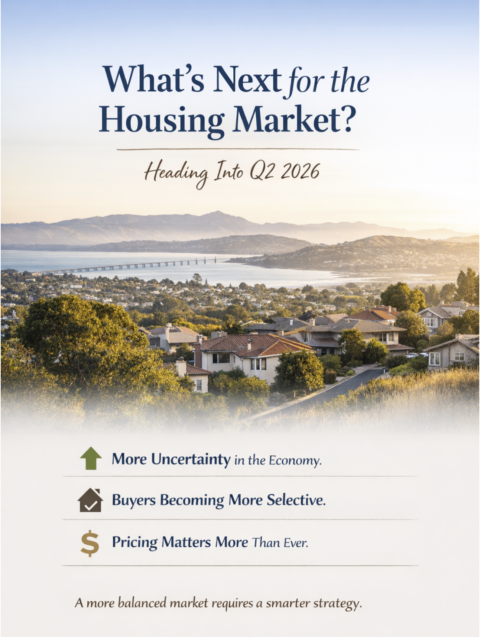
As we move into the second quarter of 2026, we’ve been getting a lot of the same question:
The honest answer is—no one can predict it with certainty. But we can look at patterns, buyer behavior, and what we’re seeing on the ground to get a pretty good sense of where things are headed.
A Market Facing More Uncertainty
There’s a lot going on right now that’s influencing how people feel about making big decisions:
Interest rates have moved higher
The cost of goods and services continues to rise
There’s more global uncertainty than we’ve seen in a while
The job market is shifting
And consumer confidence, which had been improving, is starting to soften
Any one of these on its own doesn’t change the market much. But when they all show up at once, people tend to take a step back.
How Buyers Typically React
In times like this, most buyers don’t panic—they pause.
Instead of rushing in, they take more of a “wait and see” approach:
They become more cautious
They look more closely at value
They’re less willing to stretch beyond their comfort zone
In other words, the most aggressive buyers start to step back first.
What This Means for the Market
So what does that look like in real life?
You’ll likely see fewer bidding wars. Instead of 10–15 offers, it may be more like:
2–5 offers on strong homes
And sometimes just one solid, well-qualified buyer
At the same time, buyers become more selective.
Homes that are:
Well-priced
Move-in ready
In strong locations
…are still going to do well.
Homes with trade-offs—or pricing that feels a little too aggressive—may take longer to sell.
And overall, price growth tends to slow. Not necessarily decline dramatically—but level off or adjust modestly.
The “Flight to Stability” Effect
There’s also another dynamic worth mentioning.
In uncertain times, some buyers actually lean into real estate. They’re looking for:
Stability
Something tangible
A long-term place to land
But even these buyers tend to be more thoughtful. They’re not the ones overpaying—they’re looking for value.
Why the Bay Area Is a Little Different
The Bay Area has always had some built-in support:
Limited housing supply
A strong base of high-income buyers
Long-term demand for homeownership
That doesn’t make it immune to change—but it does tend to prevent more dramatic swings.
What We Expect Moving Through Q2
If current trends continue, the most likely scenario is a more balanced, selective market.
Buyers are still there—but more cautious
Competition still happens—but not as consistently
And pricing becomes more important than ever
The margin for error just gets smaller.
What This Means for Sellers
For sellers, this doesn’t eliminate opportunity—it just changes the approach.
The homes that are performing best right now are the ones that:
Are priced strategically from the start
Show well and feel move-in ready
Line up with what buyers are expecting today
Where we’re seeing challenges is when homes:
Start too high
Rely on past peak comps
Or assume buyers will stretch the way they did before
That’s where momentum can get lost.
The Wrap
The housing market isn’t disappearing—it’s becoming more disciplined.
And in markets like this, the difference between an average result and a strong one usually comes down to:
strategy, positioning, and timing.
Frequently Asked Questions
Why are homes getting fewer offers?
Is the Bay Area housing market slowing down in 2026?
Are home prices expected to drop?
Is now a good time to sell in Belmont?
Drew and Christine Morgan are experienced REALTORS and NOTARY PUBLIC located in Belmont, CA, where they own and operate MORGANHOMES, Inc. They have assisted buyers and sellers in their community for over 30 years. Drew and Christine have received the coveted Diamond award, ranking among the top 50 agents nationwide and the top 3 in Northern California by RE/MAX. To contact them, please call (650) 508.1441 or emailinfo@morganhomes.com.
For all you need to know about Belmont, subscribe to this blog right here. You can also follow us on Facebook and on X.
This article provides educational information and is intended for informational purposes only. It should not be considered real estate, tax, insurance, or legal advice; it cannot replace advice tailored to your situation. It’s always best to seek guidance from a professional familiar with your scenario.
Recently, we were contacted by two families who had inherited their parents’ homes after the passing of the surviving parent. Unfortunately, in both situations, they had not spoken with a real estate professional beforehand, and it appears their attorney may not have been fully up to date on the newer rules.
Both families intended to move into the homes they inherited. However, because certain steps required under California’s Proposition 19 were not completed in time, the properties were reassessed to the current market value for property tax purposes.
As a result, these families—who otherwise would have been able to move into their parents’ homes and retain a much lower tax base—are now facing significantly higher property taxes. In some cases, increases like this can be financially overwhelming, leaving heirs with the difficult choice of either paying the new, higher property tax or selling the property despite wishing to reside in the home.
We felt this was important enough to bring to people’s attention, as these rules can have a major impact on families inheriting property in California. Understanding the requirements ahead of time can help prevent costly surprises and ensure that the available benefits are preserved.
How Proposition 19 Affects Children Inheriting Their Parents’ Property
California’s Proposition 19 significantly changed how property taxes are handled when children inherit real estate from their parents.
For decades under Proposition 58, children could inherit property and keep the parent’s low property tax base—even if the home became a rental or second home. Proposition 19 narrowed those rules considerably.
If a child inherits a parent’s home, the property tax base can only be preserved if three conditions are met:
1. The home must become the child’s primary residence. The child must move into the property and claim the Homeowners’ Exemption. If the home is kept as a rental, second home, or investment property, it will generally be reassessed to current market value.
2. The tax base transfer now has a limit. The inherited property can keep the parent’s tax base only up to $1,000,000 above the parent’s assessed value. If the home’s market value exceeds that threshold, the amount above the limit is added to the property’s taxable value.
3. The claim must be filed within one year. The heir must file the parent-child exclusion claim with the county assessor within one year of the transfer (usually the date of death). If this deadline is missed, the property may be reassessed to the current market value, which can significantly increase the property taxes.
➡︎ This is where many people make costly mistakes. Some heirs never file the claim at all, others miss the one-year deadline, and many confuse it with the two-year window that applies when homeowners transfer their own tax base to a replacement home(see that rule below), under Proposition 19. Understanding the difference is critical to preserving the lower property tax base.
Why This Matters
Many California homeowners purchased their homes decades ago, meaning their taxable value may be far below current market prices. Under Proposition 19, heirs must now decide whether to move into the property, sell it, or accept a potentially large increase in property taxes.
For families planning estates—or for heirs inheriting property—understanding these rules is critical to avoiding unexpected tax consequences.
Another important provision of Proposition 19 allows certain homeowners to transfer their existing property tax base to a new home when they sell their current one.
Homeowners who are 55 or older, severely disabled, or victims of a natural disaster may transfer the taxable value of their current residence to a replacement home anywhere in California. This can significantly reduce property taxes when downsizing or relocating.
To qualify, the replacement home must be purchased or newly constructed within two years of selling the original property.
After purchasing the replacement property, the homeowner should file the Base Year Value Transfer Claim with the county assessor. While the claim can typically be filed up to three years after purchasing the replacement home, filing sooner ensures the tax benefit is applied from the beginning of ownership.
Understanding these timing rules can help homeowners preserve substantial property tax savings when moving to a new home.
Proposition 19 has introduced rules that many families are still learning about—often after the fact. As we’ve seen recently, missing a deadline or not understanding the requirements can lead to property tax increases that could have been avoided with a little planning.
If you or someone in your family may be inheriting a property, or if you are considering selling and transferring your tax base to another home, taking a few minutes to understand the rules ahead of time can make a meaningful difference. If we can ever be a resource to help clarify how these changes may affect you, we are always happy to help.
Drew and Christine Morgan are the founders of MorganHomes, their independent brokerage based in Belmont. They also maintain a strategic affiliation with RE/MAX GOLD, combining the flexibility of an independent firm with the resources of one of the largest real estate networks.
As longtime Belmont residents and real estate professionals with more than 30 years of experience, they have helped generations of local families buy, sell, and make smart real estate decisions. Drew is also a Notary Public, providing additional convenience and support for clients when it matters most.
Their consistent performance has earned them RE/MAX’s prestigious Diamond Award, placing them among the top agents nationwide and among the top performers in Northern California.
If you have questions about the Belmont market or would like to discuss your situation, you can reach them at (650) 508-1441 or info@morganhomes.com.
For ongoing insights about Belmont real estate, local market trends, and community updates, you can subscribe to this blog or follow MorganHomes on Facebook and X.
Disclaimer
This article is provided for educational and informational purposes only. It is not intended as real estate, legal, tax, or insurance advice. Because every situation is unique, we recommend consulting with a qualified professional, like us, to understand your specific circumstances.
Belmont Housing Market: A Little More Choice — But Still Moving Fast
We’re about two-thirds of the way through the first quarter of 2026, and the early read on the Belmont housing market is coming into focus.
Inventory has opened up modestly. So far this year, 39 homes have come to market, compared with 34 during the same period last year — about a 15% increase. Currently, there are 31 properties in the pipeline, including 19 active listings available to buyers and another 10 “coming soon” homes preparing to enter the market. Eight properties are already pending.
At first glance, the increase in listings appears to be good news for buyers. And to a degree, it is — there are slightly more choices than there were a year ago.
But the market’s pace tells a more important story.
Homes that are going pending are averaging just nine days on the market. That’s a clear signal that new inventory is being absorbed quickly. In fact, the buyers we’ve represented this year have still found themselves in highly competitive situations. On the last two homes we pursued, each drew roughly 15 offers.
That combination — more listings, but very fast absorption — suggests that demand remains strong and pricing pressure is holding firm. If the market were softening, we would expect to see homes sitting on the market longer, more price reductions, and fewer competing offers. So far, none of those conditions are showing up in the data.
It’s still early, and there haven’t been enough closed sales yet to draw firm conclusions about pricing trends for 2026. But the early indicators point to a market that remains still seller-leaning, with motivated buyers acting quickly when well-prepared homes come to market.
The takeaway: Belmont buyers may have a few more options this year — but the window to act is still short, and competition hasn’t gone away.
What this means for you depends on your timing and your strategy. If you’re thinking about buying or selling in Belmont this year, the early trends suggest preparation and positioning matter more than ever. Sellers need to price and present their homes correctly to capture today’s fast-moving demand, and buyers need a clear plan to compete when the right property appears. If you’d like a quick, no-pressure review of your home’s current value, or a strategy session to understand your options in today’s market, feel free to reach out. We’re always happy to share what we’re seeing locally and help you make informed decisions about your next move.
About the Authors
Drew and Christine Morgan are the founders of MorganHomes, their independent brokerage based in Belmont. They also maintain a strategic affiliation with RE/MAX GOLD, combining the flexibility of an independent firm with the resources of one of the largest real estate networks.
As longtime Belmont residents and real estate professionals with more than 30 years of experience, they have helped generations of local families buy, sell, and make smart real estate decisions. Drew is also a Notary Public, providing additional convenience and support for clients when it matters most.
Their consistent performance has earned them RE/MAX’s prestigious Diamond Award, placing them among the top agents nationwide and among the top performers in Northern California.
If you have questions about the Belmont market or would like to discuss your situation, you can reach them at (650) 508-1441 or info@morganhomes.com.
For ongoing insights about Belmont real estate, local market trends, and community updates, you can subscribe to this blog or follow MorganHomes on Facebook and X.
Disclaimer
This article is provided for educational and informational purposes only. It is not intended as real estate, legal, tax, or insurance advice. Because every situation is unique, we recommend consulting with a qualified professional, like us, to understand your specific circumstances.
Just last week, a home on Francis Court — where we were writing an offer for our buyers — received 27 offers. That’s not a slowdown. That’s serious demand.
Many homeowners are staying put because they have low mortgage rates or aren’t sure where they’d move next. The result? Fewer homes for sale. And when a well-prepared home in a good Belmont location hits the market, buyers don’t have many options — so competition can be intense.
Today’s Buyers Are Serious
Buyers right now are:
Well qualified
Well funded
Focused on the long term
When the right home comes along, they act quickly — and often aggressively.
But here’s the key: Not every home gets multiple offers.
The homes that win typically have:
Smart, realistic pricing
Strong preparation and presentation
Clear value compared to recent sales
A desirable micro-location (flat streets, walkability, commute access, etc.)
In today’s market, strategy matters more than ever.
The Hidden Opportunity for Sellers
Because inventory is so limited, prepared sellers currently have:
Less competition
Highly motivated buyers
Strong negotiating leverage
The potential for multiple offers
The Francis Court property is a perfect example of what happens when strong demand meets limited supply.
Should You Wait for Rates to Drop?
Many homeowners ask this question.
The reality is: when rates fall, more buyers will enter the market — but so will more sellers. That means more competition.
Right now, the environment is unusual: Strong demand with limited competition.
Belmont Is a Local Market
Home values here depend on the details — street location, lot usability, expansion potential, commute access, and neighborhood feel. Understanding how buyers see these factors often makes the difference between a good result and a great one.
Curious What Your Home Might Do Today?
The headlines may sound uncertain, but locally, well-positioned homes are still performing very well.
If you’re wondering what your home might sell for — or whether this market makes sense for you — we’re always happy to provide a local, no-pressure analysis.
Because in today’s Belmont market, success comes from preparation and strategy — not timing the headlines.
Enjoy the day!
Drew and Christine Morgan are experienced REALTORS and NOTARY PUBLIC located in Belmont, CA, where they own and operate MORGANHOMES, Inc. They have assisted buyers and sellers in their community for over 30 years. Drew and Christine have received the coveted Diamond award, ranking among the top 50 agents nationwide and the top 3 in Northern California by RE/MAX. To contact them, please call (650) 508.1441 or emailinfo@morganhomes.com.
For all you need to know about Belmont, subscribe to this blog right here. You can also follow us on Facebook and on X.
This article provides educational information and is intended for informational purposes only. It should not be considered real estate, tax, insurance, or legal advice; it cannot replace advice tailored to your situation. It’s always best to seek guidance from a professional familiar with your scenario.
Policy Watch: Capital Gains, Mortgage Rates, and Housing Momentum
Donald Trump has expressed support for eliminating the federal capital gains tax on the sale of primary residences, calling it a potential incentive that could help homeowners access equity and increase housing market turnover. His comments followed the introduction of legislation by Marjorie Taylor Greene, titled the No Tax on Home Sales Act, which would remove the tax entirely for owner-occupied homes…
Two Powerful Marketing Strategies-which one is right for your home?
Off-Market vs. MLS Listings: What’s Better for Bay Area Sellers?
In the competitive Bay Area real estate market, the way you bring your home to market can make all the difference—not just in how quickly it sells, but in how much it sells for. One of the most common questions we hear from sellers is:
“Should I list my home on the MLS or explore an off-market strategy?”
California’s AI Windfall Is Becoming Hard To Live Without—That Could Spell Trouble for the Housing Market
California’s AI windfall is showing up in two very important places for residents: the housing market and the state’s balance sheet.
As AI-fueled gains have kept money flowing through the tech sector, they’ve propped up high-end home demand in tech centers like San Francisco while helping Sacramento plug a nearly $18 billion budget deficit.
Policy Watch: Capital Gains, Mortgage Rates, and Housing Momentum
Donald Trump has expressed support for eliminating the federal capital gains tax on the sale of primary residences, calling it a potential incentive that could help homeowners access equity and increase housing market turnover. His comments followed the introduction of legislation by Marjorie Taylor Greene, titled the No Tax on Home Sales Act, which would remove the tax entirely for owner-occupied homes…
Two Powerful Marketing Strategies-which one is right for your home?
Off-Market vs. MLS Listings: What’s Better for Bay Area Sellers?
In the competitive Bay Area real estate market, the way you bring your home to market can make all the difference—not just in how quickly it sells, but in how much it sells for. One of the most common questions we hear from sellers is:
“Should I list my home on the MLS or explore an off-market strategy?”
California’s AI Windfall Is Becoming Hard To Live Without—That Could Spell Trouble for the Housing Market
California’s AI windfall is showing up in two very important places for residents: the housing market and the state’s balance sheet.
As AI-fueled gains have kept money flowing through the tech sector, they’ve propped up high-end home demand in tech centers like San Francisco while helping Sacramento plug a nearly $18 billion budget deficit.
That dependence raises a hard question for the Golden State: What happens if the AI boom cools or, as some fear, the bubble pops? With AI gains now supporting so many pillars of the state’s economy, a downturn could rip through the state like a house of cards, given how vulnerable California is.
Belmont is still a seller’s market, but pricing accuracy matters more than it did last year.
Homes are still selling quickly, but not every home is automatically getting multiple offers.
Buyers are more selective—they’re paying premiums for:
Walkable neighborhoods
Updated homes
Large Lots & Views
Good school access
Overpricing now leads to longer days on market, which didn’t matter as much in 2024.
Well-priced homes are still selling at or above list price, just with fewer “emotion-driven” bids.
Inventory remains very tight, which continues to protect values.
Belmont hasn’t softened—it’s just gotten smarter.
San Carlos – Local Market
San Carlos is one of the strongest-performing markets on the Peninsula right now.
Demand remains extremely strong, especially near:
Downtown
Laurel Street
Good elementary schools
Prices have continued to rise, even as other cities leveled off.
Homes that show well and are priced correctly often sell fast and above asking.
Buyers are still willing to stretch for:
Turnkey homes
Flat lots
Walkability and lifestyle
Inventory is near zero, which is keeping upward pressure on prices.
San Carlos is following in Belmont’s footsteps, doing what Belmont did a year ago.
Belmont
Median price essentially flat: $2.423M → $2.418M
$/SqFt down: $1,308 → $1,244
Still selling over list (106%)
Stabilizing after a blow-off year—still competitive, but more rational.
San Carlos
Median price: $2.41M → $2.65M ⬆ +10%
Sales volume up +21%
Inventory remains near zero
One of the strongest appreciation stories in 2025.
San Mateo County – Big Picture (YOY)
Sales Activity & Volume
Closed sales:
2024: 3,569
2025: 3,822 ⬆ +7.1%
Total sales volume:
2024: $9.07B
2025: $10.10B ⬆ +11.3%
The market didn’t just rise in price—it expanded in depth. More transactions and more dollars moved through the system.
Pricing
Median sale price:
$1,950,000 → $1,980,000 ⬆ +1.5%
Average sale price:
$2.54M → $2.64M ⬆ +4.0%
Median $/SqFt:
$1,157 → $1,146 ⬇ -0.9%
2026 Market Outlook: What Buyers and Sellers Should Expect
The Belmont, San Carlos, and broader San Mateo County markets enter 2026 from a position of strength and stability, not excess. The data from 2024 and 2025 show steady demand, limited inventory, and pricing that continues to be supported by fundamentals rather than speculation.
For sellers, this means the market is still favorable—but no longer forgiving. Homes that are well prepared and accurately priced from the start are likely to attract strong interest. Overpricing, which buyers tolerated in prior years, is increasingly leading to longer market times and missed opportunities. In 2026, strategy and presentation will matter as much as location.
For buyers, conditions are improving modestly. While inventory remains tight, competition has become more measured. Buyers who are well-qualified, decisive, and realistic are finding more opportunities to negotiate—especially on homes that miss the market’s initial pricing window.
Looking ahead, price growth is expected to be moderate rather than explosive, with neighborhood-specific performance playing a larger role than countywide trends. Markets like San Carlos may continue to show momentum, while markets like Belmont are likely to reward consistency and long-term value. This is shaping up to be a market that favors informed decisions over emotion, rewarding those who understand timing, pricing, and local nuances.
Drew and Christine Morgan are experienced REALTORS and NOTARY PUBLIC located in Belmont, CA, where they own and operate MORGANHOMES, Inc. They have assisted buyers and sellers in their community for over 30 years. Drew and Christine have received the coveted Diamond Award, ranking among the top 50 agents nationwide and the top 3 in Northern California, according to RE/MAX. To contact them, please call (650) 508.1441 or emailinfo@morganhomes.com.
For all you need to know about Belmont, subscribe to this blog right here. You can also follow us on Facebook and on X.
This article provides educational information and is intended for informational purposes only. It should not be considered real estate, tax, insurance, or legal advice; it cannot replace advice tailored to your situation. It’s always best to seek guidance from a professional familiar with your scenario.
Many people feel Proposition 19 was “snuck in” or that voters didn’t fully realize what they were agreeing to. Ever since it passed, there’s been a lot of confusion and frustration. The takeaway is that it’s essential to really understand what’s on the ballot before casting a vote.
The part that confuses most people is who Prop 19 actually impacts. The truth is, it mainly affects people who inherit a home but don’t plan to live in it themselves.
How Prop 19 Works for Inherited Homes
If You Move In
If you inherit a family home and make it your primary residence, you can keep the low property tax base your parent or grandparent had.
But there’s a limit: if the market value is more than $1 million higher than the old taxable value, the amount above that gets added to your new tax base.
Example: If the old taxable value was $300,000 and the home is worth $1.6M when transferred, the new taxable value becomes $600,000. Unaffordable? Remember, these inherited homes typically come with no mortgage payment.
If You Rent It Out
If you inherit a property and don’t live in it (for example, you turn it into a rental), it’s reassessed at full market value. That means you lose the lower tax base your parent or grandparent had.
Why the change? It comes down to trade-offs. Prop 19 gave homeowners a valuable new benefit: the ability to transfer their low property tax base to any location in California when they move. However, to offset the cost, the state decided that heirs who use inherited property as an investment—not as a primary home—should pay property taxes based on today’s market value.
Put simply, if you live in the home, you retain most of the old exclusionary tax break. If you turn it into an income property, the state treats it like any other investment. While it may feel harsh, the intent was to make the system fairer by ensuring investors pay their share, while still protecting families who truly keep the home as their residence.
Prop 13 vs. Prop 19: Key Differences
Feature
Proposition 13 (1978)
Proposition 19 (2020)
Property Tax Rate
Capped at 1% of assessed value
Still capped at 1% (Prop 19 did not change this)
Annual Increases
Assessed value can rise max 2% per year
Same 2% cap applies
Reassessment Trigger
Reassessed at market value when sold or newly built
Heirs could keep the low tax base on homes (and sometimes rentals) without limits
Heirs can keep the low tax base only if they move in and use it as their primary residence. If rented out, reassessed at market value
Value Limit for Inherited Homes
No value limit; heirs kept original tax base regardless of property’s market value
Tax base is kept only up to $1 million above the original assessed value (adjusted for inflation). Anything over is added to the tax base
Moving Low Tax Base to a New Home
Only allowed for people 55+ or disabled, and only within the same county (or limited counties)
Homeowners 55+, disabled, or wildfire victims can transfer their low tax base anywhere in California up to 3 times
Overall Goal
Keep property taxes stable and predictable for long-term owners
Expand portability of tax savings for older/disabled homeowners, while limiting tax breaks on inherited investment properties
Drew and Christine Morgan are experienced REALTORS and NOTARY PUBLIC located in Belmont, CA, where they own and operate MORGANHOMES, Inc. They have assisted buyers and sellers in their community for over 30 years. Drew and Christine have received the coveted Diamond award, ranking among the top 50 agents nationwide and the top 3 in Northern California by RE/MAX. To contact them, please call (650) 508.1441 or emailinfo@morganhomes.com.
For all you need to know about Belmont, subscribe to this blog right here. You can also follow us on Facebook and on X.
This article provides educational information and is intended for informational purposes only. It should not be considered real estate, tax, insurance, or legal advice; it cannot replace advice tailored to your situation. It’s always best to seek guidance from a professional familiar with your scenario.