

Where Did All the Inventory Go? Long Time Passing…

Where did all of the listing go? Where’s the inventory?

That’s a common question today as eager home buyers are wondering if they’ll ever get a house. As we said in an earlier post, it’s not that there aren’t enough homes coming on the market, it’s that they all sell, and so it appears there are no homes to buy.

We’re getting enough questions about the hot housing market that we thought it warranted an attempt to explain what the reasons are for what Mr. Shiller (of Case-Shiller) would likely refer to as “Irrational Exuberance” after a book he authored by the same name.

Before we show you the numbers, which in some cases are absolutely mind boggling, we’ll proffer our explanation.

Our economy and the housing sector are recovering from the longest and most devastating housing downturn since the great depression. Home values plummeted for five years in a row in the end making home ownership more affordable.

As seen in this graph, home affordability peaked in 2009, yet sales were still dismal. Even with reduced home prices and record low interest rates buyers were afraid to take the plunge into home ownership.

There were still several obstacles which buyers had to overcome. Confidence in the economy and confidence in job stability. Even though home affordability peaked in 2009 potential home buyers were worried about the economy and their jobs. To compound the reluctance to move forward there was the deep rooted psychological trauma in the wake of post bubble bursting which was enough to keep most skeptics on the sideline for a few more years.

We saw things begin to change in 2011 when we were being inundated with new hires in the tech sector moving from out of state and requesting our assistance in securing a one year rental. It was the first sign that 2012 housing might pick-up—and it did.

In 2012 the “Buy Now” light switch was flipped on and buyers came out in droves to bid on the few home available. Why did so many buyers elect to more forward all at once? Because they all enjoyed the same motivating elements—America was on sale, interest rates were at historic lows, and now with companies hiring again, buyers felt comfortable in their jobs.

So in the wake of the greatest housing downturn in U.S. history, it seems plausible that might be going through a rebound equally as dramatic.

How long can this last? More “Equity Sellers” are being created every day as home prices replenish the equity lost during the downturn. More homes for sale will help the current historically low inventory levels (San Mateo County has less than two months of inventory and Belmont less than one).  But don’t expect prices to drop anytime soon. Even higher interest rates have had little affect on the prices of Peninsula homes.

Now onto the numbers...This is our post about the first quarter Belmont home sales. Here you can see how low inventory levels have created overbids averaging 114% of the seller’s asking price.

The partial title is a tribute to the endless hours my father would play the Kingston Trio’s “Where Have All the Flowers Gone” which harkens to the days of the Vietnam War resistance. If you are old enough to remember that little ditty, I’m sure it’s stuck in your head by now too…


Disclaimer:

The information contained in this article is educational and intended for informational purposes only. It does not constitute real estate, tax or legal advice, nor does it substitute for advice specific to your situation. Always consult an appropriate professional familiar with your scenario.

Are Home Prices Rising Too Fast?

Are Home Prices Rising Too Fast? [re-blog]

DAILY REAL ESTATE NEWS | MONDAY, APRIL 15, 2013Rising Home Prices

Some housing analysts are concerned that the sudden rise in home prices could make homes more unaffordable again if the price increases outpace income growth, The Wall Street Journal reports.

Average housing costs for home buyers who took out a mortgage were around 22.5 percent of average incomes, according to John Burns Real Estate Consulting. That is down from 38.5 percent in 2006, the peak of the housing bubble. The historical average is about 33 percent.

But with home prices rising in many markets and, in some, rising at a faster pace than income levels, will more people soon be priced out of the market?

Housing analysts say that, for now at least, lower mortgage rates are offsetting the higher prices of homes.

Borrowers have seen their purchasing power rise by around 33 percent over the past four years due to the low interest rates, The Wall Street Journal reports. For example, a borrower can make a $1,000 monthly mortgage payment and qualify for a $222,000 mortgage at today’s low interest rates, compared to 2008 when they’d likely qualify for $165,000 when mortgage rates were around 6.1 percent — nearly double what they are today.

Borrowers are able to withstand home-price increases because of the low rates, not because household incomes are growing, The Wall Street Journal reports. If mortgage rates tick back up to the 6 percent or 8 percent range, homes may look overpriced relative to incomes, according to housing analysts.

Source: “Why Rising Interest Rates Could Eventually Curb Price Gains,” The Wall Street Journal (April 10, 2013)

Read More

Existing Home Sales and Prices Continue to Rise
What’s Really Driving the Rise in Home Prices?

Forget Everything You Thought You Knew About Home Values

It seems there’s even more pent-up demand for housing than there was after the 1989 housing crash. The lower than usual interest rates is undoubtedly a contributing cause for the frenzied activity but what else is creating the stratospheric rise in housing activity?

It’s becoming a common event for a home to have 10-20 offers submitted by enthusiastic buyers. One first time buyer home in San Mateo recently sold with 86 offers! We’ve been in bidding wars ourselves where the winning bid paid over $300,000 more than asking price for a modest San Carlos home.
It’s probably not a leap for you to then believe that the median size home in San Mateo County climbed 29% since last March?
How’d we come up with that 29%? We adjusted it to account for the size of homes selling during the two periods. Had we not done so the raw figures showed a 34% increase.
In March of 2012 the median home in San Mateo country sold for just $689,000 and this March the median home price was $925,000. So did a lot of larger homes sell this year? For sure the upper market is starting to get traction again but the median size home selling in 2013 was only 5% larger. So we roughly estimate that if one can get a 5% large home in 2013 but have to pay 34% more, than prices probably went up by a factor of around 29%.
Looking at the housing picture for San Mateo County for March of 2013 as compare to March of 2012, we see that there were 20% fewer home sales this year as compared to last.
Why the fewer home sales if the market is so hot? Because, simply put, there are fewer homes for buyers to choose from. In 2013 there were 20 percent fewer sales but 29 % fewer new listings-which explains the low inventory.
For buyers wanting to get into a home, it may be now or never as home prices appear to have skyrocketed almost 30% in San Mateo County just in the last year. If interest rates rise, that double whammy may just put home ownership out of the reach for many.


The information contained in this article is educational and
intended for informational purposes only. It does not constitute
real estate, tax or legal advice, nor does it substitute for
advice specific to your situation. Always consult an appropriate
professional familiar with your scenario.


Belmont Home Prices & Sales for March 2013 – Can it Get Any Hotter?

Once again Belmont home sales were strong. Now that we are comparing a bull year in 2013  to 2012, another bull year, the increases seem a bit watered down since in both years thus far home sales have been strong.

Belmont Home Prices March 2013

SALES

At 22 home sales in Belmont this March, we tied last year’s impressive increase of 29% over 2011 with 22 sales once again.

DAYS ON MARKET

The time it took to sell a home in Belmont went from 38 days last March to only 29 this year—just one more affirmation of the incredibly hot market.

PERCENT RECEIVED

Sellers enjoyed another boost in the percent of their asking price they received. In March of 2011 sellers received 99.5% of asking which jumped to 101.6% in 2012 before being eclipsed by this year’s impressive 108.3%. Sellers that are worried about what they pay their agent should think less about negotiating a ½ % discount in commission and more about hiring the best agent with the best results. My parents called that “Penny wise and pound foolish”.

PRICE REDUCTIONS

Two sellers had to lower their initial asking price to entice a buyer as compared to last year when three sellers lowered their asking price. Once again, compared to 2011 when almost 1/3rd of seller reduced their asking price, this is another high water mark.

MEDIAN PRICE

The median home price in Belmont last March was $899,000 and for the second month in a row it has eclipsed the $1 million dollar mark coming in at $1,044,000 for March—though the median size home also went up from 1,763 square feet in 2012 to 1,830 in 2013. So while the size of homes selling this year are 3.8% larger, they are selling for 16% more—suggesting an overall increase of around 12% year over year. Sounds about right for what we are seeing.

MONTHS OF INVENTORY

This statistic is used represent the “Month’s of Inventory” in a given period. Essentially the time it would take to sell the entire existing inventory of homes at the current rate of monthly sales. In Belmont, that number has been dwindling each month until it reached .6 (less 18 days of inventory). That number alone might not have much meaning unless you understand that the housing inventory as whole in the US stands at 18 months—not 18 days.

Is it because there are more sales, or a declining inventory due to fewer new listings—or both?

With buyers and agents complaining about the lack of inventory, and with the lack of inventory playing a large role in the multiple offers we’re seeing, we decided we’d add a new graph to our statistics page that tracks the number of new listings and sales each month in select cities.


The information contained in this article is educational and intended for informational purposes only. It does not constitute real estate, tax or legal advice, nor does it substitute for advice specific to your situation. Always consult an appropriate professional familiar with your scenario.
Drew & Christine Morgan did not necessarily participate in these sales.

DRE License Numbers 01124318 & 01174047

Drew & Christine Morgan, REALTORS | Notary Public


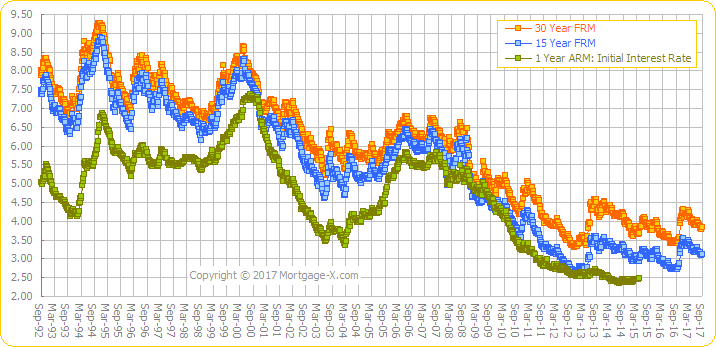
Interest Rates Predicted to be 10% by Year’s End

That could easily have been a headline ripped from the pages in major newspapers back in August of 1994 when rates were only 6%–yet by year’s end the prediction nearly came true as a mere four months later they would rise to almost 10%!

Are you old enough to remember what normal mortgage interest rates were like?

Interest Rates DropAccording to Bankrate.com, mortgage interest rates have been attractive for such a long stretch of time that many homebuyers and homeowners might not realize that rates haven’t always been this low. Mortgage interest rates in the 4-percent range were unheard of until 2010, and rates in the 5-percent range were unknown prior to 2003, according to Bankrate.com surveys through the years and a chart of monthly average mortgage interest rates tracked by the Federal Reserve since 1971.

Prior to 2003, higher mortgage interest rates were the norm. In the early 1970s, rates hovered in the 7-percent range and spiked up above 9 percent in late 1975, late 1976 and most of 1978. At the end of the decade and throughout the 1980s, mortgage interest rates rarely dipped lower than 10 percent.

In the early 1980s, mortgage interest rates brushed the stratospheric highs of 18 percent and even 19 percent. Imagine trying to get a home loan with an interest rate of 18 percent. At that rate, the mortgage interest deduction would be a very lucrative income tax perk, but the monthly payment on a loan would be far more painful than a typicalmortgage payment today.

During the 1990s, mortgage interest rates ranged from around 7 percent to roughly 9 percent for many years. It was only in 2000 that rates began to fall to earth. They held at less than 9 percent in 2000, less than 8 percent in 2001 and less than 7 percent in 2003.


Reproduced with the permission of Mortgage-X.com

If you’ve been putting off refinancing your home or buying a new one, don’t get lulled into inaction with the thought that these new low rates are here to stay.

The information
contained in this article is educational and intended for informational
purposes only. It does not constitute real estate, tax or legal advice, nor
does it substitute for advice specific to your situation. Always consult an
appropriate professional familiar with your scenario.


Drew & Christine
Morgan did not necessarily participate in these sales.

DRE License Numbers
01124318 & 01174047

Drew & Christine
Morgan, REALTORS | Notary Public


Saving More For A Down Payment–is it Wise?

Is it Wise to Save More For Your Down Payment?

Are you a first-time buyer wondering how you’ll ever have
enough of a down payment to buy your first home?

Do you wonder how much down payment you need for a home? Did
you know that if you’re buying a home and using FHA financing your down payment
could be as little as 3.5?. Ten percent down loans are also making a comeback
and are quite common once again.

But should you wait and save more for your down payment so
you can be 20% down? In our current market, that might not be such a great
idea.

Home values have been increasing rapidly in the last year.
An area in Belmont known as Sterling Downs offers many first time buyers
affordable living options. But the values there have been rising with the rest
of the tide.

This graph illustrates the price trend in the last year in
Sterling Downs, Belmont. We used homes which closed escrow since January of
last year that were three bedrooms and between 900 and 1,100 square feet so
that the sale prices weren’t affected by the size of homes selling.

Clearly it would be near impossible to keep up with the increase
in the selling prices simply by saving more money each month from your paycheck. We estimate
that in 2012 to date the average Sterling Downs home increased $75,000 or just over
$5,000 per month.

If you have been waiting to buy a home and need some advice
on some of the varying financing options which are available, feel free to contact us and
we’ll refer you to one of the great mortgage brokers who can answer all of your
questions.


Mortgage-rates27-300x300
The information
contained in this article is educational and intended for informational
purposes only. It does not constitute real estate, tax or legal advice, nor
does it substitute for advice specific to your situation. Always consult an
appropriate professional familiar with your scenario.


DRE License Numbers
01124318 & 01174047

Drew & Christine
Morgan, REALTORS | Notary Public

All data was retrieved
from MLS Listings, Inc. The Multiple Listing Service for San Mateo County.


Belmont Median Home Price Hits Record High

What’s up with this crazy market? The stock market hit an
all time high this week and our local housing prices are right in step. Pundits
say that our housing market tracks the S&P 500 and if they’re right, we’re
in for a heck of a ride.

Belmont housing prices continued to show gains into February
as Belmont had both month-to-month and year-over-year increases in the median
price—so let’s start there.

This graph shows the median price trend for the past year in
Belmont.


February 2013 for Belmont

[click on the image for a larger graph]

MEDIAN PRICE

The median home price in Belmont increased 42% last month
over a year ago. Belmont’s February home price reached $1,108,000. To put that
in perspective that is the second highest median home price for Belmont since we began tracking the market in 1998. The only other time it was this high was in
October of 2007—right before the housing crash hit the Peninsula.

If you’ve been following our market
update you know we never leave the raw numbers alone. Since Belmont has a relatively
small number of homes selling each month when a disproportionate number of
smaller or larger homes sell in a given month it impacts the median home price and
skews it off axis.

In order to adjust for this we look at the size of homes
selling in the two periods. Insofar as we know we are the only local experts
drilling down to this level of detailed analysis.

Homes which sold in February 2103 in Belmont were 20% larger
than they were in 2012 during the same period, so while the median increase in
price was 42%, could this mean the adjusted median home price gain was actually
closer to 22%?

Looking at it another way, the difference in the size of homes
selling in the two periods was 1,970 square feet in 2013 and 1640 square feet
in 2012—a difference of 330 square feet (20% increase this year). Now let’s
multiple that by the median price per square foot the homes sold for in 2012
and we get $181,500. If we add that to the median price in 2012 our adjusted
median home price for last year would be  $961,500—meaning that using this method for
adjusting the median home price we get a 15% increase year over year; and the
reality probably lies somewhere in between. Any way you slice it, 15-20% increase
year-over-year is an amazing rebound and this increase will hopefully create
more “equity sellers” and more seller’s with equity means more sellers who can sell which will in turn increase the housing supply.

One of the most impressive statistics is that only two homes had any price reduction at all and just as few sold for less than the seller’s asking price.

SALES

Sales were down this year over last so we checked the
inventory levels to try and understand why. In January of 2012 there were 21
new listings which hit the market. Adding to an already bloated inventory that
caused the inventory level last year in February to soar to 41 homes available
for sale. Contrasting that to this year when the new listings dropped 50% to
only 14 and our inventory of homes for sale stood at a paltry 12!

PERCENT OF ASKING

In February of 2012, seven of the 19 sales, or 37%, were for
more than the seller’s asking price by on average $46,000. This February 73% of
the sellers received on average $106,000 over their asking price.

For those sellers who were less fortunate, in 2012 53% sold their
home for on average $29,000 less while in 2013 only 18% had to sell for on
average $35,000 less.

The percent the sellers received of asking were 97.3% in
2012 as compared to 107.7 in 2013.

If you are considering selling your home the above statistics
might lead you to believe that it’s back to the old days when any agent could
put a sign out front and sell your home. And while that may be true—that your
home might sell—the percentage you actually receive of your asking price varies
relative to the degree of expertise in agent’s marketing plans and advice. If
you want to be statistically guaranteed that you’ll get the best results,
contact us for a consultation. Our record for selling every home we’ve listed,
for more money, and in the shortest period of time is unmatched—of the top
Belmont REALTORS, nobody has us beat.

If you are looking for someone to help you sell your home, we’re someone you should know.

The information contained in this article is educational and intended for informational purposes only. It does not constitute real estate, tax or legal advice, nor does it substitute for advice specific to your situation. Always consult an appropriate professional familiar with your scenario.

Drew & Christine Morgan did not necessarily participate in these sales.

DRE License Numbers 01124318 & 01174047

Drew & Christine Morgan, REALTORS | Notary Public

*All data was retrieved from MLS Listings, Inc. The Multiple Listing Service for San Mateo County.


Belmont Homes Sales for 2012 – Profile of a Home Sold

By now everyone has heard that the Peninsula housing market picked up last year but as is often the case, the devil is in the details.

What really went on?

Most people, including real estate agents, are under the misimpression that there were no homes to sell last year—that inventory was in short supply. Well part of the is true. The inventory was down but the number of new listings hitting the market were actually up over 2011.

There were 282 new listings in 2012 as compared to 261 in 2011. That’s about one month’s worth of new listings—not much to talk about. But that 8% increase is important because of the increase in sales.

Home sales for the two years are a different story. In 2011 there were 186 single family home sales as compared to 243 in 2012—an increase in 2012 of 31%.

That which created the low inventory of homes was that home sales were dramatically, up while the number if new listings hitting the market were up only slightly.

This short supply of homes created a buying frenzy for the few available homes on the market and of course bidding wars ensued, driving up prices.

In 2011 the median home price in Belmont was reported as $870,000 while in 2012 that number reached $912,000. That modest increase of about 5% is reflected in the statistics but to a greater degree in the real world. In 2011 the median size home which sold was 1925 square feet and in 2012 the median size home sold was 1940 square feet—15 square feet larger—not significant enough of a difference to make any calculation modifications.

Belmont, though rather representative of the overall Mid-Peninsula housing market, due to its relatively small market sample or “snaphot” if you will, can be easily distorted when fewer large homes trade hands or more distressed sales occur.

Belmont 2012 over asking graph

For a more accurate data sample we examine the entire San Mateo County as sort of a check and balance. Of course San Mateo County includes a wide array of neighborhood housing trends–while Menlo Park home prices are climbing those in Daly City for example may be still on the decline as seen in this 2008 post. That’s why when we see a dramatic market shift like the one to the left, one can only imagine how strong the lower Peninsula must be faring.


SMC Median Homes price 2008-2012

In Belmont, here’s where you can see the market shift. Of the homes which sold in 2012, 54% sold for on average $52,000 over the seller’s initial asking price with these sellers receiving 107% of their initial asking price (not the reduced price), while 11% of homes sold at the seller’s asking price and only 35% of homes sold for less—on average $32,000 less—ultimately getting only 93% of their asking price.

Contrast this to 2011 where we see that the results appear to be almost perfectly reversed, with 58% of the homes selling for less than the seller’s asking price, 11% selling at asking and only 32% which sold for more than the asking price.

And the bids are going higher: While in 2011 if you were one of the lucky sellers to get over your asking price on average you received 103% while that number jumped to 107% in 2012.

Selling a home in Belmont did get easier—so long as you worked with a seller. With more eager buyers for each available home the average time it took to sell al home dropped from 46 days down to 37.

Why did most of the homes sell for at or above the seller’s asking price and some homes still sell for less? Because even in a hot market buyers know the inventory. They have essentially unfettered access to data and with the advent of the internet the way buyers see and buy homes has changed forever. Homes which are overpriced will continue to languish on the market even during peak market conditions, and as illustrated above, receive on average 13% less!

What’s in Store for 2013?

More of the same. Rising prices, multiple offers with only the hope that more inventory will satiate some of the eager buyers. What could be a wrench in the works? Interest rates rising or natural disasters. The economy appears on the mend and apparently buyers are moving ahead with unabashed enthusiasm for housing once again,

Are you considering selling or know someone who is?

We’d love to talk with you. We have plenty of pre-approved Buyers just waiting to jump at the next opportunity.

Want to know what we can do for you?

Each year we compare our personal statistics for listings we sold in Belmont. Last year not only did we beat the averages, we beat out the other top three Belmont REALTORS with our statistics for percent of asking our sellers received, days on market and price reductions (we had none).

While the average home in Belmont sold for 101% of asking, our seller’s received on average 103.8%–netting our sellers more than any of the other top three Belmont REALTORS.*  We also came in #1 with no price reductions or cancelled listings.

And while it took our competition 37 days on average to sell their listings, we sold all of ours in less than 7.

The best measurable results and the fact that we’ve sold every home we listed last year as we have done for the past 20 years, makes us a clear choice for helping you to sell your home.

If you are looking for someone to help you sell your home, we’re someone you should know.

The information contained in this article is educational and intended for informational purposes only. It does not constitute real estate, tax or legal advice, nor does it substitute for advice specific to your situation. Always consult an appropriate professional familiar with your scenario.

Drew & Christine Morgan did not necessarily participate in these sales.

DRE License Numbers 01124318 & 01174047

Drew & Christine Morgan, REALTORS | Notary Public

*All data was retrieved from MLS Listings, Inc. The Multiple Listing Service for San Mateo County.