Take a moment to check out his new listing in Belmont!
We initiated this post on the Belmont Patch and wanted to make sure the residents of Belmont know what their City Council is working on as the newest proposal in keeping Belmont’s residence safe.
I tend to stay away from expressing our opinions about the machinations of Belmont’s City Council but I thought their recent proposal which burdens every home seller with a sewer lateral inspection and repair requirement needs some public scrutiny.
What is a sewer lateral?
It’s the underground pipe that runs from your home to the public sewer system.
What’s the issue?
In some cases, the sewer lateral can leak or even break causing sewage to seep into the ground—similar as to a leach field used in septic systems but not as sanitary. It also has the unwanted effect of possibly allowing ground water (from rain for example) to enter the sewer system which can overburden the system.
What’s the Fix?
First, you have to learn if you have a faulty sewer lateral. There is a relatively inexpensive smoke test which Belmont has been employing to detect faulty sewer laterals. The more expensive way to discover this is through a field test with a camera which is snaked through your sewer line to detect visible deficiencies.
How much does it cost if I need to repair my sewer lateral?
That depends. An short run and easy fix from your home to the street might cost under a thousand dollars but could also reach ten times that amount if there are difficulties in reaching the sewer lateral or, as in the case of many Belmont homes, the sewer lateral has a very extensive run across multiple properties before it reaches the main city sewer line.
What the City of Belmont is considering:
The Belmont City Council has been deliberating whether or not to force each homeowner to perform a test and if necessary repair the sewer lateral before they can sell their home. That proposal is called a “point of sale” or POS proposal.
What’s the problem with their proposal?
There are several issues with this approach which could cause a homeowner a problem should they need to sell their home and either not have the funds to repair the sewer lateral, or not have the time before the close of escrow. Amendments to this proposal include ways a homeowner could negotiate with a buyer to inherit the burden but so far the proposed workarounds appear to be at odds with lending and escrow institutional requirements.
What’s the answer?
The City of Belmont is currently testing sewer laterals utilizing a smoke test which offers the added benefit of detecting downspouts that may be discharging roof runoff into the sewer system rather than the storm drains. Should they find a leak they could then require the homeowner to repair their sewer lateral and have the opportunity to secure financing if needed.
The POS proposal seeks to limit the sewer lateral test to a relatively small subset of homes—only those which sell in a given year, which in 2012 was only 236—while the easily performed smoke test could potentially reach far more homes.
One wonders if the city is truly interested in fixing the sewer lateral problem or pushing it off onto those who will have little voice in the next election—those selling their home and moving away.
UPDATE–I attended the meeting with the Belmont staff and council on Thursday, the 14th to hear their newest idea of the Point of Sale requirement for sewer laterals. Be clear, the City Council has directed the staff to discuss how to best implement the POS, not whether or not the POS is the best way to deal with the issue.
Clearly there is a need to repair broken sewer lateral lines in our city. Having sewage seep into the surrounding ground is not ideal, but the larger problem appears to be the amount of water which enters broken sewer laterals during and after heavy rains. This water then ends up taxing an already overburdened treatment system and anyone who lives in Belmont knows the cost of maintaining our sewer system keeps getting passed along in the form of rate increases on our property tax bills.
But is it leaking water into our sewer laterals which is the major culprit or is it the city’s very own main lines? The smoke tests which the city has been performing clearly revealed one of the greatest issues are folks who have tied their downspouts into the sewer system rather than divert the water to run down the curb and into the storm drain. So again we question, are we moving forward armed with all of the information we need or just moving forward to give the impression we’re making progress?
The rainy season is almost over and we’d suggest the council, which appears ahead of their skis right now, take a step back and get more information and input before storming ahead. Gathering more information from lending institutions, title companies and plumbing contractors who specialize in sewer lateral replacement might prove to be a good start. Having the city deliver the results of their smoke testing to the public for scrutiny might also show some good faith that these decisions are based on solid data; then set a date for action prior to next years’ rainy season.
The question of course today is why a POS vs. requiring each property owner to test and fix their sewer laterals? If the City Council is truly concerned about fixing the issue, a POS requirement severs to only uncover a small percentage of the defective sever lateral lines—commensurate with home many homes sell each year. Since it’s an election year, this seems a politically palatable way to deliver bad news—only those moving would be affected by the cost (estimated to average $7,500 per household). But is it the best answer to the problem? Probably not.
If the council is truly concerned with the health and safety of its citizens it might continue down the path of requiring each and every homeowner to remedy this situation independent on whether or not they are moving. I’m struggling with this but the only reason I can see for not requiring every homeowner to repair their lateral is it would be politically unfavorable.
If the City Council has its way a POS would be eminent. The staff has been directed to develop a step-by-step plan for administrating this new burden. The proposal, if I can paraphrase it and as it stands now, is before a home could be transferred, it would need to have a certification the sewer lateral is intact. That encumbers the homeowner to order and pay for a sewer lateral camera inspection costing about $150-$200 dollars depending upon ease of access. The results of the test and camera footage shall be delivered to the public works department for analysis—promised not to take more than a day or two. If your sewer lateral passes, you get to pass “GO”. If not, you will be required to fix it and provide a certification to the city prior to the close of escrow. Of course the city will have its hand out for encroachment permits, building permits and so forth and they’ve offered no proposed relief on these fees in order for homeowners to comply. Or, the third option presented on Thursday, was that the buyer of the property could sign a pledge to repair the sewer later at their expense with 180 days of closing—and deliver a deposit as security of performance—an amount which has yet to be determined.
Of course this will raise all sorts of red flags for lenders, who if they get wind this requirement exists, will force the repair of the sewer lateral prior to the close of escrow as part of a lending requirement. So while we applaud the city staff for attempting a workaround, their third prong option still has some kinks in it. Namely that once the seller and buyer negotiate who will pay for this repair those negotiations will become part of the contract—the very contract the lender will scrutinize and thus require a sewer lateral certification before they will lend on the property.
As REALTORS, we’re used to handling city issues in the form of disclosure such as the new smoking ordinance, school boundary issue, or even dog and alarm licensing requirements so this newest burden which the city apparently feels we are fighting just for the sake of having to do less work, is really a non sequester for us. What this will burden is the home sale transaction—the seller and the buyer—to find a way to appease the city’s new requirement without unwittingly defrauding the lender at the same time.
The views expressed here are my own–Drew Morgan and not necesarily the views of the National Association of REALTORS, The California Association of REALTOS, The San Mateo Association of Realtors or even my wife.
By now everyone has heard that the Peninsula housing market picked up last year but as is often the case, the devil is in the details.
What really went on?
Most people, including real estate agents, are under the misimpression that there were no homes to sell last year—that inventory was in short supply. Well part of the is true. The inventory was down but the number of new listings hitting the market were actually up over 2011.
There were 282 new listings in 2012 as compared to 261 in 2011. That’s about one month’s worth of new listings—not much to talk about. But that 8% increase is important because of the increase in sales.
Home sales for the two years are a different story. In 2011 there were 186 single family home sales as compared to 243 in 2012—an increase in 2012 of 31%.
That which created the low inventory of homes was that home sales were dramatically, up while the number if new listings hitting the market were up only slightly.
This short supply of homes created a buying frenzy for the few available homes on the market and of course bidding wars ensued, driving up prices.
In 2011 the median home price in Belmont was reported as $870,000 while in 2012 that number reached $912,000. That modest increase of about 5% is reflected in the statistics but to a greater degree in the real world. In 2011 the median size home which sold was 1925 square feet and in 2012 the median size home sold was 1940 square feet—15 square feet larger—not significant enough of a difference to make any calculation modifications.
Belmont, though rather representative of the overall Mid-Peninsula housing market, due to its relatively small market sample or “snaphot” if you will, can be easily distorted when fewer large homes trade hands or more distressed sales occur.
For a more accurate data sample we examine the entire San Mateo County as sort of a check and balance. Of course San Mateo County includes a wide array of neighborhood housing trends–while Menlo Park home prices are climbing those in Daly City for example may be still on the decline as seen in this 2008 post. That’s why when we see a dramatic market shift like the one to the left, one can only imagine how strong the lower Peninsula must be faring.
In Belmont, here’s where you can see the market shift. Of the homes which sold in 2012, 54% sold for on average $52,000 over the seller’s initial asking price with these sellers receiving 107% of their initial asking price (not the reduced price), while 11% of homes sold at the seller’s asking price and only 35% of homes sold for less—on average $32,000 less—ultimately getting only 93% of their asking price.
Contrast this to 2011 where we see that the results appear to be almost perfectly reversed, with 58% of the homes selling for less than the seller’s asking price, 11% selling at asking and only 32% which sold for more than the asking price.
And the bids are going higher: While in 2011 if you were one of the lucky sellers to get over your asking price on average you received 103% while that number jumped to 107% in 2012.
Selling a home in Belmont did get easier—so long as you worked with a seller. With more eager buyers for each available home the average time it took to sell al home dropped from 46 days down to 37.
Why did most of the homes sell for at or above the seller’s asking price and some homes still sell for less? Because even in a hot market buyers know the inventory. They have essentially unfettered access to data and with the advent of the internet the way buyers see and buy homes has changed forever. Homes which are overpriced will continue to languish on the market even during peak market conditions, and as illustrated above, receive on average 13% less!
What’s in Store for 2013?
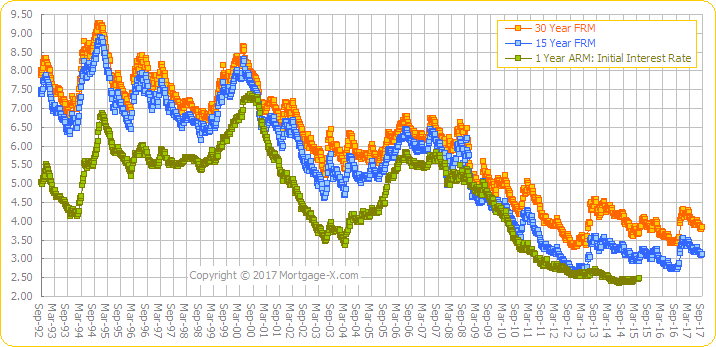
More of the same. Rising prices, multiple offers with only the hope that more inventory will satiate some of the eager buyers. What could be a wrench in the works? Interest rates rising or natural disasters. The economy appears on the mend and apparently buyers are moving ahead with unabashed enthusiasm for housing once again,
Are you considering selling or know someone who is?
We’d love to talk with you. We have plenty of pre-approved Buyers just waiting to jump at the next opportunity.
Want to know what we can do for you?
Each year we compare our personal statistics for listings we sold in Belmont. Last year not only did we beat the averages, we beat out the other top three Belmont REALTORS with our statistics for percent of asking our sellers received, days on market and price reductions (we had none).
While the average home in Belmont sold for 101% of asking, our seller’s received on average 103.8%–netting our sellers more than any of the other top three Belmont REALTORS.* We also came in #1 with no price reductions or cancelled listings.
And while it took our competition 37 days on average to sell their listings, we sold all of ours in less than 7.
The best measurable results and the fact that we’ve sold every home we listed last year as we have done for the past 20 years, makes us a clear choice for helping you to sell your home.
If you are looking for someone to help you sell your home, we’re someone you should know.
The information contained in this article is educational and intended for informational purposes only. It does not constitute real estate, tax or legal advice, nor does it substitute for advice specific to your situation. Always consult an appropriate professional familiar with your scenario.
Drew & Christine Morgan did not necessarily participate in these sales.
DRE License Numbers 01124318 & 01174047
Drew & Christine Morgan, REALTORS | Notary Public
*All data was retrieved from MLS Listings, Inc. The Multiple Listing Service for San Mateo County.

LOOKING FOR THE IDEAL HOME IN BELMONT?
Continue readingWe’re starting the post off with SALES instead of MEDIAN PRICE. Why? Because this year has all been about the increase in sales and low inventory.
Continue readingBelmont home sales were down year-over-year in November of 2012 ending a nine month run of increased sales over last year.
Continue readingAre we bouncing along the bottom or is the housing recovery in full swing?
Continue readingOctober of 2012 saw more than a 100% increase in home sales year-over-year with 23 home sales in Belmont as compared to only 11 last October.
Continue readingSeller’s here’s your lesson. Where less of an asking price is actually more, buyers are feverishly snapping up well priced homes.
Continue readingWe predicted that this market would “bounce along the bottom†for awhile before seeing any substantive increase.
Continue reading