

A LOOK AT 2021 HOUSING AND WHAT LIES AHEAD IN 2022

Unless you’ve been living under a rock the past two years, you’ve no doubt heard that home values climbed their assent into the stratosphere.

Stratosphere

But as local agents for over 25 years, even we have a hard time wrapping our heads around the staggering numbers.

You may have also heard that there’s “no inventory”. Well, that’s not exactly true.

Then what’s causing the spike in prices? High demand, not lack of supply—unlike the overall economy that’s suffering from a lack of supply and high demand.

Comparing the annual number for 2020 to 2021, we’ll start with the inventory of homes for sale.

The number of new listings that came on the market in 2020 was 234 in 2020 and 249 in 2021 which is an increase of 6.4% more homes available for sale in 2021. Then why is everyone talking about low inventory? Because sales went from 183 units in 2020 to 254 in 2021—a whopping 38% increase—so there are no homes left to buy.

One might ponder, “How can that be?” If you only have an increase of 6.4% in new listings, how can you have 38% more sales. The answer is everything is selling in 2021 while in 2020 some of those new listings never made it into escrow.

That’s evident in the days on market, which dropped 45%, from 20 days to only 11, and the percent a seller received over the asking price climbed from 105% in 2020 to 114% in 2021. 

Another indicator of the scant number of homes available at any given moment is the “Months of Inventory” statistic, that measures how long it would take to sell all of the available inventory at the current rate of sales. That dropped from a meager .4 months, to an almost immeasurable .1 month, (overall, the U.S. stands at around six months of inventory at any given time).

What effect did this have on home values? Nothing, but it had a lot to do with home prices. They hit their highest level in history recording a median home price of $2,245,000 up from $1,888,000—a 19% increase YOY and a 28% increase in the past two years—while the size of homes selling in the last two periods stayed statistically similar at 1,968 and 1,962 square feet respectively. 

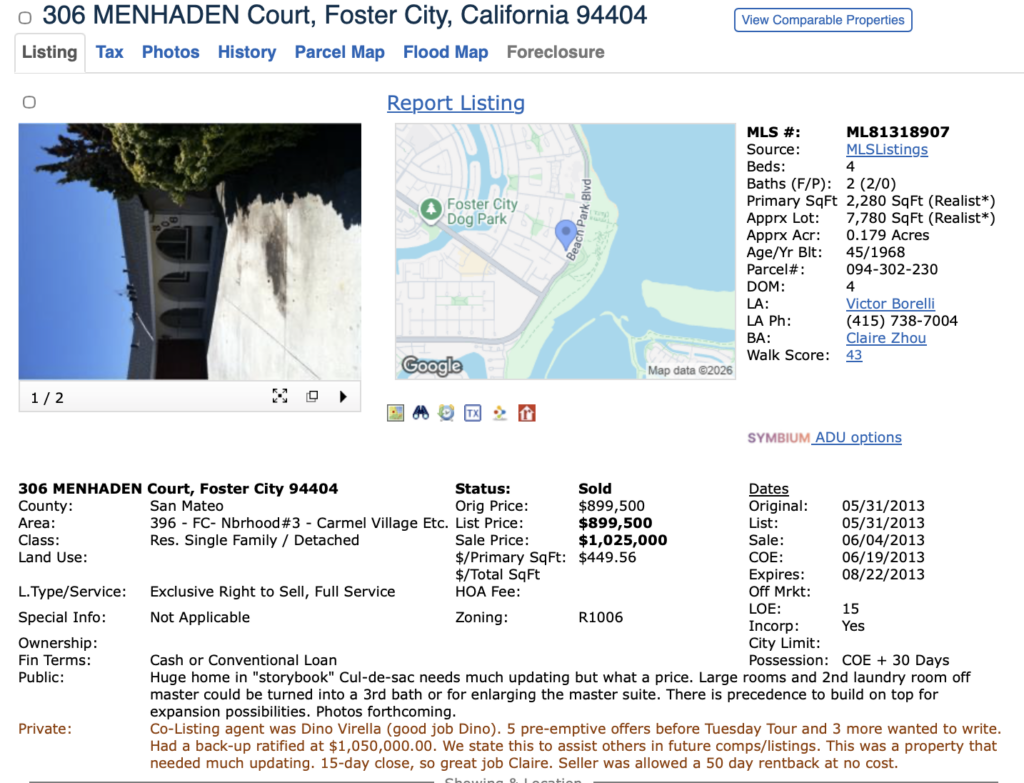
This is an article we did back in 2018 on the supposed crest of interest rate hikes.

There is some cooling off of the astronomical climb in prices as noted by the Case-Shiller study for the Bay Area’s metropolitan area, but that may not reflect our local hot spot trends in the mid-peninsula.

What to Watch Out For

Rising Interest Rates

Rising interest rates may give buyers some relief from a super-heated market, may also serve to quell their purchasing power while softening prices. The irony is just when buyers may be able to compete in the market, even if they were to pay less for a home, they’ll end up paying more in interest in their loans.

Drew & Christine Morgan are REALTORS/NOTARY PUBLIC in Belmont, CA. with more than 25 years of experience in helping sellers and buyers in their community. As Diamond recipients, Drew and Christine are ranked in the top 50 RE/MAX agents nationwide and the top 3 in Northern California.  They may be reached at (650) 508.1441 or emailed at info@morganhomes.com.

For all you need to know about Belmont, subscribe to this blog right here. You can also follow us on Facebook at https://www.facebook.com/Morganhomesand on Twitter @ https://twitter.com/morganhomes

The information contained in this article is educational and intended for informational purposes only. It does not constitute real estate, tax, insurance or legal advice, nor does it substitute for advice specific to your situation. Always consult an appropriate professional familiar with your scenario.

Zillow’s Inaccurate Zestimates May be Blamed for Zillow’s Own Financial Woes and Cancelling their iBuyer Program

How accurate are Zillow’s Zestimates? As it turns out, Zillow’s CEO seems to have lost faith in his companies own ability to assess home values.

Company founder and CEO Rich Barton added in his report [to investors] that “we’ve determined the unpredictability in forecasting home prices far exceeds what we anticipated and continuing to scale Zillow Offers would result in too much earnings and balance-sheet volatility.”

Rich Barton

During an earnings call with investors, Barton ultimately concluded that Zillow has been unable to accurately price homes for future sales.

Our observed error rate has been far more volatile than we thought possible,” Barton said during the call. He later added that “fundamentally we have been unable to predict future pricing of homes to a level of accuracy that makes this a safe business to be in.”

As REALTORS®, a common issue arises when representing sellers or buyers is the Zestimate®️they sometimes rely upon to determine value for the property in question.

Invariably, we spend an inordinate amount of time explaining to our buyers and sellers that the Zestimate they see on-line has very little to do with the actual market value of a home.

The problem with Zillow’s algorithm is that while it can compare the size and age of a home using public records, location and lot size, it has an impossible task of sourcing sufficient details of a home for an accurate valuation.

For example, Zillow has no way of knowing if the homes being compared have been recently updated, and if so with what quality of materials.

Are the lots these homes sit upon all the same insofar as usability? A level ¼ acre lot is worth far more than a steep ½ acre lot but Zillow’s algorithm has no access to these important details, and it can’t differentiate between the two.

To sum it up, we tell our clients, “Zillow has never been to your home, or seen the inside. They can’t possibly know what your home is really worth—but it’s a fun app”.

The sad news is Zillow has taken down their own work force by their assumption they could use their quantitative analysis to predict home values.

The report ultimately states that Zillow plans “to wind down Zillow Offers, the company’s iBuying service in which Zillow acts as the primary purchaser and seller of homes.” CEO Rich Barton went on to say that the move should take several quarters and will also result in Zillow reducing its workforce by approximately 25 percent, according to a report Tuesday. 

Quote Source: Imnan Real Estate News

Drew & Christine Morgan are REALTORS/NOTARY PUBLIC in Belmont, CA. with more than 25 years of experience in helping sellers and buyers in their community. As Diamond recipients, Drew and Christine are ranked in the top 50 RE/MAX agents nationwide and the top 3 in Northern California.  They may be reached at (650) 508.1441 or emailed at info@morganhomes.com.

For all you need to know about Belmont, subscribe to this blog right here. You can also follow us on Facebook at https://www.facebook.com/Morganhomes and on Twitter @ https://twitter.com/morganhomes

The information contained in this article is educational and intended for informational purposes only. It does not constitute real estate, tax, insurance, or legal advice, nor does it substitute for advice specific to your situation. Always consult an appropriate professional familiar with your scenario.

BELMONT HOME VALUES CONTINUE THEIR ASCENT AS SALES DECLINED

It wasn’t just Sir Richard Branson and Jeff Bezos that have shepherded in a new era. Belmont single family homes values have continued their pandemic born steep ascent.

First, the numbers:

Belmont home values continued their astronomical ascent as sales declined in September of 2021. Belmont sales of single family homes fell 9.6% from September of 2020 to the same period in 2021. Compared to September of 2019, pre-pandemic, sales were up this year more than 53% in 2021.

The average time it took to sell a home went down from 19 days to 12.

The Months of Inventory—the time it would take to sell all the homes on the market at the current rate of sales—went from .8 months down to .5, and the available inventory of homes to choose from went from 21 in 2020, to only 11 in 2021. To put this into perspective, the U.S. housing inventory sits at 6.1 months.

The median home price rose from $1,925,000 to $2,235,000, close to a 12% increase YOY. It’s important to note that the size of homes selling in these two periods went down, from 2,150 ft² to 1,737 ft², a 19% decrease, which serves to only magnify the cost to the consumer. 

The price per ft² in 2020 was $979 and increased to $1,299 in 2021. It’s typical for the price per square foot to go up when smaller homes are selling, since it does not take into consideration the lot which the homes sit upon.

What is noteworthy is while the size of homes selling in these two periods went down 19%, prices went up 12%—illustrating that for 12% more in 2021, one could only get a 19% smaller home.

The percentage sellers received also went up from 101% of the asking price in 2020 to 112% in 2021, underscoring the strong demand.

Due to the increase in home values, the cost of home ownership, while borrowing money at 3% interest, went up $1,000 per month in just the last year. If interest rates were to rise to just 4%, the median price home in Belmont would cost ~ additional $1,000 per month.  

According to Mike Farrell of Wells Fargo, a person wishing to buy the median priced Belmont home with 20% down in 2020 needed to earn ~$225,0000 a year, while in 2021 that rose to $300,000 per year. That’s assuming the borrower has no other debt, such as credit card, car payments or school loans.

For buyers with stock options, puting a larger down payment may be an option to increase their buying power without worrying about needing more income to qualify for a mortgage. But for buyers with traditional salaries—essential workers from Teachers, Police, Firefighters, and hospital workers to grocery store employees, and restaurant workers who, without help from outside wealthy family members, will have little hope of ever buying into the dream of home ownership in the Bay Area.

Unfortunately, we see the same story playing out in San Mateo County as a whole.

The most important take-aways from these numbers are the median home price, which jumped 6% YOY, while the size of homes selling were 2% smaller, and the percentage the seller received of their asking price jumped 6 percentage points from 102% of asking to 108%.

As a direct result of the pandemic, many apartment renters, and condominium owners, found to work from home—and in many cases home school children, they needed more space. Since public gatherings were off the table—they wanted a yard as well as no common areas such as elevators. This created a glut of condominiums on the market.

It goes without saying, that we are in unchartered waters in terms of housing demand. Looking at this data from Case-Shiller®️, as compiled by FRED®, which covers the San Francisco MSA (Metropolitan Statistical Area) comprised of five of the nine Bay Area Counties, one can see the dramatic spike in home values beginning in 2020.

If you have considered selling your home and would like to maximize the proceeds from your sale, please contact us for a no obligation assessment.

Drew & Christine Morgan are REALTORS/NOTARY PUBLIC in Belmont, CA. with more than 25 years of experience in helping sellers and buyers in their community. As Diamond recipients, Drew and Christine are ranked in the top 50 RE/MAX agents nationwide and the top 3 in Northern California.  They may be reached at (650) 508.1441 or emailed at info@morganhomes.com.

For all you need to know about Belmont, subscribe to this blog right here. You can also follow us on Facebook at https://www.facebook.com/Morganhomes and on Twitter @ https://twitter.com/morganhomes

The information contained in this article is educational and intended for informational purposes only. It does not constitute real estate, tax, insurance, or legal advice, nor does it substitute for advice specific to your situation. Always consult an appropriate professional familiar with your scenario.

The Forbidden Fruit is Thy Neighbor’s Tree

Do you have a neighbor that’s a nuisance? Many do, yet they may be unaware. We’re talking about nuisance trees. Say your neighbor’s tree has limbs over your fence, or the neighboring tree’s roots are damaging your driveway. What can you do about it?

The good news is you do have rights—but they’re limited. You can’t just walk on over to your neighbor’s property and start cutting the offending tree down, or roots back, as that could be trespassing. But California Civil Code 3346 does consider the encroachment of branches or roots onto your property to be a nuisance. You are allowed to trim the tree or roots from a neighboring property that are encroaching onto your land so long as that tree is not destroyed or permanently damaged. If your actions destroy your neighbors’ tree, or even cause substantial damage so that the tree’s value is impacted, you can be held liable for treble damages (three times the actual amount).

picking an Apple Tree

What about the fruit from your neighbor’s tree? This time of year your neighbor’s tree could be bursting with peaches, pears, lemons, and limes—almost falling off of the trees. Almost, being the operative word. If your neighbor has a fruit tree that overhangs your property, the fruit on the tree belongs to that of your neighbor, even if it’s on your side of the fence. Any fruit that has fallen from your neighbor’s tree onto your property is considered the fruits of your labor for picking them up. In other words, they’re all yours.

Case Law regarding trees.

The information contained in this article is educational and intended for informational purposes only. It does not constitute real estate, tax, insurance, or legal advice, nor does it substitute for advice specific to your situation. Always consult an appropriate professional familiar with your scenario.

Drew & Christine Morgan are REALTORS/NOTARY PUBLIC in Belmont, CA. with more than 25 years of experience in helping sellers and buyers in their community. As Diamond recipients, Drew and Christine are ranked in the top 50 RE/MAX agents nationwide and the top 3 in Northern California.  They may be reached at (650) 508.1441 or emailed at info@morganhomes.com.

For all you need to know about Belmont, subscribe to this blog right here. You can also follow us on Facebook at https://www.facebook.com/Morganhomes and on Twitter @ https://twitter.com/morganhomes

Critical Steps to Financial Planning

Financial planning is an integral part of any successful portfolio.

We don’t pretend to offer financial advice, but we do offer real estate advice and the two often overlap.

For example, every two years a married homeowner filing joint tax returns can sell their primary residence and enjoy the first $500,000 of capital gains tax free. We’d be remise if we didn’t remind those to whom we’ve sold homes about this option to keep more of their equity in their own pocket.

Of course, we realize that most people don’t move every two years just to save on capital gains. 

First, homes don’t appreciate that much in two years to realize the savings, and people get entrenched in their neighborhood, while others just love their house and have no plans to move, but failing to plan ahead, could cost one hundreds of thousands of dollars.

When Might One Consider this Option?

If you have lived in your home in the Bay Area for more than five years you’ve probably already surpassed the $500,000 capital gains abatement threshold. 

Are you outgrowing your home? With interest rates are still at historically low levels, now might be an ideal time to consider a move up into the space you need.

If you’re retired or near retirement and would like to downsize, selling your home while the market is at record highs might be the time to employ that exit strategy you’ve been considering.  Afterall, when the last market correction occurred it took 7 years for the median home price to return to the previous high. Seven years is a long time to postpone retirement just to wait for home prices to rebound to current levels.

Worried about higher property taxes on a larger home? The recently passed Proposition 19 in California just might help mitigate the hit of higher property taxes with the ability to carry your existing low tax base to your replacement property and pay only a small increase if buying a more expensive home. 

If you’re downsizing, you can carry your existing tax base without adjustment.

We’re here to help answer any of your questions on how to make a move possible if you choose to do so.

If you have questions about tax implications or estate planning please seek advice from your attorney, CPA or other professional.

Drew & Christine Morgan are REALTORS/NOTARY PUBLIC in Belmont, CA. with more than 25 years of experience in helping sellers and buyers in their community. As Diamond recipients, Drew and Christine are ranked in the top 50 RE/MAX agents nationwide and the top 3 in Northern California.  They may be reached at (650) 508.1441 or emailed at info@morganhomes.com.

For all you need to know about Belmont, subscribe to this blog right here. You can also follow us on Facebook at https://www.facebook.com/Morganhomes and on Twitter @ https://twitter.com/morganhomes

The information contained in this article is educational and intended for informational purposes only. It does not constitute real estate, tax, insurance or legal advice, nor does it substitute for advice specific to your situation. Always consult an appropriate professional familiar with your scenario.

Housing Market’s Unbearable Heat

The Bay Area housing market is as hot as it’s ever been for sellers, but the real heat is on buyers to get a home as throngs enter the market. It’s no longer race to get a home, it’s a marathon.

Frustrated buyers are using low interest rates which have empowered them to bid higher in multiple offer situations. The result, prices are rapidly rising.

Take San Mateo County for example. We compared May of 2020 to this year and across the board, the numbers show high demand and higher prices.

Table

Description automatically generated

Reports of low inventory creating the feverish market are simply misreported. Low inventory implies there are no homes for sale, but looking at the numbers, one can easily see that the number of New Listings are up 14.2% over last year, while inventory of available homes to purchase is down 36%. There are scant homes to choose between, because more homes are selling and faster than before, not because fewer homes are coming to market.

The Months of Inventory in the last column says it all. Months of inventory represents the time it would take to sell the current inventory of homes at the current sales pace. That’s down from 2.4 months of inventory last year to less than one month of inventory in 2021 (the national average is typically six months of inventory).

The YOY median home sale price increase of a staggering 26% YOY illustrates the effect of demand outstripping supply, as buyers outbid one another to secure a home before interest rates rise, and their buying power is reduced, or their mortgage payment goes up.

In our town of Belmont, we see a similar pattern, but since it’s a smaller sample size, some of the numbers are more pronounced. 

Take the number of new listings for sale—up 53% over 2020, yet the available homes to sell are down 35%. This is clearly due to the 122% increase in closed sales.

It’s understandable to question why then did the median home prices rise half of what they did in the overall San Mateo County stats? Simply put, Belmont started with a higher median home price, and has less elasticity in the price threshold to increase at the same rate as less expensive areas included in the San Mateo County Statistics.

What could cool this superheated housing climate? Any number of things, but higher interest rates could be the first to show on the horizon.

Drew & Christine Morgan are REALTORS/NOTARY PUBLIC in Belmont, CA. with more than 25 years of experience in helping sellers and buyers in their community. As Diamond recipients, Drew and Christine are ranked in the top 50 RE/MAX agents nationwide and the top 3 in Northern California.  They may be reached at (650) 508.1441 or emailed at info@morganhomes.com.

For all you need to know about Belmont, subscribe to this blog right here. You can also follow us on Facebook at https://www.facebook.com/Morganhomes and on Twitter @ https://twitter.com/morganhomes

The information contained in this article is educational and intended for informational purposes only. It does not constitute real estate, tax, insurance or legal advice, nor does it substitute for advice specific to your situation. Always consult an appropriate professional familiar with your scenario.

What You Don’t Know Will Hurt You

Today’s real estate market might seem untenable for buyers. Since the pandemic began, looking at homes is harder, and competition as fierce as it’s ever been.

Homes seem to all be selling with multiple offers for hundreds of thousands of dollars over the seller’s asking price, and the inventory appears paltry.

Home buyers are facing relentless competition in the housing market, driven by low mortgage rates and inventory. According to the latest REALTORS® Confidence Index, based on real estate transactions nationwide in March, agents report an average of five offers on their most recent listing.

In a separate report by Redfin published in April, 72% of the brokerage’s agents faced competition when submitting an offer for their clients—up from 66.7% in March. [Source California Association of REALTORS]

But is what you are hearing from your colleagues who missed out on several homes, and even the media reports accurate?

A lot of what you may be hearing is true, but sensational stories always pique our interest and that’s what we tend to remember. But there’s more to the story…

Are Homes Selling Fast?

Did you know that there are over 600 homes for sale in San Mateo County as of today, June 2, 2021, and that the average days these homes have been on the market is 51? We’re willing to bet that would surprise most home shoppers today. What’s wrong with these homes? They’re overpriced, and ripe for an under asking offer. 

Home sales that are pending may give us a more accurate measure of how long homes that are highly desirable sit on the market, and that answer may also surprise you—22 days.

Now not all of these homes would make the cover of Architectural Digest, but keep an open mind when looking at homes, some are a true diamond in the rough. Remember, if you’re looking for what everyone else wants, you’ll also be competing with everyone else. 

What About Low Inventory?

Looking at the sales of homes, we compared the number of new listings in the first quarter of 2020 to the first quarter of 2021 and there were 256 more listings this year than last—an increase of 20% in new listings YOY.

Since sales were also up 20% during the same periods, the excess inventory of new listings was quickly gobbled up, giving the impression that there’s no inventory of homes available for sale.

Notice in the last column, that the months of inventory, which is the time it would take to deplete the inventory of homes given the current rate of sales, reflects that 20% drop with the months of inventory dropping from 1.8 months to 1.5—hardly earth shattering.

Table, calendar

Description automatically generated

The median home price is the number everyone should be watching. In San Mateo County, it’s up 13.5% YOY for the first quarter of 2021. This means the median priced homes which sold last year for $1,600,000, just cost buyers a whopping $250,000 more this year.

If you’re a buyer and you’re frustrated with the competitive home market today, waiting it out could prove to be a fool’s errand. Between possible interest rate hikes, and home value increases, trying to save more money to buy more home may have you sidelined in today’s housing market and chasing the elusive.

Summer Hope

There may be some hope as we approach the summer for less competition in the pursuit of Bay Area housing. With Memorial Day past, the unofficial start to summer under way and kids are out of school, it’s time for parents to start taking their children on vacations. 

June marks the beginning of the slower months for sales activity. This lasts usually until a week after kids are back in school. Summer provides a good opportunity to get a home with less competition than in spring and before people return from summer trips.

For all you need to know about local real estate, subscribe to this blog right here. You can also follow us on Facebook at https://www.facebook.com/Morganhomes and on Twitter @ https://twitter.com/morganhomes

The information contained in this article is educational and intended for informational purposes only. It does not constitute real estate, tax, insurance or legal advice, nor does it substitute for advice specific to your situation. Always consult an appropriate professional familiar with your scenario.

Why Open Houses Were Never Necessary After All

The Corona Virus pandemic changed a lot of things in our lives over the past year. We lost too many loved ones, we feared not only strangers but our friends and neighbors.

And we learned a lot. A lot about whom to trust, that we could survive at home with one another 24/7. Some good did come out of this very bad pandemic, but only if we remember the lessons learned.

Winston Churchill wrote, “Those that fail to learn from history are doomed to repeat it.” The 1918 “Spanish Flu” pandemic that ironically started in Kansas, not in Spain, taught us a lot about how to handle future pandemics—what to do as well as what not to do. If only our leaders during the COVID pandemic had studied the past. These past lessons may not always ward off doom, but they can provide some insights into the present and even the future.

Our real estate industry was hit hard when the March 2020 lock down was instated. Weeks into the lockdown, our industry was finally deemed an essential business, so while we were technically allowed to go into work nobody dared do so—it was too soon, too many unknowns remained.

Sales of single-family homes in San Mateo County dropped 78% during the first month of the stay-at-home order. Only homes that were vacant were allowed to be visited, and even then, with only stifling restrictive rules.

Open houses were off limits to the public. The only in-person showings were on a one-on-one basis with the buyer’s agent and their clients—the listing agent representing the seller was not allowed to attend.

The real estate market had every reason to falter during the pandemic, but it didn’t, it rallied, as we discussed in our blog post about pandemic sales in 2020—up 180% over 2019.

So, do we need open houses at all then? Or the age-old question. “Do Open Houses Sell Homes?”

This debate has been going on for as long as open houses have been in vogue, but there has never been a way to empirically test whether open houses are necessary or not, until now. 

The Facts

Now every market may be slightly different, but in Belmont, sales during the pandemic without open houses rallied. Here are the numbers:

New Listings                            Up 89%

Closed Sales                            Up 180%

Average Days on Market        Down 71%

Median Home Price                Up 4.5%

Price Per Sq Ft                         Up 25.5%

We are not saying that the lack of open houses was what helped sales, it’s just that apparently, not having open houses didn’t hurt them either. Skeptics might say that had the public been able to attend open houses sales might have been even higher. Of course, we will never know what “might have happened”. We do know that sales were up, and a lot fewer people caught the virus.

In the past, we liked open houses because we generated more new business from them. Sellers of occupied homes liked them because during one open house 50-100 people can see their home without having to set individual initial showings during the seller’s dinner time. 

We’ve held many open houses at the request of our clients, but we gladly refrained from them when they had reservations about the process.

Moving Forward

There are many new agents that are suffering greatly in the absence of hosting open homes. Without a mature book of repeat business, and a scant marketing budget, they rely heavily on meeting new prospects face to face at open houses.

Very soon open houses will once again be allowed. And we suspect newer agents without repeat clients will quickly ask their contemporaries if they can hold one of their listings open to regain some market share.

Just Say No

Throw Away Your Alarm System

That’s what you just did, when you opened your house to the public. It’s a well known fact that open house are not without their downside. Allowing unvetted and often unqualified people who wander off the street into one’s home and who are not represented by an agent, have free access to walk around and take videos as they scope out your home’s valuables as a target for burglary.

Vacant homes make for especially easy targets for criminals. Open houses allow them the opportunity to take inventory of your home’s items, find easy access during an open house, and even leave a window partially open, only to come back and take appliances—light fixtures—even the copper plumbing!

How Many is too Many?

Your home might be of adequate size, but add 50 strangers milling around all at once during an open house and all of a sudden your home just might feel too small for buyers who need more space. We once heard a buyer remark to their significant other during an open house and say, “Let’s get out of here. This house would be way to crowded with our friends”.

If you’re a seller adverse to having hundreds of strangers—many of whom are unqualified to purchase your home, peeking into your home all weekend long, you may find comfort in knowing that you can avoid placating your agent’s desire for more personal business, and instead feel free to push back and take charge of what is best for you and your family’s level of comfort and security.

For all you need to know about Belmont, subscribe to this blog right here. You can also follow us on Facebook at https://www.facebook.com/Morganhomes and on Twitter @ https://twitter.com/morganhomes

The information contained in this article is educational and intended for informational purposes only. It does not constitute real estate, tax, insurance or legal advice, nor does it substitute for advice specific to your situation. Always consult an appropriate professional familiar with your scenario.