
Possible Tax Hike Looming

1 Month Left to Sell Before Possible Tax Hike

Some home sellers would need a sale contract inked before the end of 2017 in order to avoid a big tax bill that would be imposed if the GOP tax reform proposals become law. Both the House and Senate bills would require sellers to have lived in their residence for a longer period of time before qualifying for the capital gains tax exclusion on the sale of a primary home. They would have to live in their house at least five years out of the last eight; right now, the requirement is two years out of the last five.

The Senate version, however, includes an exception for transactions in which a contract is written before Jan. 1, even if the closing occurs in 2018. The bill passed by the House includes no such exception. Therefore, homeowners who are currently thinking about selling have only one month left to complete a deal before proposed tax changes would take effect. Should tax reform be enacted, some homeowners who sell in 2018 may no longer qualify for the capital gains exclusion, which covers up to $250,000 for an individual and $500,000 for a married couple. As a result, the difference between your client’s tax bill pre- and post-tax reform could be huge.

https://youtu.be/jbGfwJBwslk

It won’t be known whether the House or Senate version of tax reform is adopted until the bill is finalized, which could happen in a few weeks. But sellers who haven’t lived in their house for more than five of the last eight years will want to act quickly regardless of the version that is approved.

______________________

Drew & Christine Morgan are REALTORS/NOTARY PUBLIC in Belmont, CA. with more than 20 years of experience in helping sellers and buyers in their community. As Diamond recipients, Drew and Christine are ranked in the top 50 RE/MAX agents nationwide and the top 3 in Northern California.  They may be reached at (650) 508.1441 or emailed at info@morganhomes.com.

For all you need to know about Belmont, subscribe to this blog right here. You can also follow us on Facebook at https://www.facebook.com/Morganhomes and on Twitter @ https://twitter.com/morganhomes

The information contained in this article is educational and intended for informational purposes only. It does not constitute real estate, tax or legal advice, nor does it substitute for advice specific to your situation. Always consult an appropriate professional familiar with your scenario

Belmont Home Value’s Increase—Is There No End in Sight?

Before we head into the winter slow season for home sales, we’ll take a quick look back at Q3 home sales for Belmont, and the larger San Mateo County.

BELMONT & SAN MATEO COUNTY

HOME SALES—

Belmont had 78 new listings in Q3 as compared to 64 last year during the same period, and increase of 18%.

San Mateo County’s inventory of new listings dropped 6% YOY

INVENTORY/SALES—

Ironically, even with more new listings the inventory dropped 21% YOY. Why? Because sales increased 17% eliminating housing inventory.

SMC’S overall inventory also dropped—31% YOY, and sales dropped by 3.4%

DAYS ON MARKET (DOM) —

The time it took to sell a home in Belmont, on average, dropped from 16 days to 14

SMC Days on market dropped from 27 to 23

MEDIAN HOME PRICE

The median home price increased 12.7% YOY for Q3 for closed homes. When we compared the size of the homes selling in the two periods, there was statistically no difference, at 1784 ft² in 2016 and 1,748 ft² in 2017—so we made no adjustment for square footage interfering with the median home price swing. Note that Belmont it an all-time median home price point this October 2017.

San Mateo COUNTY’S MEDIAN HOME PRICE ROSE 9.5% YOY IN Q3

PERCENT RECEIVED

Belmont home seller’s eked out 4.4% more for their homes over their list price than last year during the same period.

In San Mateo County that number went up to 3.7% of asking

WRAP-UP

In every category in regards to home sale activity, Belmont outperformed and outpaced San Mateo County leading speculation that the peak for Belmont home values have not yet been reached.

Drew & Christine Morgan are REALTORS/NOTARY PUBLIC in Belmont, CA. with more than 20 years of experience in helping sellers and buyers in their community. As Diamond recipients, Drew and Christine are ranked in the top 50 RE/MAX agents nationwide and the top 3 in Northern California.  They may be reached at (650) 508.1441 or emailed at info@morganhomes.com.

For all you need to know about Belmont, subscribe to this blog right here. You can also follow us on Facebook at https://www.facebook.com/Morganhomes and on Twitter @ https://twitter.com/morganhomes

The information contained in this article is educational and intended for informational purposes only. It does not constitute real estate, tax or legal advice, nor does it substitute for advice specific to your situation. Always consult an appropriate professional familiar with your scenario


Will There Be an End to Home Bidding Wars?

With unusually low home inventory levels, many buyers are feeling frustrated and overwhelmed at the prospect of ever getting their ideal home, or have first-hand experience at losing the home of their dreams in a bidding frenzy.

Yet not all homes sell for over their asking price. In fact many sell below. Granted, they may seem far and few between, but they are out there. In fact, so far in 2017, 25% of San Mateo County home sales sold for less than what the sellers were asking. Many wouldn’t think that’s true, and we’d be willing to bet that if asked, many would say that it’s a lot less, like 1%, but they’d be wrong. Perception is not always reality. The media’s constant coverage of how “crazy” the housing market is, has been drummed into the minds of buyers—and sellers. And the homes that people see closing well above the asking price, only serve to validate the overall impression that the market is overzealous. And that emboldens people’s impressions, but it’s more of an emotional response, than one of accuracy. It is however, what people talk about and what they remember.

We sold a home just last month at 534 Wellington Avenue to a buyer of ours. The sellers expected six offers and received none. We stepped in and delivered a full price offer and it was accepted. It’s the second lowest 3 bedroom sale in San Carlos on the west side this year.

One way to get a good deal is to focus on homes which have been initially overpriced. Any home which is still on the market after 14 days is probably one that will need a price reduction, or may be willing to take a lower offer. These are opportunities that buyers may want to focus on if the multiple bids are giving rise to second thoughts about buying a home.

As for timing the market, there are times of the year that homes get more attention and more multiple offers. We just went through that period—February, March, April and now May. A lot of “why” homes sell with more offers and at a higher percentage of the sellers asking price has to do with several factors.

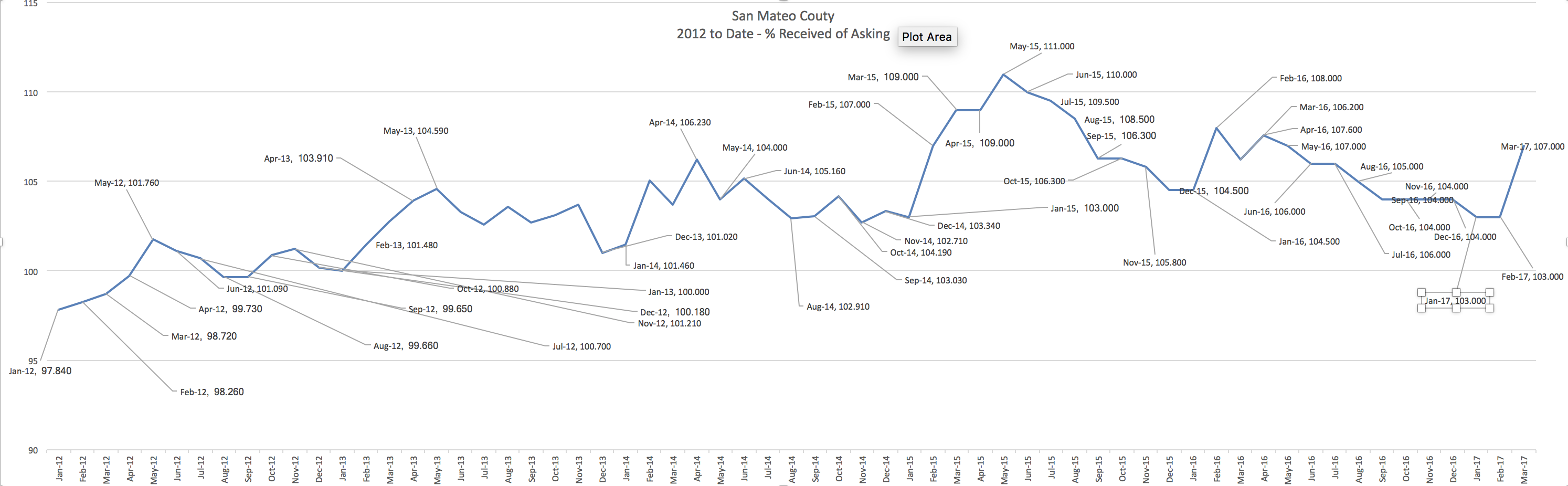
[Click on the graph below for a larger image]


As the new year begins, buyers and sellers are slow to come out of their market hibernation, but buyers seem to thaw out first. Many buyers have just received their end-of-year bonus, which they had been waiting for to jump into the housing market.

Some buyers with children are desperately trying to get a home in order to get their kids registered into a new school before the vacancies fill up—most first enrollment periods end within the first month or two of the start of the school year.

Another influence is that buyers who had lost out on homes in the prior year now focus more than ever on not losing out again, and they bid more aggressively than other buyers who may be just dipping their toes into the waters. And by June, these more aggressive buyers have all won—they have their home and the buyers that are left are the less aggressive buyers and overbids begin to wane. This typically happens around June, as this graph above of San Mateo County home sales since the turnaround in 2012 illustrates. It’s important to note however, that while the percentage a seller receives, and the number of overbids may be fewer, that doesn’t mean that prices decline. A high home price bar has already been established in the spring and it typically carries through until the end of the year. [Note: These statistics typically lag the market by a month—the typical escrow period. So a high sale percentage in May, was likely consummated in April].

Then of course there’s the competitive spirit. Buyers want what other buyers want and often a bidding frenzy ensues, pushing prices perhaps higher than they otherwise would be. It’s important to note that the aggressive buyer gets the home—the buyer that was willing to pay more than any other buyer at that moment in time. Did they overpay? Perhaps. But now they are a comparable sale for the next home, which invariably will sell for more, and so on and so forth until at the end of the year we have “appreciation”.

Drew & Christine Morgan are REALTORS/NOTARY PUBLIC in Belmont, CA. with more than 20 years of experience in helping sellers and buyers in their community. As Diamond recipients, Drew and Christine are ranked in the top 50 RE/MAX agents nationwide and 3rd in Northern California. They may be reached at (650) 508.1441 or emailed at info@morganhomes.com.

For all you need to know about Belmont, subscribe to this blog right here. You can also follow us on Facebook at https://www.facebook.com/Morganhomesand on Twitter @ https://twitter.com/morganhomes

The information contained in this article is educational and intended for informational purposes only. It does not constitute real estate, tax or legal advice, nor does it substitute for advice specific to your situation. Always consult an appropriate professional familiar with your scenario.


New Listings in Pricey Bay Area Counties Rose Significantly

The California Association of REALTORS™  has released a recent report on the state of the California’s housing, naming San Mateo County as having the highest median price in the state. They went one to mention the rising number of new listings. Could this mean that sellers are finally thinking the market is near its top? Will housing inventory open up, and water down the tidal wave of multiple offers? It’s probably too soon in the year to tell, but the tide may be changing, as we commented on at the end of 2016.

• C.A.R.’s Unsold Inventory Index, which measures the number of months needed to sell the supply of homes on the market at the current sales rate, rose to 3.7 months in January from 2.6 months in December. The index stood at 4.3 months in January 2016.

• New listings in pricey Bay Area counties, such as Marin, San Francisco, San Mateo, and Santa Clara rose significantly from December, a possible indication of sellers cashing out robust price appreciation experienced over the past few years.

• New statewide active listings continued to decline, dipping 0.3 percent from December and 10.5 percent from January 2016.

• The median number of days it took to sell a single-family home went up from 33 days in December to 37 days in January but was down from 44.2 days in January 2016.

• C.A.R.’s sales-to-list price ratio* was 98.1 of listing prices statewide in January, 98.2 percent in December and 97.8 in January 2016.

• The average price per square foot** for an existing, single-family home statewide was $240 in January, $242 in December, and $228 in January 2016.
• San Francisco County had the highest price per square foot in January at $841/sq. ft., followed by San Mateo ($723/sq. ft.), and Santa Clara ($567/sq. ft.). Counties with the lowest price per square foot in January included Del Norte ($124/sq. ft.), Kings ($125/sq. ft.), and Kern ($127/sq. ft.).

• After mortgage rates surged in the final few weeks of 2016, the 30-year, fixed-mortgage interest rate averaged 4.15 percent in January, down from 4.2 percent in December but was up from 3.87 percent in January 2016, according to Freddie Mac. The five-year, adjustable-rate mortgage interest rates edged up in January to an average of 3.24 percent, from 3.23 percent in December and 2.98 percent in January 2016.

Reprinted with permission form the California Association of REALTORS®

_____________________________________________________________________________________

Drew & Christine Morgan are REALTORS/NOTARY PUBLIC in Belmont, CA. with more than 20 years of experience in helping sellers and buyers in their community. They may be reached at (650) 508.1441 or emailed at info@morganhomes.com.

For all you need to know about Belmont, subscribe to this blog right here. You can also follow us on Facebook at https://www.facebook.com/Morganhomesand on Twitter @ https://twitter.com/morganhomes

The information contained in this article is educational and intended for informational purposes only. It does not constitute real estate, tax or legal advice, nor does it substitute for advice specific to your situation. Always consult an appropriate professional familiar with your scenario.

Housing May Be Approaching Equilibrium

A lot transpires at the end of the year. There are resolutions for the new year, and reflection upon the year just passed. There’s wrapping up the holiday decorations and reflecting upon the celebratory memories.

And then there’s wrapping up the year-end business for us. Surveying what happened in our local housing market and taking a stab at the “Why”?

We posted an article for our blog in December which we authored and was originally printed in the Examiner. It was aptly titled, “Shifting Market in Play”. In it, we discussed the subtle but noticeable shift in our housing market towards a market approaching equilibrium—that being a market wherein the demand is nearing the supply. That’s a good thing, as a more normal market is a more sustainable market.

It’s not simply that demand for housing is waning, but rather demand at the newly established price point is down. In other words, fewer people can afford the median price home which has had a dampening effect on home sales.

Affordability is affected by three major factors: median house price, mortgage interest rates, and household income. Mortgage rates are still below historical averages, and household income is on the rise. So, what is keeping housing affordability down are home prices—which are ironically artificially inflated due to the first two factors, low interest rates and high income.

Comparing the year-end numbers for Belmont, we see that listings were up but sales were down. The time it took to sell a home was higher, but the price the sellers received and the percent of the seller’s asking price were lower.

2016-2017 YOY Data


The median price appears to have taken a hit too, but upon further examination, one can see that while the median price was down 1.5%, the median size home that sold last year was down even more, at 3.4%.

When the housing market dropped in 2007, home values bounced along at the bottom for several years before climbing again. This is typically true at the peak as well. Are we there? We could be. Data from Q1 & Q2 will give us a more clear picture.

Drew & Christine Morgan are REALTORS/NOTARY PUBLIC in Belmont, CA. with more than 25 years of experience in helping sellers and buyers in their community. They may be reached at (650) 508.1441 or emailed at info@morganhomes.com.

For all you need to know about Belmont, subscribe to this blog right here. You can also follow us on Facebook at https://www.facebook.com/Morganhomesand on Twitter @ https://twitter.com/morganhomes

The information contained in this article is educational and intended for informational purposes only. It does not constitute real estate, tax or legal advice, nor does it substitute for advice specific to your situation. Always consult an appropriate professional familiar with your scenario.


The Eleventh Hour on the Eleventh Day of the Eleventh Month—Where Will You Be?

The Eleventh Hour on the Eleventh Day of the Eleventh Month—Where Will You Be?

Veterans Day originated as “Armistice Day” on Nov. 11, 1919, the first anniversary of the end of World War I. Armistice is an agreement made by opposing sides in a war to stop fighting for a certain time— a truce.

Congress passed a resolution in 1926 for an annual observance, and Nov. 11 became a national holiday beginning in 1938.Veterans Day

Veterans Day is not to be confused with Memorial Day–a common misunderstanding, according to the U.S. Department of Veterans Affairs. Memorial Day (the fourth Monday in May) honors American service members who died in service to their country or as a result of injuries incurred during battle, while Veterans Day pays tribute to all American veterans–living or dead–but especially gives thanks to living veterans who served their country honorably during war or peacetime.

  • In 1954, President Eisenhower officially changed the name of the holiday from Armistice Day to Veterans Day.
  • In 1968, the Uniform Holidays Bill was passed by Congress, which moved the celebration of Veterans Day to the fourth Monday in October. The law went into effect in 1971, but in 1975 President Ford returned Veterans Day to November 11, due to the important historical significance of the date.
  • Britain, France, Australia and Canada also commemorate the veterans of World Wars I and II on or near November 11th: Canada has Remembrance Day, while Britain has Remembrance Sunday (the second Sunday of November). In Europe, Britain and the Commonwealth countries it is common to observe two minutes of silence at the eleventh hour on the eleventh day of the eleventh month.

_____________________________________________________________________________________

Drew & Christine Morgan are REALTORS/NOTARY PUBLIC in Belmont, CA. with more than 20 years of experience in helping sellers and buyers in their community. They may be reached at (650) 508.1441 or emailed at info@morganhomes.com.

For all you need to know about Belmont, subscribe to this blog right here. You can also follow us on Facebook at https://www.facebook.com/Morganhomes and on Twitter @ https://twitter.com/morganhomes

The information contained in this article is educational and intended for informational purposes only. It does not constitute real estate, tax or legal advice, nor does it substitute for advice specific to your situation. Always consult an appropriate professional familiar with your scenario.


Local Housing Market Shows Signs of Change

BELMONT (AND BAY AREA) MARKET SHIFT

In order to know what changed in our housing market, one must understand that markets are constantly in flux, it’s just hard to see when you are in the middle of one—sort of like being in the eye of a hurricane. We looked at home sales in Belmont and compared the periods from January to September for 2015 and 2016. We’re always asked what’s going on in our market and we like to be armed with facts.

Most people want to know if the housing market is in the seller’s or buyer’s favor-if prices are going up, steady, or dropping. Buyers want to know as they are trying to decide if they should wait and see what happens with the market, or just move forward with life’s plans.

Anecdotally, many agents will tell you their opinion based upon their personal observations. If they had a hard time selling their last home they might tell you the market is “changing” and if their last listing flew off the shelf they might proclaim the housing market to be as robust as ever. But whatever people feel, the numbers don’t lie. They are an unemotional representation of what is occurring in a given market.

Let’s first discuss the market conditions. There’s a lot of hyperbole as to the state of our current housing market. Sellers are still in the mindset that they hold all of the cards, yet buyers are beginning to push back on prices. Sellers are receiving fewer offers, many have had to lower their asking prices, and homes are often times closing below the asking price—something that rarely happened from 2012-2015. This would suggest a shifting market.

Clearly, the sky is not falling, the shift is towards a more normal market, where homes sit on the market longer, and may sell above, at, or below the seller’s asking price. This long awaited market shift is not a correction, but rather a predictable and healthy move towards a more balanced and sustainable market. To be blunt, prices have risen to a level that the majority of buyers can no longer afford.

We first examined all of the home sales in Belmont that occurred in 2015 through August 31st in order to compare with the same period in 2016. We added no search filter other than the date range, since the larger the pool of sales, the more reliable the data.

Here are the data:belmont-analysuis-for-10-2016

We added an arrow to represent if the numbers went up or down as compared to 2015, and then rated with a “Thumb’s Up” icon for those parameters that showed little change or improved a bit over 2015.

Note that while the raw median home price dropped in 2016, you can see at the very bottom of this inset that we made an adjustment, since smaller homes sold in 2016 of the two periods we examined. So for example, although the size of homes which sold were 4.8% smaller in 2016, they only sold for 1.2% less. Could that be interpreted that the median price actually rose 3.6%? Our numerical calculation based upon price per square foot comes up with 1.5%. In either case, it’s a modest increase year over year at best.

On a macro-level, when we look at the San Francisco Metropolitan Statistical Area (SFMSA) as produced by Case-Shiller for Standard and Poor’s, which encompasses the counties of Marin, Alameda, Contra Costa, San Francisco and San Mateo, one can see that there was a nominal 1% increase in home values between May and June alone. This lends more credence to our theory that home values are initially topping out in higher priced areas like the Mid- Peninsula.

It’s clear that a market shift has occurred. While the median home price reflects a marginal change year over year (YOY), in almost every category there’s a distinct shift towards a more normal market. There were fewer homes selling for more than the asking price and the ones that did sell over asking sold for 30% less than in 2015. There were more cancelled listings, and more price reductions for greater amounts. The inventory of homes for sale is growing—up from 0.3 to 0.7 months of inventory (still considered seller’s territory).

The month’s supply of inventory is the measure of how many months it would take for the current inventory of homes on the market to sell, given the current pace of home sales. For example, if there are 50 homes on the market and 10 homes selling each month, there is a 5-month supply of homes for sale. The months of supply are a good indicator of whether a particular real estate market is favoring buyers or sellers. Typically, a market that favors sellers has less than 3 months of supply, while more than 6 months of supply indicates an excess of homes for sale that favors buyers.

Belmont still has less than one month of housing inventory but Foster City, also on the Mid-Peninsula, is currently running a housing inventory level of 3 months. What this means is that the market shift will no doubt continue until there’s a full blown correction. We could be years away from that happening, but we appear to be moving in that direction and we’re also moving into the slowest part of the season (winter), when seller’s typically net the least for their homes. In addition, if interest rates rise—and they should since they are at historic lows—that too will have a damping effect on home values in the near future.

How long will the new normal market continue? We’ll save that wild card question for other talking heads. Nobody really knows of course, and anybody that professes to know should scare you. However, the market appears to have hit a price threshold. As fewer and fewer buyers can qualify for the median priced home, more sellers will be getting less windfall profits like they did during the meteoric rise over the last three years.

Drew & Christine Morgan are REALTORS/NOTARY PUBLIC in Belmont, CA. with more than 20 years of experience in helping sellers and buyers in their community. They may be reached at (650) 508.1441.

The information contained in this article is educational and intended for informational purposes only. It does not constitute real estate, tax or legal advice, nor does it substitute for advice specific to your situation. Always consult an appropriate professional familiar with your scenario.

Days on the Market—What’s in a Statistic…

How long it takes when selling one’s home to get into contract is one of the most nerve racking periods during the home sale process—for sellers, but how long should it take to sell a home?gambling

Don’t gamble on the outcome. Our study shows that selling a home too fast or having it take too long can be detrimental. Not every case is the same, and not every market has the same perception, but on the Bay Area, specifically the mid-peninsula, statistically, there’s a sweet spot for selling a home quickly, and getting the most money at the same time.

One must understand how potential buyers view this statistic in order to evaluate why there’s a correlation.

When a home is being sold “off-market”, or off the MLS, buyers can have a difficult time ascertaining the intrinsic value. If a seller is asking “X”, potential buyers might think it’s worth the asking price—perhaps more, or less, who knows?

When that same homes goes “Live” to the entire community of house hunters and REALTORS®, if no offers materialize within the first 10 days—or on offer day—it’s a safe bet that the home is overpriced for the value offered, and will more likely than not eventually, sell for less—and savvy buyers know this.

If hordes of buyers line up right away to make offers, buyers looking on will feel confident that the home is priced well—or even too low. Conversely, if the home languishes on the market more than 14 days, and there’s scant interest, it’s a pretty good indication to buyers that the home may be priced too high—or worse that there’s something wrong with the home. In either of the latter cases, buyers will often sit back and wait to see what happens. They typically wonder when, and or if, the seller will lower the asking price.

This is when the tables shift and buyers are empowered to make offers at or below the seller’s asking price.

As a seller the last thing you want to do is overprice your home. Trying to alter a general opinion that there may be something wrong with your home puts a seller in a quandary, if not a perilous position.

Sellers can’t advertise that there’s “nothing wrong with their home”, since certainly every home has some inherent flaw. What they’d like to advertise is, “There’s no reason you shouldn’t be buying my home—it’s just as good as all of the others”. Except that, it’s probably overpriced.

What other factors can cause the days a home is on the market to creep up? In addition to the number one factor of overpricing a home, there’s accessibility and presentation.

Making your home hard to show can be hugely detrimental to getting the most buyers in to see your home. Making it “appointment only” or having it shown through your “agent only” will invariably limit the number of potential visits to your home.

When Real Estate agents set up a day to show their buyers homes, they know everyone’s time is limited. It does no good for them to show buyers so many homes that their buyers become overwhelmed, so agents will limit the showings to as many as they can comfortably fit in. If your home is hard to get into, they might save it for another day—or they might skip it altogether. Often a buyer will find a suitable home on their first outing.

Buyers are busy people. Often they are juggling jobs with long hours, pets and/or small children as they traipse around trying to find a suitable home. Having an open house where they can leisurely stop by on a weekend afternoon will benefit the accessibility of your home and increase the showings. Think how many mid-week dinner time appointments can be deferred by inviting buyers to a weekend open house.

Is one weekend enough? Many times it can be, but then you could be missing out on that one high bidder who was out of town on a business trip, or heavenly forbid, a weekend getaway from the stress of house hunting.  Imagine how frustrating it is for buyers who finally take a break for a one-week vacation only to learn that there dream home sold before they could return. And if you’re a seller, imagine potentially leaving that much money on the table.

Lastly, but certainly not least, is a home’s presentation. Not all sellers nor their agents present homes the same way. Some sellers despite their agents’ vehement admonitions will still cook a fried fish diner right before a critical showing. Real estate agents can also sabotage a seller’s likelihood of a sale by not realizing the importance of market saturation advertising—tapping onto the full potential of the internet with international and social marketing which includes the latest 3D virtual tours, video and of course Facebook and Twitter portals.

Our Next Post…Photographing Your Home—It’s Not Child’s Play. The photography of your homes is best left to professional. Too often we see homes presented with pictures taken from a cell phone.

_____________________________________________________________________________________

Drew & Christine Morgan are REALTORS/NOTARY PUBLIC in Belmont, CA. with more than 20 years of experience in helping sellers and buyers in their community. They may be reached at (650) 508.1441 or emailed at info@morganhomes.com.

For all you need to know about Belmont, subscribe to this blog right here. You can also follow us on Facebook at https://www.facebook.com/Morganhomes and on Twitter @ https://twitter.com/morganhomes

The information contained in this article is educational and intended for informational purposes only. It does not constitute real estate, tax or legal advice, nor does it substitute for advice specific to your situation. Always consult an appropriate professional familiar with your scenario.


Making Heads or Tails of The Housing Market

Making Heads or Tails of The Housing MarketCoin Toss

Whenever the real estate market has been heading in an upward or downward direction for an extended period of time, people naturally begin to question when the current trajectory will end—and we are not immune to that natural tendency.

We live in Belmont and our real estate office is in Belmont but we also look to national and macro indicators as well, since the Bay Area really is its own microcosm of tech and real estate activity and what happens in the Bay Area tends to stay in the Bay Area.

Trying to make heads or tails of our local market is much harder since the number of sales (data points) are so few they are easily distorted by one or two outlier sales—a bidder who “had to have the home” and paid way too much, or a seller that sold off market for far too little.

The Macro Level

We post Standard & Poor’s Case-Shiller analysis each month to our web site. Even though the data has a three month lag time, its relative information and year-over-year data points are telling.

This is a graph of the MSA for our area—referred to as the San Francisco MSA (Metropolitan Statistical Area) but it’s composed of counties, Alameda, Contract Costa, Marin, San Francisco and San Mateo. Note that we’ve recently experienced a blip on the radar of declining index values for two months in a row.  Is it a trend? It could be. We’ll know more over the next two month’s reporting periods. Since the beginning of the recovery in February of 2012, there have only been two other instances when the index declined, only to bounce right back up—but only one  cycle of decline during this period ever lasted more than three consecutive months . What is disconcerting is that four of the five index declines have occurred in the last two years.SFMSA 2015-2016

With that in mind, we turn to Belmont home sales for March 2016.

Stats March 2016

The chart depicts Belmont real estate activity for the month of March in 2015 as compared to March 2016.

SALES

Sales of existing single family homes waere down 70 percent YOY, which might seem frightening except that inventory levels—the homes available to sell were down 60%.

MEDIAN HOME PRICE

We believe this actually dropped, here’s why. Technically, the median home price was up 6.3% YOY but that bought a Belmont home which was over 30% larger than in 2015. The 539 square feet difference at the going rate of $643 per square foot equals a disparity of almost $350,000. If you were to subtract that from the 2016 median home price, we get an adjusted media home price of $1,175,000—or an 18% drop in the median home price YOY.

PERCENT RECEIVED

This also dropped from 120% of asking in 2015 to 104.5% in 2016—a 13% drop. Now 120% in March of last year was an anomaly, but still on either side of March in 2015 it was 107% and 117%.

Belmont home values have reached a point where fewer and fewer people qualify for the median home price. That puts a damper on the rate of appreciation, so we expect that this year we will see more volatility in the numbers, and continue to put these numbers into perspective as best we can.

Disclaimer:

Drew & Christine Morgan are REALTORS/NOTARY PUBLIC in Belmont, CA. with more than 20 years experience in helping sellers and buyers in their community. They may be reached at (650) 508.1441 or emailed at info@morganhomes.com.

You can find them on Facebook at https://www.facebook.com/Morganhomes and also find them on Twitter @ https://twitter.com/morganhomes

The information contained in this article is educational and intended for informational purposes only. It does not constitute real estate, tax or legal advice, nor does it substitute for advice specific to your situation. Always consult an appropriate professional familiar with your scenario.

Free Solar Panels May not be Such a Bright Idea

Solar power leases may have pitfalls. We’re seeing more and more solar panel popping up on home these days and with them come issue when trying to resell one’s home. Studies have suggested that the addition of solar panels on a home can boost a home’s value. But sometimes those solar panels can sabotage a deal when it comes time to sell.Solar Power Savings

Selling Green Homes

Making the Case for Energy-Efficient Homes

Energy-Efficient Mortgages Gain Popularity

More Builders Find the Sun Is a Selling Point

Do Green Homes Fetch Higher Sales Prices?

More companies are offering home owners a contract to lease solar panels where they pay no upfront costs for the installation and could start saving on their electricity bills right away. But some home owners who sign onto these deals are finding some snags when they go to sell.

Many potential buyers are leery of taking on the leasing payment contracts for the next 15 to 17 years because they often have to qualify on credit from the solar companies themselves, in addition to the mortgage. Also, some buyers are hesitant to sign a contract because they’re concerned the solar equipment will become obsolete or won’t amount to a big savings in the end after paying the leasing fee.

We asked Solar city over to our home in Belmont for an estimate. Of course the carrot is free installation, but the savings is minimal. Since they are leasing you the equipment, they take an override on the energy their panels on your roof produce–and they sell that energy to you at a reduced rate–but it’s not anywhere close to free, as if you owned the equipment.

But we’re seeing issues trying to re-sell home with leased solar panels. Some home buyers are refusing to buy the house unless the seller buys out of the remaining lease payment stream — which could be $15,000 or more. If you’re going to eventually buy-out the contract anyway, it’s a far better idea to but it up front and enjoy 100% of the energy dollar savings.

In Fresno, Calif., a couple trying to sell their house told The Los Angeles Times that it attracted multiple offers but two sets of buyers backed out of the contracts due to the leased solar panels on their roof. The buyers felt the long-term cost of the lease agreement was too high or they were concerned about the credit qualifications they had to meet in order to take over the lease. Ultimately, the couple selling the home had to pay $22,000 to break the lease with the solar company so that they could sell the house.

With the rising popularity of solar, we already have seen several disputes arise over solar panel leases, and we expect the problem will get nothing but more frequent.

Residential solar installations are rising dramatically — up by 50 percent per year since 2012, according to the Solar Energy Industries Association.

Before you sign on the dotted line for a solar lease, check with your accountant for tax consequences if you purchase the system, you might qualify for a tax incentive write-off. A simple home equity line of credit may be all you need to qualify to own 100% of the power your home generates.

Source: “Leased Solar Panels Can Complicate – or Kill – a Home Sale,” The Los Angeles Times (March 22, 2015)