


A Tale of Two Cities—How Strong Is the Market? A Local Look at Belmont, San Carlos & San Mateo County

Tale of Two Cities

Belmont– Local Market

Belmont is still a seller’s market, but pricing accuracy matters more than it did last year.

  • Homes are still selling quickly, but not every home is automatically getting multiple offers.
  • Buyers are more selective—they’re paying premiums for:
    • Walkable neighborhoods
    • Updated homes
    • Large Lots & Views
    • Good school access
  • Overpricing now leads to longer days on market, which didn’t matter as much in 2024.
  • Well-priced homes are still selling at or above list price, just with fewer “emotion-driven” bids.
  • Inventory remains very tight, which continues to protect values.

Belmont hasn’t softened—it’s just gotten smarter.


San Carlos – Local Market

San Carlos is one of the strongest-performing markets on the Peninsula right now.

  • Demand remains extremely strong, especially near:
    • Downtown
    • Laurel Street
    • Good elementary schools
  • Prices have continued to rise, even as other cities leveled off.
  • Homes that show well and are priced correctly often sell fast and above asking.
  • Buyers are still willing to stretch for:
    • Turnkey homes
    • Flat lots
    • Walkability and lifestyle
  • Inventory is near zero, which is keeping upward pressure on prices.

San Carlos is following in Belmont’s footsteps, doing what Belmont did a year ago.

Belmont

  • Median price essentially flat: $2.423M  $2.418M
  • $/SqFt down: $1,308  $1,244
  • Still selling over list (106%)

Stabilizing after a blow-off year—still competitive, but more rational.

San Carlos

  • Median price: $2.41M  $2.65M ⬆ +10%
  • Sales volume up +21%
  • Inventory remains near zero

One of the strongest appreciation stories in 2025.

San Mateo County – Big Picture (YOY)

Sales Activity & Volume

  • Closed sales:
    • 2024: 3,569
    • 2025: 3,822 ⬆ +7.1%
  • Total sales volume:
    • 2024: $9.07B
    • 2025: $10.10B ⬆ +11.3%
  • The market didn’t just rise in price—it expanded in depth. More transactions and more dollars moved through the system.

Pricing

  • Median sale price:
    • $1,950,000 → $1,980,000 ⬆ +1.5%
  • Average sale price:
    • $2.54M → $2.64M ⬆ +4.0%
  • Median $/SqFt:
    • $1,157 → $1,146 ⬇ -0.9%

2026 Market Outlook: What Buyers and Sellers Should Expect

The Belmont, San Carlos, and broader San Mateo County markets enter 2026 from a position of strength and stability, not excess. The data from 2024 and 2025 show steady demand, limited inventory, and pricing that continues to be supported by fundamentals rather than speculation.

For sellers, this means the market is still favorable—but no longer forgiving. Homes that are well prepared and accurately priced from the start are likely to attract strong interest. Overpricing, which buyers tolerated in prior years, is increasingly leading to longer market times and missed opportunities. In 2026, strategy and presentation will matter as much as location.

For buyers, conditions are improving modestly. While inventory remains tight, competition has become more measured. Buyers who are well-qualified, decisive, and realistic are finding more opportunities to negotiate—especially on homes that miss the market’s initial pricing window.

Looking ahead, price growth is expected to be moderate rather than explosive, with neighborhood-specific performance playing a larger role than countywide trends. Markets like San Carlos may continue to show momentum, while markets like Belmont are likely to reward consistency and long-term value.
This is shaping up to be a market that favors informed decisions over emotion, rewarding those who understand timing, pricing, and local nuances.

Drew and Christine Morgan are experienced REALTORS and NOTARY PUBLIC located in Belmont, CA, where they own and operate MORGANHOMES, Inc. They have assisted buyers and sellers in their community for over 30 years. Drew and Christine have received the coveted Diamond Award, ranking among the top 50 agents nationwide and the top 3 in Northern California, according to RE/MAX. To contact them, please call (650) 508.1441 or emailinfo@morganhomes.com.

For all you need to know about Belmont, subscribe to this blog right here. You can also follow us on Facebook and on X.

This article provides educational information and is intended for informational purposes only. It should not be considered real estate, tax, insurance, or legal advice; it cannot replace advice tailored to your situation. It’s always best to seek guidance from a professional familiar with your scenario.

BROKER | MANAGER | NOTARY

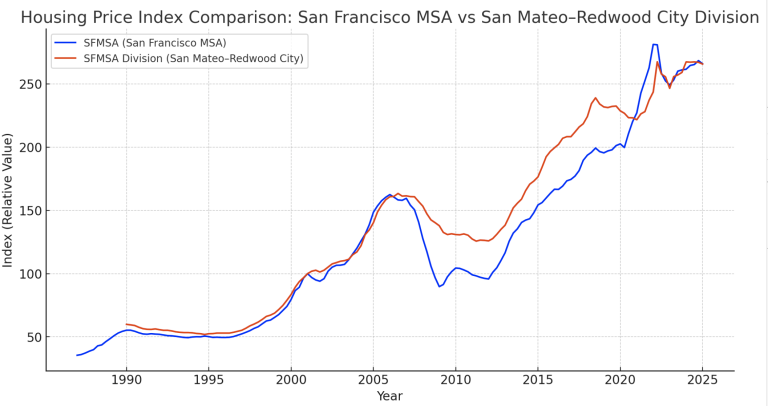
Which Pays More? Comparing San Francisco MSA and San Mateo–Redwood City Housing Returns

SFMSA va MSAD

Bay Area Housing Showdown: San Francisco Metro vs. the Peninsula

Until recently, the famous Case-Shiller housing reports lumped the entire Bay Area into the San Francisco MSA—covering Alameda, San Francisco, Marin, San Mateo, and Contra Costa. That broad view smoothed out some of the ups and downs, but it also mixed fast-growing markets with slower ones.

As the population pushed past 2.5 million, analysts carved out a new sub-market: the San Mateo–Redwood City Division, which focuses more on the Peninsula. While this still includes some underperformers (like Daly City and South San Francisco), it’s a welcome step toward highlighting mid-Peninsula dynamics.

So how do the two compare?
If you had invested in 1990, the San Francisco MSA would have returned about 8% more than the Peninsula division. But here’s the twist—those extra gains came with more volatility. The Peninsula, while slightly behind in raw returns, offered a smoother ride.

Growth Since 1990

  • San Francisco MSA (metro-wide)
    • Total Growth: +381%
    • CAGR: ~4.6% annually
  • San Mateo–Redwood City Division
    • Total Growth: +344%
    • CAGR: ~4.3% annually

🔑 Insight: The metro-wide San Francisco market slightly outperformed the Peninsula Division in both cumulative growth and annualized return.

SFMSA vs MSAD

📊 Volatility & Cycles

  • San Francisco MSA
    • Bigger swings during the dot-com bust (2000–2002) and 2008 housing crash.
    • More dramatic rebounds in the tech booms (2012–2022).
    • Essentially more “leveraged to tech cycles.”
  • San Mateo–Redwood City Division
    • Tracks very closely but with slightly milder peaks and troughs.
    • The Peninsula benefits from strong fundamentals (jobs, income, schools) but didn’t surge quite as aggressively in the big runups.

🏆 Which is the Better Investment?

  • San Francisco MSA (metro-wide):
    Better for maximum long-term appreciation, but you need tolerance for volatility.
  • San Mateo–Redwood City Division:
    Slightly lower growth, but steadier and less extreme in downturns. Likely better if you prioritize stability and resilience over maximum upside.

👉 In short:

  • Metro (SFMSA) = higher growth, higher volatility.
  • Peninsula (Division) = steadier, still strong, but slightly less aggressive growth.

Here’s the investment scenario analysis (1990  2025) for a $500,000 purchase in each market:

  • San Francisco MSA (metro-wide):
    $500,000 
     ~$2.40 million
  • San Mateo–Redwood City Division (Peninsula):
    $500,000 
     ~$2.22 million

📊 Our Interpretation

  • Both markets delivered excellent long-term gains.
  • The metro-wide San Francisco market outperformed by about $186,000 over 35 years.
  • The Peninsula provided nearly the same wealth-building power but with slightly smoother cycles.

👉 In other words, investing in the SF metro as a whole yielded ~8% more wealth by 2025, but the Peninsula may have offered a calmer ride with fewer sharp downturns.

* Note that The MSAD is also a part of the larger MSA data−So in effect the Peninsula market helped the numbers in the San Francisco MSA market.

Drew and Christine Morgan are experienced REALTORS and NOTARY PUBLIC located in Belmont, CA, where they own and operate MORGANHOMES, Inc. They have assisted buyers and sellers in their community for over 30 years. Drew and Christine have received the coveted Diamond award and ranked among the top 50 agents nationwide and the top 3 in Northern California by RE/MAX. To contact them, please call (650) 508.1441 or emailinfo@morganhomes.com.

For all you need to know about Belmont, subscribe to this blog right here. You can also follow us on Facebook and on Twitter.

This article provides educational information and is intended for informational purposes only. It should not be considered real estate, tax, insurance, or legal advice; it cannot replace advice tailored to your situation. It’s always best to seek guidance from a professional familiar with your scenario.

BROKER | MANAGER | NOTARY
Suppressing Consumer Confidence–It’s all in the headlines

There you go again…Int4

That line was made famous by Ronald Reagan when he was running for office against President Jimmy Carter in 1980. It was used by then Mr. Reagan as a way to diffuse opponents who harped upon the same issues over and over.

Well the media is at it again. The media loves its headlines and of course they need to sell papers so it’s not put past them to choose a sensational attention grabbing headline and find data to support it.

Take the August 19, 2010 report on home sales in the Bay Area. The headline in the San Jose Mercury read “Peninsula home sales plunge in July”. Define plunge?

They reported, “After steadily rising for several months, Peninsula home sales plummeted to near-historic lows in July as demand remained tepid and the federal homebuyer tax credits that had helped caffeinate the marketplace in the past year finally went away".

When were these “near historic lows”? How near and how low were they?

Clearly the article is saying sales are down, and they are, but they fail the test of balanced journalism when they neglect to add the caveat “as expected”.

The accuracy of their article is subject to scrutiny as well. I reviewed our own analysis which we do every month since I didn’t recall being impressed by the large discrepancy in year-over-year sales mentioned in their article.

Our data is mined from the Multiple Listing Service. It doesn't contain all home sales—just ones which were listed with real estate agents. The percentage of homes which transfer ownership without the involvement of a real estate professional remains consistently a small percentage of all the homes which transfer—consistent being the operative word since the delta from one month to another is negligible.

Our statistics showed 385 single family homes closed escrow in July 2010, down from 393 in July 2009. According to our data the number of fewer sales this July compared to last were just eight, or 2%.

The San Jose Mercury claimed it was the lowest month for home sales in 20 years. But how many fewer homes sold? They don’t say. They also don’t mention that Dataquick, the source cited in their article as the resource for their reporting, issued a statement on August 19th, 2010 (the date cited as being used by the San Jose Mercury) saying that they only estimated the sales for San Mateo County:

“San Diego-based MDA DataQuick is a division of MDA Lending Solutions, a subsidiary of Vancouver-based MacDonald Dettwiler and Associates. MDA DataQuick monitors real estate activity nationwide and provides information to consumers, educational institutions, public agencies, lending institutions, title companies and industry analysts. Because of late data availability, sales were estimated in Alameda and San Mateo counties.”

But more to the point, industry experts predicted that home sales would drop after the expiration of the housing stimulus tax credit on May 1, 2010. Last year—the year used for comparing sales—the tax credit was still available in July.  One only has to go back to 2007 to see sales as low as they were this July, not 20 years.

In Santa Clara county they report: “1,159 single-family resale homes that closed escrow represented a drop of 24.3 percent from the 1,531 sold a year earlier, making this the second-slowest July since 1990, according to figures released Thursday by the real estate information service MDA DataQuick.

I didn’t bother to verify any of this information. But let’s assume it’s more accurate than what they reported about San Mateo County. Sales haven’t been this low since…1990. Why does that date ring a bell? It’s the date of the last housing downturn. So what their report tells us is home sales drop when the housing market drops, and sales have not started to pick up yet, because they no doubt will someday.

But what the report does is continue to fan the flames of consumer skepticism. Unless and until the housing market recovers, the rest of the country will suffer. Responsible reporting might help us get back on track sooner rather than later. We expect the facts—the news—good or bad. Just don’t skew what you choose to report to further your own agenda.

Sale SMC