
Belmont Home Value’s Increase—Is There No End in Sight?

Before we head into the winter slow season for home sales, we’ll take a quick look back at Q3 home sales for Belmont, and the larger San Mateo County.

BELMONT & SAN MATEO COUNTY

HOME SALES—

Belmont had 78 new listings in Q3 as compared to 64 last year during the same period, and increase of 18%.

San Mateo County’s inventory of new listings dropped 6% YOY

INVENTORY/SALES—

Ironically, even with more new listings the inventory dropped 21% YOY. Why? Because sales increased 17% eliminating housing inventory.

SMC’S overall inventory also dropped—31% YOY, and sales dropped by 3.4%

DAYS ON MARKET (DOM) —

The time it took to sell a home in Belmont, on average, dropped from 16 days to 14

SMC Days on market dropped from 27 to 23

MEDIAN HOME PRICE

The median home price increased 12.7% YOY for Q3 for closed homes. When we compared the size of the homes selling in the two periods, there was statistically no difference, at 1784 ft² in 2016 and 1,748 ft² in 2017—so we made no adjustment for square footage interfering with the median home price swing. Note that Belmont it an all-time median home price point this October 2017.

San Mateo COUNTY’S MEDIAN HOME PRICE ROSE 9.5% YOY IN Q3

PERCENT RECEIVED

Belmont home seller’s eked out 4.4% more for their homes over their list price than last year during the same period.

In San Mateo County that number went up to 3.7% of asking

WRAP-UP

In every category in regards to home sale activity, Belmont outperformed and outpaced San Mateo County leading speculation that the peak for Belmont home values have not yet been reached.

Drew & Christine Morgan are REALTORS/NOTARY PUBLIC in Belmont, CA. with more than 20 years of experience in helping sellers and buyers in their community. As Diamond recipients, Drew and Christine are ranked in the top 50 RE/MAX agents nationwide and the top 3 in Northern California.  They may be reached at (650) 508.1441 or emailed at info@morganhomes.com.

For all you need to know about Belmont, subscribe to this blog right here. You can also follow us on Facebook at https://www.facebook.com/Morganhomes and on Twitter @ https://twitter.com/morganhomes

The information contained in this article is educational and intended for informational purposes only. It does not constitute real estate, tax or legal advice, nor does it substitute for advice specific to your situation. Always consult an appropriate professional familiar with your scenario


Waterdog Tavern in Belmont-What’s in a Name?

Waterdog Tavern

We were delighted as were many Belmont residents with the opening of a new restaurant, Waterdog Tavern in the Carlmont Village Shopping Centre last year. This past Spring, they opened the spacious outdoor area for sociable dining in a “dog friendly” environment, and we now visit frequently with our dog, Wyatt.

If you see us outside with this friendly little guy, stop by to say hello!

One of the questions we often hear: Where did they get the name Waterdog Tavern?

Since Belmont is our home, and we’re quite familiar about our local history, we knew at once where they got the clever name. We asked the owners, Toby and Anne, who often get asked the same question, to weigh in for our readers about the backstory of why they picked the name they did. Enjoy!

Toby McMillan (Owner):

Our family moved to Belmont from Sacramento in 2006. Not long afterwards Anne & I were strolling through Carlmont Village for the first time, when we came upon the outdoor area where the old Carlmont Nursery used to display their huge selection of Japanese Maples. We both remarked how beautiful the space was, and hoped that someday the adjacent restaurant (Hola!) might make arrangements to serve food & beer in the outdoor space – a few picnic tables would be great. I remarked, not very seriously at the time, that if it were ever possible to get both of those spaces, we should jump on the chance.

Fast forward to the Fall of 2015. After seriously searching for a couple of years for the right space to open a new restaurant that had outdoor seating and great parking, Carlmont Nursery and Hola! decided to close their doors within a month of each other. We pinched ourselves that two spaces had become available simultaneously and set out to create a casual, comfortable, warm, inviting restaurant, where the community and those traveling by The Village could gather to enjoy great food & drinks – The Tavern concept was born. Now…what to name it?

We had come up with different names for other concepts, but they were all location specific and would not work with what we had planned for this restaurant. As Belmont residents, we wanted the name to reflect the surroundings and the casualness of the concept. One day I was talking to a friend, and they mentioned they had taken their dog for a walk at Waterdog Lake, and a light bulb went on: Waterdog Tavern! Waterdog Lake is not only a long time Belmont landmark, but is known by folks up & down the Peninsula. To add to that, we had already begun tossing around the idea of making the Beer Garden dog friendly, and with so many local residents walking their dogs at Waterdog Lake on a regular basis it seemed a perfect fit.

Now with that being said, we are aware that the name of Waterdog Lake has nothing to do with dogs, but was coined because the lake (officially named Notre Dame Lake) used to teem with salamanders, and ‘waterdog’ is a salamander nickname. Anne has fond childhood memories of spotting waterdogs in her Grandma’s fountain in Belmont. Having made the decision to make the Beer Garden dog-friendly, we came up with our ‘Shaking Dog’ logo as a bit of a play on words. A recognition of all of the waterdogs that we all know and love, including our Australian Shepard, Buddy… We mean no disrespect to salamanders and have enjoyed sharing our story with guests!


Belmont Home Price Increases Slow to a Crawl

In each of our Newsletters we bring you the recent Belmont home sales for the previous month. This time we thought we’d stack up the months of August to the same time last year, so the variance from the previous year is obvious.

The first thing that jumps out at us is that there were 33% fewer sales overall.  If we take out the one off-market sale in 2016, the time it took for the homes to sell really didn’t change. Homes are still selling briskly at about 10-14 days on the market—which really is more dependent upon which day the seller elects to hear offers.

There were two homes which underwent a price reduction before selling, and one home that sold for under the seller’s asking price in 2017, and none in 2016. Still, the amount the seller’s received stayed at around 108% of the seller’s asking price.

Since the size of homes which sold in both years was statistically unchanged, the median price difference YOY is very reliable. It shows that homes in Belmont rose on average almost 10% YOY with the median home price rising a modest 5.13 %. Are we near the top of the market? These almost nominal increases would suggest so, though to a buyer, in real dollars, the medium price home in Belmont just went up $75,000.

[CLICK ON THE IMAGE FOR A FULL SIZE RENDERING]


Drew & Christine Morgan are REALTORS/NOTARY PUBLIC in Belmont, CA. with more than 20 years of experience in helping sellers and buyers in their community. As Diamond recipients, Drew and Christine are ranked in the top 50 RE/MAX agents nationwide and the top 3 in Northern California.  They may be reached at (650) 508.1441 or emailed at info@morganhomes.com.

For all you need to know about Belmont, subscribe to this blog right here. You can also follow us on Facebook at https://www.facebook.com/Morganhomes and on Twitter @ https://twitter.com/morganhomes

The information contained in this article is educational and intended for informational purposes only. It does not constitute real estate, tax or legal advice, nor does it substitute for advice specific to your situation. Always consult an appropriate professional familiar with your scenario.

Bay Area Home Values Eclipse Historical Records

Case Shiller Report for June 2017

The Case-Shiller Report was released June 27th, the last Tuesday of the month, which tracks home sales in 20 metropolitan cities around the country, called MSA’s, of Metropolitan Statistical Areas.

Our MSA (Metropolitan Statistical Area) in the Bay Area consist of five counties—Marin, San Francisco, San Mateo, Alameda and Contra Costsa. It’s important to note that while home values might be headed upward at a dramatic pace in the counties of San Francisco and San Mateo, they might be lagging in Alameda and Contra Costa, thus diluting the upward trend in one county vs. the whole MSA. This has been the case in our area since the housing recovery began in earnest in 2012.

The same goes for the 20 city composite index, which takes 20 metropolitan cities in the country and tracks them as an average trend.

While the 10 and 20 city composite indices shows that the housing market has not yet eclipsed the all-time high recorded around March of 2006, in the Bay Area, we have.

This graph which we built utilized the data from Case-Shiller for our SFMSA and illustrates that we have reached a new all-time high for home values. However, it’s important to note that the delta between the trend line and the peak where we are today, illustrating where the straight-line home values should be, is far less than in the peak of 2006, where we see a much great deviance off the trend line values. In fact, the peak of 2006 was 58% higher above the trend line than it is today.

One might infer from this that we are not as overvalued as it might appear at first glance.

This give some credence to the synopsis for the Standard and Poor’s Case-Schiller analysis and discussion.

Case-Shiller Analysis by Standard & Poor’s— ANALYSIS

Great View of San Francisco

“As home prices continue rising faster than inflation, two questions are being asked: why? And, could this be a bubble?” says David M. Blitzer Managing Director and Chairman of the Index Committee at S&P Dow Jones Indices. “Since demand is exceeding supply and financing is available, there is nothing right now to keep prices from going up. The increase in real, or inflation-adjusted, home prices in the last three years shows that demand is rising. At the same time, the supply of homes for sale has barely kept pace with demand and the inventory of new or existing homes for sale shrunk down to only a four- month supply. Adding to price pressures, mortgage rates remain close to 4% and affordability is not a significant issue.

“The question is not if home prices can climb without any limit; they can’t. Rather, will home price gains gently slow or will they crash and take the economy down with them? For the moment, conditions appear favorable for avoiding a crash. Housing starts are trending higher and rising prices may encourage some homeowners to sell. Moreover, mortgage default rates are low and household debt levels are manageable. Total mortgage debt outstanding is $14.4 trillion, about $400 billion below the record set in 2008. Any increase in mortgage interest rates would dampen demand. Household finances should be able to weather a fairly large price drop.”

Drew & Christine Morgan are REALTORS/NOTARY PUBLIC in Belmont, CA. with more than 20 years of experience in helping sellers and buyers in their community. As Diamond recipients, Drew and Christine are ranked in the top 50 RE/MAX agents nationwide and the top 3 in Northern California.  They may be reached at (650) 508.1441 or emailed at info@morganhomes.com.

For all you need to know about Belmont, subscribe to this blog right here. You can also follow us on Facebook at https://www.facebook.com/Morganhomes and on Twitter @ https://twitter.com/morganhomes

The information contained in this article is educational and intended for informational purposes only. It does not constitute real estate, tax or legal advice, nor does it substitute for advice specific to your situation. Always consult an appropriate professional familiar with your scenario


Will There Be an End to Home Bidding Wars?

With unusually low home inventory levels, many buyers are feeling frustrated and overwhelmed at the prospect of ever getting their ideal home, or have first-hand experience at losing the home of their dreams in a bidding frenzy.

Yet not all homes sell for over their asking price. In fact many sell below. Granted, they may seem far and few between, but they are out there. In fact, so far in 2017, 25% of San Mateo County home sales sold for less than what the sellers were asking. Many wouldn’t think that’s true, and we’d be willing to bet that if asked, many would say that it’s a lot less, like 1%, but they’d be wrong. Perception is not always reality. The media’s constant coverage of how “crazy” the housing market is, has been drummed into the minds of buyers—and sellers. And the homes that people see closing well above the asking price, only serve to validate the overall impression that the market is overzealous. And that emboldens people’s impressions, but it’s more of an emotional response, than one of accuracy. It is however, what people talk about and what they remember.

We sold a home just last month at 534 Wellington Avenue to a buyer of ours. The sellers expected six offers and received none. We stepped in and delivered a full price offer and it was accepted. It’s the second lowest 3 bedroom sale in San Carlos on the west side this year.

One way to get a good deal is to focus on homes which have been initially overpriced. Any home which is still on the market after 14 days is probably one that will need a price reduction, or may be willing to take a lower offer. These are opportunities that buyers may want to focus on if the multiple bids are giving rise to second thoughts about buying a home.

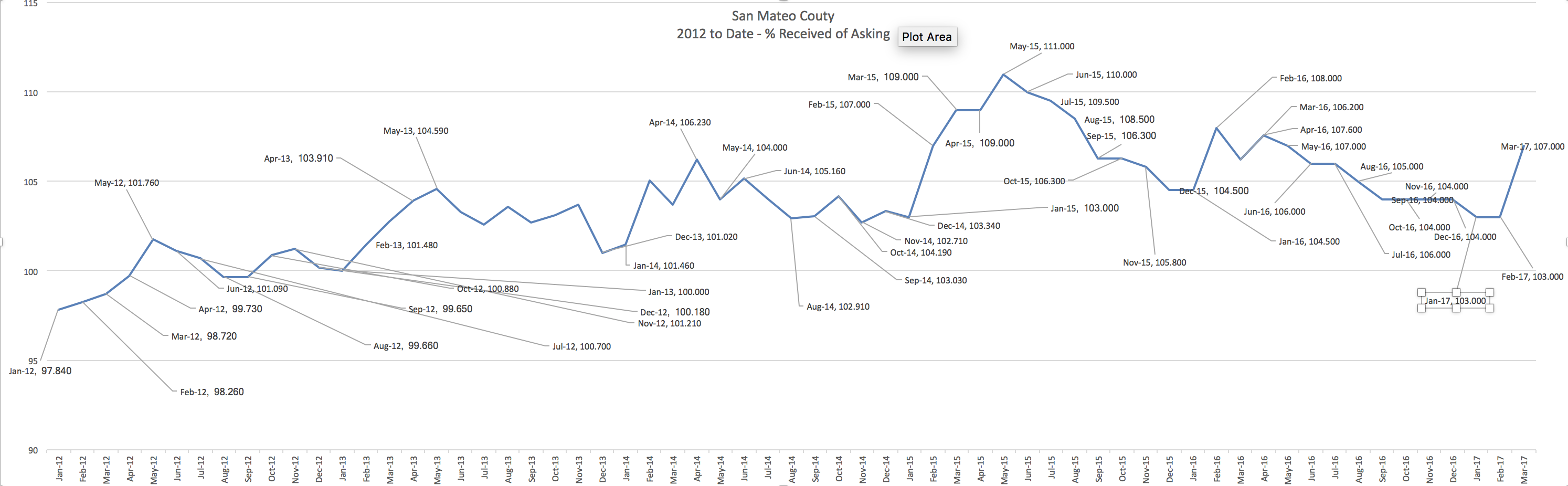
As for timing the market, there are times of the year that homes get more attention and more multiple offers. We just went through that period—February, March, April and now May. A lot of “why” homes sell with more offers and at a higher percentage of the sellers asking price has to do with several factors.

[Click on the graph below for a larger image]


As the new year begins, buyers and sellers are slow to come out of their market hibernation, but buyers seem to thaw out first. Many buyers have just received their end-of-year bonus, which they had been waiting for to jump into the housing market.

Some buyers with children are desperately trying to get a home in order to get their kids registered into a new school before the vacancies fill up—most first enrollment periods end within the first month or two of the start of the school year.

Another influence is that buyers who had lost out on homes in the prior year now focus more than ever on not losing out again, and they bid more aggressively than other buyers who may be just dipping their toes into the waters. And by June, these more aggressive buyers have all won—they have their home and the buyers that are left are the less aggressive buyers and overbids begin to wane. This typically happens around June, as this graph above of San Mateo County home sales since the turnaround in 2012 illustrates. It’s important to note however, that while the percentage a seller receives, and the number of overbids may be fewer, that doesn’t mean that prices decline. A high home price bar has already been established in the spring and it typically carries through until the end of the year. [Note: These statistics typically lag the market by a month—the typical escrow period. So a high sale percentage in May, was likely consummated in April].

Then of course there’s the competitive spirit. Buyers want what other buyers want and often a bidding frenzy ensues, pushing prices perhaps higher than they otherwise would be. It’s important to note that the aggressive buyer gets the home—the buyer that was willing to pay more than any other buyer at that moment in time. Did they overpay? Perhaps. But now they are a comparable sale for the next home, which invariably will sell for more, and so on and so forth until at the end of the year we have “appreciation”.

Drew & Christine Morgan are REALTORS/NOTARY PUBLIC in Belmont, CA. with more than 20 years of experience in helping sellers and buyers in their community. As Diamond recipients, Drew and Christine are ranked in the top 50 RE/MAX agents nationwide and 3rd in Northern California. They may be reached at (650) 508.1441 or emailed at info@morganhomes.com.

For all you need to know about Belmont, subscribe to this blog right here. You can also follow us on Facebook at https://www.facebook.com/Morganhomesand on Twitter @ https://twitter.com/morganhomes

The information contained in this article is educational and intended for informational purposes only. It does not constitute real estate, tax or legal advice, nor does it substitute for advice specific to your situation. Always consult an appropriate professional familiar with your scenario.


Why a Buyer Representaion Agreement Could Help You

How to decide if committing to one real estate agent is important, or should you “play the field”. We wanted to take a moment to explain a bit more about the Buyer Represention agreement, why we use one, and why it is important to you as well.

Most agents will attempt to work with 20-30 prospective buyers at a time in the hope that one will purchase a home through them—that’s an outdated model. We take a more focused approach. We work with no more than two buyers at a time in order to provide a heightened level of service. We’re not here to just set you up on an automated email list for homes—you can do that on your own. We set ourselves apart by taking proactive steps in finding you the ideal home. We meet and discuss each week to find new off market opportunities for our clients. And if you’re a client, we can even door knock and direct mail to targeted neighborhoods to find you a motivated seller.

Networking to uncover off-market opportunities is our main focus during your home search. With the advanced search engines available on the internet, everyone has access to the public
inventory. We try and uncover homes to which otherwise you would not have access.

Initially, we like to tour several homes in various areas with our clients to understand their wants and needs first-hand. This is a valuable aspect of the process, since we use this information when we go to work locating properties which are good fit for our clients.

But even focusing on working with just two buyers, it’s impossible for us to be showing homes every weekend to our clients (we also work Monday through Friday trying to find off-market properties and previewing homes).

This is why open houses are a great way for you to visit homes at your leisure. If you zero in a perspective home, that’s when we make an appointment to show you the home in private and uninterrupted. We employ our many years of visiting and following inspectors around properties to help put the deficiencies in the inspection reports into perspective.  We’ll tell you if we wouldn’t buy a particular home, and we can do that because we’re confident that at some point, we will find you the ideal home.

Would you want your agent to pressure you into buying a home, out of fear they may lose you to another agent? Or rest assured knowing that your best interest is always first and foremost.

This is just one of the important reasons that as a buyer, you should want to have an agreement in place.

Another reason to work with an agreement, is to distinguish yourself from a customer and become a client. And the difference is whether or not you are committed to the relationship with an agreement. A “Customer” does not enjoy the same legal protections that are afforded a “Client”. Many agents will work strictly with customers, because they are desperate to land a sale. The last thing you should want is a desperate agent trying to find you a home.

And then there’s the practicality of with whom we decide to work. As a client, you are privy to our “Pocket” of off-market listing. These are of course reserved for those with whom we have a relationship of mutual respect and trusMutal Agreementt.

The agreement also protects us against the threat of “procuring cause”. You see, when you walk into an open house, that agent could lay claim to you as the procuring cause of locating the home, and we may be excluded from representing you. These cases of procuring cause actions typically involve a hearing or even a lawsuit to unravel. But the issue you will encounter is that you will no longer have your own representation. In this situation, if you want to buy that home, you may be forced to work with the seller’s agent. When this occurs, Dual Agency representation exists and the agent can no longer advise you on how to proceed with an offer, but rather becomes an “order taker”—we’re willing to bet that’s not the kind of assistance you want when purchasing perhaps your largest investment ever.

Lastly, imagine your own employment situation. Would you go to work everyday wondering if you’ll ever be fairly compensated for your work? We assume enough risk as it is, as many buyers change their minds and never purchase a home.

We hope that this will shed some clarity on why a written working understanding is important to a mutually respective relationship.

Drew & Christine Morgan are REALTORS/NOTARY PUBLIC in Belmont, CA. with more than 3

Drew and Christine Morgan are experienced REALTORS and NOTARY PUBLIC located in Belmont, CA. They have been assisting buyers and sellers in their community for over 30 years. Drew and Christine have received the coveted Diamond award and ranked among the top 50 agents nationwide and top 3 in Northern California by RE/MAX. To contact them, please call (650) 508.1441 or email info@morganhomes.com.

For all you need to know about Belmont, subscribe to this blog right here. You can also follow us on Facebook and on Twitter.

This article provides educational information and is intended for informational purposes only. It should not be considered as real estate, tax, insurance, or legal advice, and it cannot replace advice tailored to your specific situation. It’s always best to seek guidance from a professional who is familiar with your scenario.

0 years of experience in helping sellers and buyers in their community. As Diamond recipients, Drew and Christine are ranked in the top 50 RE/MAX agents nationwide. They may be reached at (650) 508.1441 or emailed at info@morganhomes.com.

For all you need to know about Belmont, subscribe to this blog right here. You can also follow us on Facebook at https://www.facebook.com/Morganhomesand on Twitter @ https://twitter.com/morganhomes

The information contained in this article is educational and intended for informational purposes only. It does not constitute real estate, tax or legal advice, nor does it substitute for advice specific to your situation. Always consult an appropriate professional familiar with your scenario.


Housing May Be Approaching Equilibrium

A lot transpires at the end of the year. There are resolutions for the new year, and reflection upon the year just passed. There’s wrapping up the holiday decorations and reflecting upon the celebratory memories.

And then there’s wrapping up the year-end business for us. Surveying what happened in our local housing market and taking a stab at the “Why”?

We posted an article for our blog in December which we authored and was originally printed in the Examiner. It was aptly titled, “Shifting Market in Play”. In it, we discussed the subtle but noticeable shift in our housing market towards a market approaching equilibrium—that being a market wherein the demand is nearing the supply. That’s a good thing, as a more normal market is a more sustainable market.

It’s not simply that demand for housing is waning, but rather demand at the newly established price point is down. In other words, fewer people can afford the median price home which has had a dampening effect on home sales.

Affordability is affected by three major factors: median house price, mortgage interest rates, and household income. Mortgage rates are still below historical averages, and household income is on the rise. So, what is keeping housing affordability down are home prices—which are ironically artificially inflated due to the first two factors, low interest rates and high income.

Comparing the year-end numbers for Belmont, we see that listings were up but sales were down. The time it took to sell a home was higher, but the price the sellers received and the percent of the seller’s asking price were lower.

2016-2017 YOY Data


The median price appears to have taken a hit too, but upon further examination, one can see that while the median price was down 1.5%, the median size home that sold last year was down even more, at 3.4%.

When the housing market dropped in 2007, home values bounced along at the bottom for several years before climbing again. This is typically true at the peak as well. Are we there? We could be. Data from Q1 & Q2 will give us a more clear picture.

Drew & Christine Morgan are REALTORS/NOTARY PUBLIC in Belmont, CA. with more than 25 years of experience in helping sellers and buyers in their community. They may be reached at (650) 508.1441 or emailed at info@morganhomes.com.

For all you need to know about Belmont, subscribe to this blog right here. You can also follow us on Facebook at https://www.facebook.com/Morganhomesand on Twitter @ https://twitter.com/morganhomes

The information contained in this article is educational and intended for informational purposes only. It does not constitute real estate, tax or legal advice, nor does it substitute for advice specific to your situation. Always consult an appropriate professional familiar with your scenario.


Shifting Market in Play

NOTE: Shifting Market in Play is an article we did for the Examiner in December, when asked to comment on 2016—A Year in Review: This is a link to the original article.

In order to understand our current housing market, one must appreciate that markets are constantly in flux. In our town of Belmont, we looked at home sales and compared the periods from January thru November for years 2015 and 2016.

Let’s first discuss the market conditions. There’s a lot of hyperbole as to the state of our current housing market. Sellers are still in the mindset that they hold all of the cards, yet buyers are beginning to push back on prices. Sellers are receiving fewer offers, many have had to lower their asking prices, and homes are often times closing below the asking price—something that rarely happened from 2012-2015. This suggests a shifting market.

Clearly, the sky is not falling, the shift is towards a more normal market, where homes sit on the market longer, and may sell above, at, or below the seller’s asking price. This long awaited market shift is not a correction, but rather a predictable and healthy move towards a more balanced and sustainable market. To be blunt, prices have risen to a level at which the majority of buyers can no longer afford the median priced home, resulting in a cooling down effect on the housing market.

We first examined all of the home sales in Belmont that occurred in 2015 through November in order to compare those with the same period of home sales in 2016. We added no search filter other than the date range, since the larger the pool of sales, the more reliable the data.

2015 2016 % ∆
Sales 178 181 1.7%
Median Home Price $1,516,500 $1,389,000 -8.4%
Home ft² 1850 1760 -4.9%
$/ft² 830 856 3.1%
DOM (Days on market) 12 11 -8.3%
% Received 114.5 107.2 -6.4%
Price Reductions 9 19 111.1%
For How Much $120,638 $118,477 -1.8%
Sold Over Asking 156 149 -4.5%
Sold At Asking 6 10 66.7%
Sold Under Asking 16 22 37.5%


It’s clear that a market shift has occurred. Note that the median home price reflects a significant decrease year over year (YOY), and part of that is simply because smaller homes sold in 2016 skewing the numbers. But in almost every category there’s a distinct shift towards a more normal market. There were fewer homes selling for more than the asking price and the ones that did sell over asking sold for 33% less over asking than in 2015. There were more cancelled listings, and more price reductions for greater amounts. The inventory of homes for sale is growing—up from 0.3 to 0.7 months of inventory (still considered seller’s territory).

On a more macro-level, when we look at the San Francisco Metropolitan Statistical Area (SFMSA) as produced by Case-Shiller for Standard and Poor’s, which encompasses the counties of Marin, Alameda, Contra Costa, San Francisco and San Mateo, one can see that while the YOY increase in their index was a rise of almost 15%, there was only a nominal 0.5% increase in home values since April.

How long will the new normal market continue? We’ll save that wild card question for other talking heads. Nobody really knows of course, and anybody that professes to know should give you cause for concern. However, the market appears to have hit a price threshold. As fewer buyers can qualify for the median priced home, more sellers will be getting less windfall profits like they did during the meteoric rise over the last three years.

Drew & Christine Morgan are REALTORS/NOTARY PUBLIC in Belmont, CA with RE/MAX Star Propeties. with more than 20 years of experience in helping sellers and buyers in their community. They may be reached at (650) 508.1441 or emailed at info@morganhomes.com.

For all you need to know about Belmont, subscribe to this blog right here. You can also follow us on Facebook at https://www.facebook.com/Morganhomes and on Twitter @ https://twitter.com/morganhomes

The information contained in this article is educational and intended for informational purposes only. It does not constitute real estate, tax or legal advice, nor does it substitute for advice specific to your situation. Always consult an appropriate professional familiar with your scenario.

Local Housing Market Shows Signs of Change

BELMONT (AND BAY AREA) MARKET SHIFT

In order to know what changed in our housing market, one must understand that markets are constantly in flux, it’s just hard to see when you are in the middle of one—sort of like being in the eye of a hurricane. We looked at home sales in Belmont and compared the periods from January to September for 2015 and 2016. We’re always asked what’s going on in our market and we like to be armed with facts.

Most people want to know if the housing market is in the seller’s or buyer’s favor-if prices are going up, steady, or dropping. Buyers want to know as they are trying to decide if they should wait and see what happens with the market, or just move forward with life’s plans.

Anecdotally, many agents will tell you their opinion based upon their personal observations. If they had a hard time selling their last home they might tell you the market is “changing” and if their last listing flew off the shelf they might proclaim the housing market to be as robust as ever. But whatever people feel, the numbers don’t lie. They are an unemotional representation of what is occurring in a given market.

Let’s first discuss the market conditions. There’s a lot of hyperbole as to the state of our current housing market. Sellers are still in the mindset that they hold all of the cards, yet buyers are beginning to push back on prices. Sellers are receiving fewer offers, many have had to lower their asking prices, and homes are often times closing below the asking price—something that rarely happened from 2012-2015. This would suggest a shifting market.

Clearly, the sky is not falling, the shift is towards a more normal market, where homes sit on the market longer, and may sell above, at, or below the seller’s asking price. This long awaited market shift is not a correction, but rather a predictable and healthy move towards a more balanced and sustainable market. To be blunt, prices have risen to a level that the majority of buyers can no longer afford.

We first examined all of the home sales in Belmont that occurred in 2015 through August 31st in order to compare with the same period in 2016. We added no search filter other than the date range, since the larger the pool of sales, the more reliable the data.

Here are the data:belmont-analysuis-for-10-2016

We added an arrow to represent if the numbers went up or down as compared to 2015, and then rated with a “Thumb’s Up” icon for those parameters that showed little change or improved a bit over 2015.

Note that while the raw median home price dropped in 2016, you can see at the very bottom of this inset that we made an adjustment, since smaller homes sold in 2016 of the two periods we examined. So for example, although the size of homes which sold were 4.8% smaller in 2016, they only sold for 1.2% less. Could that be interpreted that the median price actually rose 3.6%? Our numerical calculation based upon price per square foot comes up with 1.5%. In either case, it’s a modest increase year over year at best.

On a macro-level, when we look at the San Francisco Metropolitan Statistical Area (SFMSA) as produced by Case-Shiller for Standard and Poor’s, which encompasses the counties of Marin, Alameda, Contra Costa, San Francisco and San Mateo, one can see that there was a nominal 1% increase in home values between May and June alone. This lends more credence to our theory that home values are initially topping out in higher priced areas like the Mid- Peninsula.

It’s clear that a market shift has occurred. While the median home price reflects a marginal change year over year (YOY), in almost every category there’s a distinct shift towards a more normal market. There were fewer homes selling for more than the asking price and the ones that did sell over asking sold for 30% less than in 2015. There were more cancelled listings, and more price reductions for greater amounts. The inventory of homes for sale is growing—up from 0.3 to 0.7 months of inventory (still considered seller’s territory).

The month’s supply of inventory is the measure of how many months it would take for the current inventory of homes on the market to sell, given the current pace of home sales. For example, if there are 50 homes on the market and 10 homes selling each month, there is a 5-month supply of homes for sale. The months of supply are a good indicator of whether a particular real estate market is favoring buyers or sellers. Typically, a market that favors sellers has less than 3 months of supply, while more than 6 months of supply indicates an excess of homes for sale that favors buyers.

Belmont still has less than one month of housing inventory but Foster City, also on the Mid-Peninsula, is currently running a housing inventory level of 3 months. What this means is that the market shift will no doubt continue until there’s a full blown correction. We could be years away from that happening, but we appear to be moving in that direction and we’re also moving into the slowest part of the season (winter), when seller’s typically net the least for their homes. In addition, if interest rates rise—and they should since they are at historic lows—that too will have a damping effect on home values in the near future.

How long will the new normal market continue? We’ll save that wild card question for other talking heads. Nobody really knows of course, and anybody that professes to know should scare you. However, the market appears to have hit a price threshold. As fewer and fewer buyers can qualify for the median priced home, more sellers will be getting less windfall profits like they did during the meteoric rise over the last three years.

Drew & Christine Morgan are REALTORS/NOTARY PUBLIC in Belmont, CA. with more than 20 years of experience in helping sellers and buyers in their community. They may be reached at (650) 508.1441.

The information contained in this article is educational and intended for informational purposes only. It does not constitute real estate, tax or legal advice, nor does it substitute for advice specific to your situation. Always consult an appropriate professional familiar with your scenario.

Days on the Market—What’s in a Statistic…

How long it takes when selling one’s home to get into contract is one of the most nerve racking periods during the home sale process—for sellers, but how long should it take to sell a home?gambling

Don’t gamble on the outcome. Our study shows that selling a home too fast or having it take too long can be detrimental. Not every case is the same, and not every market has the same perception, but on the Bay Area, specifically the mid-peninsula, statistically, there’s a sweet spot for selling a home quickly, and getting the most money at the same time.

One must understand how potential buyers view this statistic in order to evaluate why there’s a correlation.

When a home is being sold “off-market”, or off the MLS, buyers can have a difficult time ascertaining the intrinsic value. If a seller is asking “X”, potential buyers might think it’s worth the asking price—perhaps more, or less, who knows?

When that same homes goes “Live” to the entire community of house hunters and REALTORS®, if no offers materialize within the first 10 days—or on offer day—it’s a safe bet that the home is overpriced for the value offered, and will more likely than not eventually, sell for less—and savvy buyers know this.

If hordes of buyers line up right away to make offers, buyers looking on will feel confident that the home is priced well—or even too low. Conversely, if the home languishes on the market more than 14 days, and there’s scant interest, it’s a pretty good indication to buyers that the home may be priced too high—or worse that there’s something wrong with the home. In either of the latter cases, buyers will often sit back and wait to see what happens. They typically wonder when, and or if, the seller will lower the asking price.

This is when the tables shift and buyers are empowered to make offers at or below the seller’s asking price.

As a seller the last thing you want to do is overprice your home. Trying to alter a general opinion that there may be something wrong with your home puts a seller in a quandary, if not a perilous position.

Sellers can’t advertise that there’s “nothing wrong with their home”, since certainly every home has some inherent flaw. What they’d like to advertise is, “There’s no reason you shouldn’t be buying my home—it’s just as good as all of the others”. Except that, it’s probably overpriced.

What other factors can cause the days a home is on the market to creep up? In addition to the number one factor of overpricing a home, there’s accessibility and presentation.

Making your home hard to show can be hugely detrimental to getting the most buyers in to see your home. Making it “appointment only” or having it shown through your “agent only” will invariably limit the number of potential visits to your home.

When Real Estate agents set up a day to show their buyers homes, they know everyone’s time is limited. It does no good for them to show buyers so many homes that their buyers become overwhelmed, so agents will limit the showings to as many as they can comfortably fit in. If your home is hard to get into, they might save it for another day—or they might skip it altogether. Often a buyer will find a suitable home on their first outing.

Buyers are busy people. Often they are juggling jobs with long hours, pets and/or small children as they traipse around trying to find a suitable home. Having an open house where they can leisurely stop by on a weekend afternoon will benefit the accessibility of your home and increase the showings. Think how many mid-week dinner time appointments can be deferred by inviting buyers to a weekend open house.

Is one weekend enough? Many times it can be, but then you could be missing out on that one high bidder who was out of town on a business trip, or heavenly forbid, a weekend getaway from the stress of house hunting.  Imagine how frustrating it is for buyers who finally take a break for a one-week vacation only to learn that there dream home sold before they could return. And if you’re a seller, imagine potentially leaving that much money on the table.

Lastly, but certainly not least, is a home’s presentation. Not all sellers nor their agents present homes the same way. Some sellers despite their agents’ vehement admonitions will still cook a fried fish diner right before a critical showing. Real estate agents can also sabotage a seller’s likelihood of a sale by not realizing the importance of market saturation advertising—tapping onto the full potential of the internet with international and social marketing which includes the latest 3D virtual tours, video and of course Facebook and Twitter portals.

Our Next Post…Photographing Your Home—It’s Not Child’s Play. The photography of your homes is best left to professional. Too often we see homes presented with pictures taken from a cell phone.

_____________________________________________________________________________________

Drew & Christine Morgan are REALTORS/NOTARY PUBLIC in Belmont, CA. with more than 20 years of experience in helping sellers and buyers in their community. They may be reached at (650) 508.1441 or emailed at info@morganhomes.com.

For all you need to know about Belmont, subscribe to this blog right here. You can also follow us on Facebook at https://www.facebook.com/Morganhomes and on Twitter @ https://twitter.com/morganhomes

The information contained in this article is educational and intended for informational purposes only. It does not constitute real estate, tax or legal advice, nor does it substitute for advice specific to your situation. Always consult an appropriate professional familiar with your scenario.