

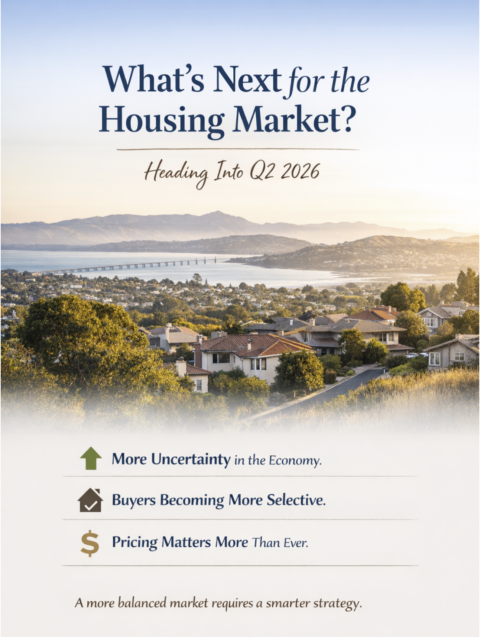
Thinking About Selling or Buying in this year? Here’s What We’re Seeing Locally

Bay Area Homes

As we move into the second quarter of 2026, we’ve been getting a lot of the same question:

The honest answer is—no one can predict it with certainty. But we can look at patterns, buyer behavior, and what we’re seeing on the ground to get a pretty good sense of where things are headed.


There’s a lot going on right now that’s influencing how people feel about making big decisions:

  • Interest rates have moved higher
  • The cost of goods and services continues to rise
  • There’s more global uncertainty than we’ve seen in a while
  • The job market is shifting
  • And consumer confidence, which had been improving, is starting to soften

Any one of these on its own doesn’t change the market much.
But when they all show up at once, people tend to take a step back.


In times like this, most buyers don’t panic—they pause.

Instead of rushing in, they take more of a “wait and see” approach:

  • They become more cautious
  • They look more closely at value
  • They’re less willing to stretch beyond their comfort zone

In other words, the most aggressive buyers start to step back first.


So what does that look like in real life?

You’ll likely see fewer bidding wars.
Instead of 10–15 offers, it may be more like:

  • 2–5 offers on strong homes
  • And sometimes just one solid, well-qualified buyer

At the same time, buyers become more selective.

Homes that are:

  • Well-priced
  • Move-in ready
  • In strong locations

…are still going to do well.

Homes with trade-offs—or pricing that feels a little too aggressive—may take longer to sell.

And overall, price growth tends to slow.
Not necessarily decline dramatically—but level off or adjust modestly.


There’s also another dynamic worth mentioning.

In uncertain times, some buyers actually lean into real estate.
They’re looking for:

  • Stability
  • Something tangible
  • A long-term place to land

But even these buyers tend to be more thoughtful.
They’re not the ones overpaying—they’re looking for value.


The Bay Area has always had some built-in support:

  • Limited housing supply
  • A strong base of high-income buyers
  • Long-term demand for homeownership

That doesn’t make it immune to change—but it does tend to prevent more dramatic swings.


If current trends continue, the most likely scenario is a more balanced, selective market.

  • Buyers are still there—but more cautious
  • Competition still happens—but not as consistently
  • And pricing becomes more important than ever

The margin for error just gets smaller.


For sellers, this doesn’t eliminate opportunity—it just changes the approach.

The homes that are performing best right now are the ones that:

  • Are priced strategically from the start
  • Show well and feel move-in ready
  • Line up with what buyers are expecting today

Where we’re seeing challenges is when homes:

  • Start too high
  • Rely on past peak comps
  • Or assume buyers will stretch the way they did before

That’s where momentum can get lost.


The housing market isn’t disappearing—it’s becoming more disciplined.

And in markets like this, the difference between an average result and a strong one usually comes down to:

strategy, positioning, and timing.

Frequently Asked Questions

Why are homes getting fewer offers?

Is the Bay Area housing market slowing down in 2026?

Are home prices expected to drop?

Is now a good time to sell in Belmont?

Drew and Christine Morgan are experienced REALTORS and NOTARY PUBLIC located in Belmont, CA, where they own and operate MORGANHOMES, Inc. They have assisted buyers and sellers in their community for over 30 years. Drew and Christine have received the coveted Diamond award, ranking among the top 50 agents nationwide and the top 3 in Northern California by RE/MAX. To contact them, please call (650) 508.1441 or emailinfo@morganhomes.com.

For all you need to know about Belmont, subscribe to this blog right here. You can also follow us on Facebook and on X.

This article provides educational information and is intended for informational purposes only. It should not be considered real estate, tax, insurance, or legal advice; it cannot replace advice tailored to your situation. It’s always best to seek guidance from a professional familiar with your scenario.

BROKER OWNER | MANAGER | NOTARY

Inherited a Home in California? Here’s How Proposition 19 Could Change the Property Taxes

Recently, we were contacted by two families who had inherited their parents’ homes after the passing of the surviving parent. Unfortunately, in both situations, they had not spoken with a real estate professional beforehand, and it appears their attorney may not have been fully up to date on the newer rules.

Both families intended to move into the homes they inherited. However, because certain steps required under California’s Proposition 19 were not completed in time, the properties were reassessed to the current market value for property tax purposes.

As a result, these families—who otherwise would have been able to move into their parents’ homes and retain a much lower tax base—are now facing significantly higher property taxes. In some cases, increases like this can be financially overwhelming, leaving heirs with the difficult choice of either paying the new, higher property tax or selling the property despite wishing to reside in the home.

We felt this was important enough to bring to people’s attention, as these rules can have a major impact on families inheriting property in California. Understanding the requirements ahead of time can help prevent costly surprises and ensure that the available benefits are preserved.

How Proposition 19 Affects Children Inheriting Their Parents’ Property

California’s Proposition 19 significantly changed how property taxes are handled when children inherit real estate from their parents.

For decades under Proposition 58, children could inherit property and keep the parent’s low property tax base—even if the home became a rental or second home. Proposition 19 narrowed those rules considerably.

The New Rules

If a child inherits a parent’s home, the property tax base can only be preserved if three conditions are met:

1. The home must become the child’s primary residence.
The child must move into the property and claim the Homeowners’ Exemption. If the home is kept as a rental, second home, or investment property, it will generally be reassessed to current market value.

2. The tax base transfer now has a limit.
The inherited property can keep the parent’s tax base only up to $1,000,000 above the parent’s assessed value. If the home’s market value exceeds that threshold, the amount above the limit is added to the property’s taxable value.

3. The claim must be filed within one year.
The heir must file the parent-child exclusion claim with the county assessor within one year of the transfer (usually the date of death). If this deadline is missed, the property may be reassessed to the current market value, which can significantly increase the property taxes.

➡︎ This is where many people make costly mistakes. Some heirs never file the claim at all, others miss the one-year deadline, and many confuse it with the two-year window that applies when homeowners transfer their own tax base to a replacement home (see that rule below), under Proposition 19. Understanding the difference is critical to preserving the lower property tax base.

Why This Matters

Many California homeowners purchased their homes decades ago, meaning their taxable value may be far below current market prices. Under Proposition 19, heirs must now decide whether to move into the property, sell it, or accept a potentially large increase in property taxes.

For families planning estates—or for heirs inheriting property—understanding these rules is critical to avoiding unexpected tax consequences.

✓ Carrying Your Property Tax Base to a New Home [Here’s an online calculator]

Another important provision of Proposition 19 allows certain homeowners to transfer their existing property tax base to a new home when they sell their current one.

Homeowners who are 55 or older, severely disabled, or victims of a natural disaster may transfer the taxable value of their current residence to a replacement home anywhere in California. This can significantly reduce property taxes when downsizing or relocating.

To qualify, the replacement home must be purchased or newly constructed within two years of selling the original property.

After purchasing the replacement property, the homeowner should file the Base Year Value Transfer Claim with the county assessor. While the claim can typically be filed up to three years after purchasing the replacement home, filing sooner ensures the tax benefit is applied from the beginning of ownership.

Understanding these timing rules can help homeowners preserve substantial property tax savings when moving to a new home.

Proposition 19 has introduced rules that many families are still learning about—often after the fact. As we’ve seen recently, missing a deadline or not understanding the requirements can lead to property tax increases that could have been avoided with a little planning.

If you or someone in your family may be inheriting a property, or if you are considering selling and transferring your tax base to another home, taking a few minutes to understand the rules ahead of time can make a meaningful difference. If we can ever be a resource to help clarify how these changes may affect you, we are always happy to help.

Other Articles:

About the Authors

Drew and Christine Morgan are the founders of MorganHomes, their independent brokerage based in Belmont. They also maintain a strategic affiliation with RE/MAX GOLD, combining the flexibility of an independent firm with the resources of one of the largest real estate networks.

As longtime Belmont residents and real estate professionals with more than 30 years of experience, they have helped generations of local families buy, sell, and make smart real estate decisions. Drew is also a Notary Public, providing additional convenience and support for clients when it matters most.

Their consistent performance has earned them RE/MAX’s prestigious Diamond Award, placing them among the top agents nationwide and among the top performers in Northern California.

If you have questions about the Belmont market or would like to discuss your situation, you can reach them at (650) 508-1441 or info@morganhomes.com.

For ongoing insights about Belmont real estate, local market trends, and community updates, you can subscribe to this blog or follow MorganHomes on Facebook and X.


Disclaimer

This article is provided for educational and informational purposes only. It is not intended as real estate, legal, tax, or insurance advice. Because every situation is unique, we recommend consulting with a qualified professional, like us, to understand your specific circumstances.