
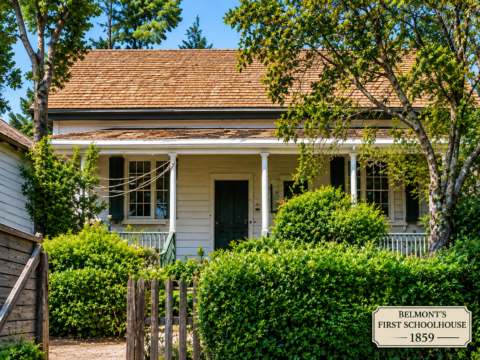
As Belmont approaches its 100th birthday on October 29, 2026, we continue our Centennial Series by looking back much further—to a time when Belmont wasn’t yet a city, and its first school consisted of a handful of children gathering in a local resident’s home.
Belmont’s First Classroom
By 1859, enough families were living in the small settlement of Belmont that educating their children had become a community priority.
That year, Augustus P. Molitor, a Belmont resident who operated a real estate business in San Francisco, offered his home for use as a temporary schoolhouse. It isn’t known whether classes were actually held there in 1859, but by 1860, seventeen children were attending school in the Molitor home, including Molitor’s daughter, Mary.
Other local parents soon joined the effort. They helped Molitor raise $300 by subscription, while Belmont residents successfully petitioned the San Mateo County Board of Supervisors to establish the Belmont School District.
Belmont Gets a Schoolhouse
Belmont’s first schoolhouse was located on the estate of Robert P. Mills. In March 1864, local taxpayers decided the building would be taken down and its lumber reused to construct a school on a lot at Clark and Waltermire.
The following month, Belmont voters approved the community’s first school bond—$1,000—to complete the new schoolhouse.
By December 1864, the building was ready for students.
The Clark and Waltermire property apparently became unavailable, however, and Molitor deeded another site to the school trustees. According to historical accounts, if the schoolhouse were still standing at that location today, it would be very near 956 El Camino Real.
Then, in 1873, the schoolhouse moved again—this time across the railroad tracks to the east side of Old County Road near O’Neill Avenue.
School Life, Belmont Style
By today’s standards, the accommodations were decidedly basic.
One early Belmont resident remembered the school as essentially four walls beneath a simple roof, with a cloakroom entrance and wooden floor.
Originally, students sat on rough wooden benches without backs. By the late 1870s, conditions had improved somewhat, with rows of desks and seats, a teacher’s desk, and a large black iron stove in the center of the classroom.
The stove helped during the winter. Summer required a little more ingenuity.
Belmont’s early version of “air conditioning” consisted of a student sloshing a bucket of water across the classroom floor.
The school calendar was different, too. Classes ran from July through December and again from April through June. What we would now consider summer vacation essentially came during the winter months because local roads could become nearly impassable.
Belmont’s one and only teacher was paid $50 per month.
Among the school’s supplies were two dozen lead pencils, a copy of Swinton’s Word Analysis, Castile soap, a looking glass—and, reflecting a very different era of classroom discipline, a whip.
Dead Frogs and Schoolhouse Justice
By the 1880s, a well had been dug on the school property to provide drinking water. Unfortunately, its usefulness was somewhat inconsistent: historical accounts note that the well was occasionally condemned because there were dead frogs in it.
School discipline was equally memorable.
Nineteenth-century teachers kept records not only of students’ misbehavior but also of the number of lashes administered as punishment. Recorded offenses included such things as throwing rocks at swallows, tearing a book out of spite, and building a fire beneath the County Road Bridge.
Belmont schoolchildren apparently knew how to keep their teacher busy.
The Little Schoolhouse Makes Way for a Growing Belmont
By 1889, Belmont had outgrown its one-room school.
Residents approved another bond—this time for $5,000—to purchase property and construct a much larger school. The new two-story building featured a mansard roof and belfry, two main classrooms on each floor, and additional rooms upstairs for teachers.
The new school opened in the fall of 1890 on Emmett Avenue between El Camino Real and Sixth Avenue.
Meanwhile, the old schoolhouse had one final chapter.
It remained near O’Neill Avenue until 1890, when it was sold for the princely sum of $62.50 and moved yet again, this time to another property on Old County Road belonging to Eugene O’Neill. In its later years, Belmont’s former schoolhouse served as a private residence.
In barely three decades, Belmont had gone from 17 children being taught in a resident’s home to a substantial two-story school serving a growing community.
It’s another reminder that long before Belmont officially became a city in 1926, the people who lived here were already building the foundations of the community we know today.
As always, we hope you enjoy our Belmont Centennial Series as we celebrate Belmont’s 100th birthday on October 29, 2026.

*Historical information adapted from Images of America: Belmont by Cynthia Karpa McCarthy.
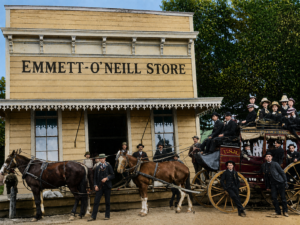
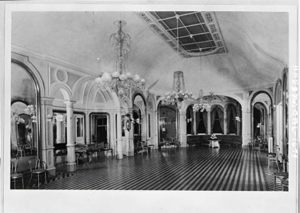
Historic photographs courtesy of the Belmont Historical Society, as published in Images of America: Belmont. Selected images have been digitally restored and colorized for this series.