
Today, it’s easy to take transportation on the Peninsula for granted. We can drive from Belmont to San Francisco or San Jose in less than an hour—traffic permitting, of course.
But long before Highway 101, El Camino Real as we know it today, or even the railroad, getting around the Peninsula meant traveling by horse and stagecoach.
And Belmont was an important stop along the way.
The Emmett-O’Neill Store: More Than a General Store
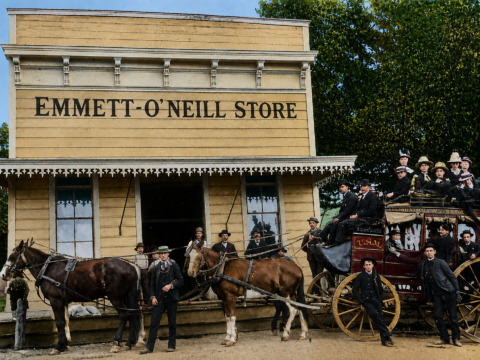
Beginning in the early 1850s, the Emmett-O’Neill Store, located near the intersection of Old County Road and Ralston Avenue, served as a regular stagecoach stop.
In those days, general stores were often much more than places to purchase supplies. They frequently served as community gathering places and local post offices as well.
Stagecoaches carried not only passengers but also the U.S. Mail. Historic coaches were sometimes marked “U.S.M.” on their sides, identifying their role in carrying mail between communities.
One surviving photograph shows a coach belonging to the Redwood City and Pescadero Stage Co., a reminder of the network of stage lines that once connected Peninsula communities before the railroad.
Belmont to Half Moon Bay — By Stagecoach
Two early Belmont businessmen, Carl Janke and Henry Carstens, recognized Belmont’s strategic location at the eastern end of one of the shortest routes across the Peninsula to Half Moon Bay.
They established their own stage line between Belmont and Half Moon Bay, appropriately named the Belmont Accommodation Company.
Imagine making that trip in the 1850s—not in an air-conditioned car, but in a horse-drawn coach traveling over primitive roads through the hills.
It was transportation, but it certainly wasn’t luxury travel.
And It Wasn’t Cheap
A one-way stagecoach fare between San Francisco and San Jose was typically about $10.
That may not sound extraordinary today—until you consider that a teacher at the time earned only about $50 to $60 per month.
Put another way, a single one-way stagecoach trip could cost roughly 17% to 20% of a teacher’s entire monthly salary. A round trip could consume a third or more of a month’s wages.
Travel was not something everyone undertook casually.
Then Came the Railroad
Everything began to change with the formation of the San Francisco & San José Railroad in 1860.
By 1863, a train was making a daily run south from San Francisco to Mayfield, near present-day Palo Alto. Stagecoaches still played an important role, however, carrying passengers onward from stops in places such as San Mateo and Redwood City.
Six months later, the railroad connected San Francisco and San Jose, approximately 50 miles apart.
The stagecoach era didn’t disappear overnight. Instead, for a time, the old and new transportation systems worked together as the Peninsula transitioned from horse-powered travel to rail.
The Railroad Changes Belmont
The arrival of the railroad did far more than make transportation easier. It began changing what Belmont could become.
By April 1864, the railroad was advertising “moonlight excursion” trains, and Belmont increasingly became a destination for visitors escaping San Francisco and San Jose.
And one of the men who had helped connect Belmont by stagecoach was ready for the new era.
Carl Augustus Janke, a German immigrant who settled in Belmont in 1860, acquired property around Sixth Street and Ralston Avenue and developed Belmont Park, a recreation destination modeled after the beer gardens of his native Germany.
Belmont Park offered a dance hall, bar, restaurant, ice cream parlor, carousel, platforms built among the trees, footbridges over creeks—and even brass bands.
By the 1870s, thousands of people were coming to Belmont for weekend recreation.
The railroad that might have seemed destined to make the stagecoach obsolete instead helped transform this little Peninsula settlement into a destination.
From Stagecoaches to Trains—and Eventually Automobiles
Southern Pacific Railroad purchased the San Francisco & San José Railroad in 1870, and excursion trains continued bringing visitors to Belmont.
By around 1900, however, Belmont Park had closed and the railroad discontinued its excursion trains.
Another transportation revolution was already beginning.
Newspapers were starting to advertise automobiles.
Within the span of roughly half a century, Belmont had witnessed transportation evolve from horse-drawn stagecoaches carrying passengers and mail, to steam-powered trains bringing thousands of visitors, and finally to the automobile.
Yet if you stand today near Old County Road and Ralston Avenue, it’s worth remembering that more than 170 years ago, travelers once stopped there at the Emmett-O’Neill Store.
They might have climbed aboard a stagecoach bound for Half Moon Bay, waited for the mail to arrive—or simply watched the horses being readied for the next leg of the journey.
Long before Belmont became the city we know today, it was already a stop along the way.
As always, we hope you enjoy our Belmont Centennial Series as we celebrate Belmont’s 100th birthday on October 29, 2026.

*Historical information adapted from Images of America: Belmont by Cynthia Karpa McCarthy.
Historic photographs courtesy of the Belmont Historical Society, as published in Images of America: Belmont. Selected images have been digitally restored and colorized for this series.