
Why the way buyers compete can matter almost as much as how many buyers are competing.
When a desirable home attracts multiple offers, sellers naturally focus on one question: How do we get the strongest possible price and terms?
One of the less obvious decisions is whether buyers should submit a fixed, “best and final” price — essentially a blind bid — or whether the seller should accept an escalation clause, sometimes called a relative bid or sharp bid.
What is an Escalation clause and Relative Bid?
An escalation clause says, in effect: “I will pay more than the highest competing offer, usually by a specified amount, up to a maximum price.” That’s called a relative bid, AKA “Sharp Bid”.
Example: A buyer offers $2,000,000 and agrees to beat any bona fide competing offer by $10,000, up to a maximum purchase price of $2,150,000.
If the next-highest competing offer is $2,075,000, the escalation clause may move that buyer’s price to $2,085,000 — not all the way to the buyer’s $2,150,000 ceiling.
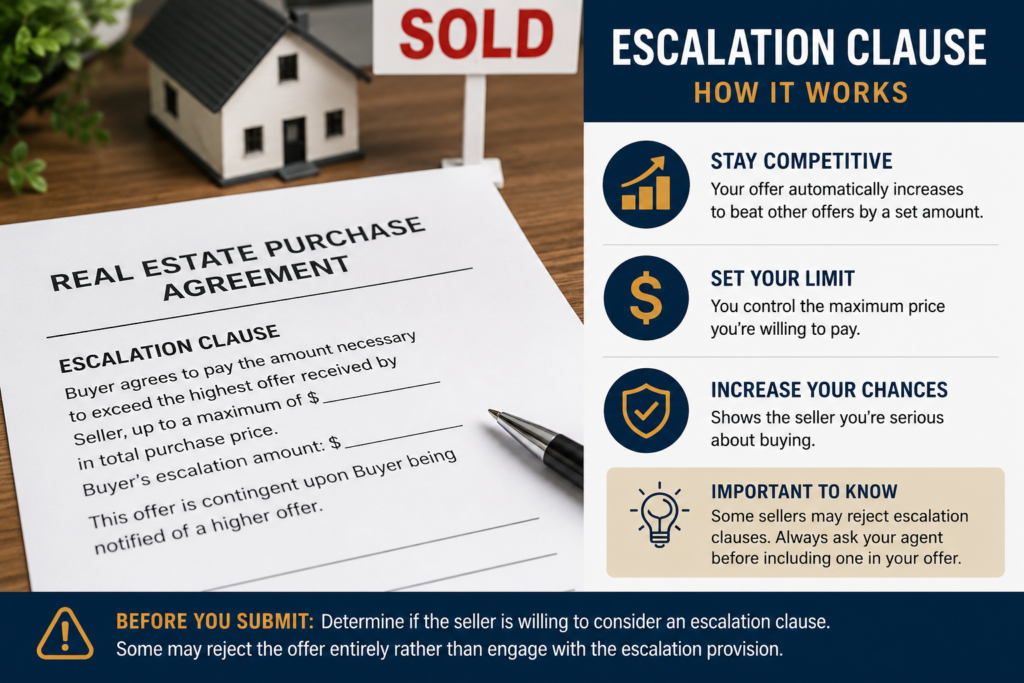
That protection is valuable to the buyer
The buyer has disclosed a willingness to pay up to $2,150,000, but the formula is designed to ensure they pay only enough to beat the competition. In other words, the buyer gets the house without necessarily having to reveal that entire amount in the final purchase price.
Now compare that with blind bidding
Suppose the seller instead tells all interested buyers to submit their highest and best offer by Tuesday at 2:00 p.m.
Three buyers submit:
Buyer C wins at $2,150,000. Compare that with the escalation example above, where the same buyer could potentially have purchased the property for only $2,085,000.
Difference to the seller: $65,000.
That is the fundamental tension. An escalation clause can encourage a buyer to remain in the bidding, but it also provides a mechanism to avoid an unnecessary overbid.
So who generally benefits?
In a strong multiple-offer market, a clean best-and-final process generally favors the seller because each buyer must independently decide what the property is worth to them — without knowing what number will be just enough to win.
An escalation clause generally favors the buyer because it creates a ceiling while allowing the buyer to pay only the amount required by the competing offer and the agreed escalation increment.
But escalation clauses can still be useful to a seller.
There is an important wrinkle: an escalation clause may reveal valuable information. If a buyer submits a $2,000,000 offer with an escalation ceiling of $2,150,000, the seller now knows that buyer has already expressed a willingness to go substantially higher.
Depending on the circumstances, the seller may decide not to simply accept the formula. Instead, the seller may counter at a price or on terms that better reflect the buyer’s demonstrated interest. Price is also only one component of an offer; financing, contingencies, deposit, closing date, and certainty of performance can materially affect which offer is actually strongest.
The takeaway
For buyers, an escalation clause can be an excellent tool for competing aggressively without automatically paying the maximum price.
For sellers, blind best-and-final bidding can create stronger price competition because buyers must show their hand.
For an experienced listing agent, the key is recognizing what each bidding structure reveals — and using that information to protect the seller’s negotiating position.
Before submitting a relative bid with an escalation clause, it is paramount to determine whether the seller is receptive to such an offer. Some sellers view sharp bids as disingenuous or contrary to the spirit of a “highest and best” process and may refuse to consider them altogether—potentially rejecting an otherwise competitive offer in its entirety.
In a competitive real estate market, how an offer is structured can matter almost as much as the price itself. Buyers need to understand the risks and advantages of revealing an escalation ceiling, while sellers need to understand how different bidding formats can affect the final sales price.
As always, thank you for your interest in our work.

Drew and Christine Morgan are experienced REALTORS® and longtime Mid-Peninsula real estate professionals based in Belmont, California, where they own and operate MORGANHOMES, Inc. They help buyers and sellers navigate important real estate decisions with experienced guidance, thoughtful strategy, and highly personalized service. Their achievements include RE/MAX’s prestigious Diamond Club Award, recognition among the Top 50 RE/MAX agents nationwide, and ranking among the Top 3 in Northern California.
To speak directly with Drew or Christine, call (650) 508-1441 or emailinfo@morganhomes.com.
For all you need to know about Belmont, subscribe to this blog right here. You can also follow us on Facebook and on X.
This article provides educational information and is intended for informational purposes only. It should not be considered real estate, tax, insurance, or legal advice; it cannot replace advice tailored to your situation. It’s always best to seek guidance from a professional familiar with your scenario.
BROKER | MANAGER | NOTARY